Table of Contents
Selling candles from China: the US rules, the EU fire safety and chemical labels, and how candles and diffusers ship
The US bans lead in candle wicks and little else. In the EU a scented candle can need two labels, and diffuser oil needs a different line.


Search how to sell candles from China and you get candle-supply shops, craft blogs on pouring your own, and listings for rolls of warning stickers. They are written for people making candles at home. None of them tells a Shopify brand buying finished candles and diffusers from a factory what to ask for, which label belongs on which product, what the product page has to show, or which shipping line a reed diffuser travels on.
The short answer: in the US, the one hard rule is a ban on lead in metal-cored wicks; the fire safety and labelling standards are voluntary, though large retailers ask for them, and diffuser oils fall under hazardous substance labelling. In the EU, every candle carries a fire safety label, and a scented candle, wax melt or diffuser can also need a chemical hazard label, a poison centre notification and the same hazard on the product page. On the shipping side, candles usually go as general goods, but diffuser oils and room sprays are liquids that need a different line or are refused.
This guide covers:
- The US rules: the lead wick ban and the voluntary candle standards
- The EU fire safety label every candle carries
- The chemical hazard label on scented candles, wax melts and diffusers, and what goes on the product page
- Which line candles, diffusers and LED candles go on
- What the glass jar does to the shipping cost, and how long candles take

The US rules: one ban and three voluntary standards
The US has no mandatory safety standard for candles. It has one ban, and the rest is voluntary standards that buyers and retailers use.
- No lead in metal-cored wicks. Since 15 October 2003, a candle made with a metal-cored wick is banned unless the metal core has no more than 0.06% lead, and the outer packaging it ships in is labelled "Conforms to 16 CFR 1500.17(a)(13)". Most candles use cotton, paper or wood wicks, but some container candles use a zinc or tin core to keep the wick upright. Ask the factory what the wick is made of, in writing.
- The voluntary standards. The CPSC lists the ASTM candle standards as voluntary: F2058 for the fire safety label, F2417 for fire safety, F2179 for the glass containers, and F2601 for candle accessories such as holders and warmers. Large US retailers often ask suppliers to meet them, and a label matching F2058 is the usual minimum.
- Diffuser oils are a hazardous substance question. A reed diffuser oil that is harmful if swallowed needs cautionary labelling under the Federal Hazardous Substances Act. In 2013 the CPSC recalled a brand's fragrance diffusers because the label did not say they contained petroleum distillates, which can enter the lungs if swallowed.
Ask the factory for the safety data sheet of the fragrance oil and of the finished diffuser. It tells you what the hazard is, and the same sheet fills in the EU label. This is a summary, not legal advice; a test lab can tell you which tests your range needs.
The EU fire safety label on every candle
In the EU, candles are covered by the General Product Safety Regulation, and three European standards are how a candle is usually shown to be safe: EN 15493 for fire safety, EN 15426 for soot, and EN 15494 for the safety label. The label applies to every candle, scented or not:
- The general warning sign, the yellow triangle with an exclamation mark.
- Three mandatory messages, as symbols or text: never leave a burning candle unattended, keep away from things that can catch fire, and keep away from children and pets.
- Extra mandatory messages for some types: "use a heat resistant candleholder" for candles that need one, and "use in a suitable bowl filled with water" for floating candles.
- Optional messages where they fit the candle, such as how far apart to keep candles, trimming the wick, or "do not touch: may be hot" for container candles.
The label has to be visible and legible on the product or its packaging. Symbols save printing a label per language, which is why most candle labels use them. Wax melts and diffusers do not burn, so the fire safety standards do not apply to them, but the chemical rules below do.
The chemical hazard label on scented candles, wax melts and diffusers
A scented candle, a wax melt and a reed diffuser are chemical mixtures under EU law. Fragrance oils often contain substances that can cause an allergic skin reaction, and enough of them makes the whole product classified as hazardous under the CLP Regulation. When it is, or when the label has to carry "Contains (substance). May produce an allergic reaction", the product needs a CLP label:

- What it shows: the supplier's name, address and phone number, the nominal quantity (grams for candles and wax melts, millilitres for diffusers), the product name, the hazard pictograms, a signal word, the hazard and precautionary statements, and any extra wording from the safety data sheet.
- Where it goes: on the packaging that holds the product, because a label cannot go on wax that burns. An open glass jar, a tealight's foil cup or an open paper box do not count as packaging, so a classified candle needs a box or wrap that carries the label. A diffuser bottle carries the label, and so does its outer box.
- A poison centre notification and a UFI. A product classified as hazardous needs a notification to the poison centre in each EU country where it is sold, and a 16-digit UFI code on the label that links it to that notification.
- No "non-toxic". On a classified product, CLP bans words such as "non-toxic", "non-harmful" or "ecological" on the label and packaging.
- The product page. A product page counts as an advert under CLP, and an advert for a classified product has to give its hazard. Trading standards guidance in the UK puts the rule of thumb simply: if it appears on the product label, it should also appear on your website.
The classification starts from the fragrance supplier's safety data sheet, so ask the factory for it before you design the box. The factory's own label is often in Chinese only; an EU label is in the language of each country you sell to. Since 13 December 2024, every EU listing also has to show the manufacturer's name and contact details, an EU responsible person when the manufacturer is outside the EU, a picture of the product and its warnings. This is a summary, not legal advice; a compliance service can classify a fragrance and draft the label.
Which line candles and diffusers go on
Parcel lines out of China run separate products by goods class, and a parcel goes on the one its contents allow. YunExpress, a frontier line, runs a general "Economy, Unrestricted" product beside its battery and cosmetics products. SDH, a lowest-cost line to the US, runs general goods, battery and sensitive goods lines.
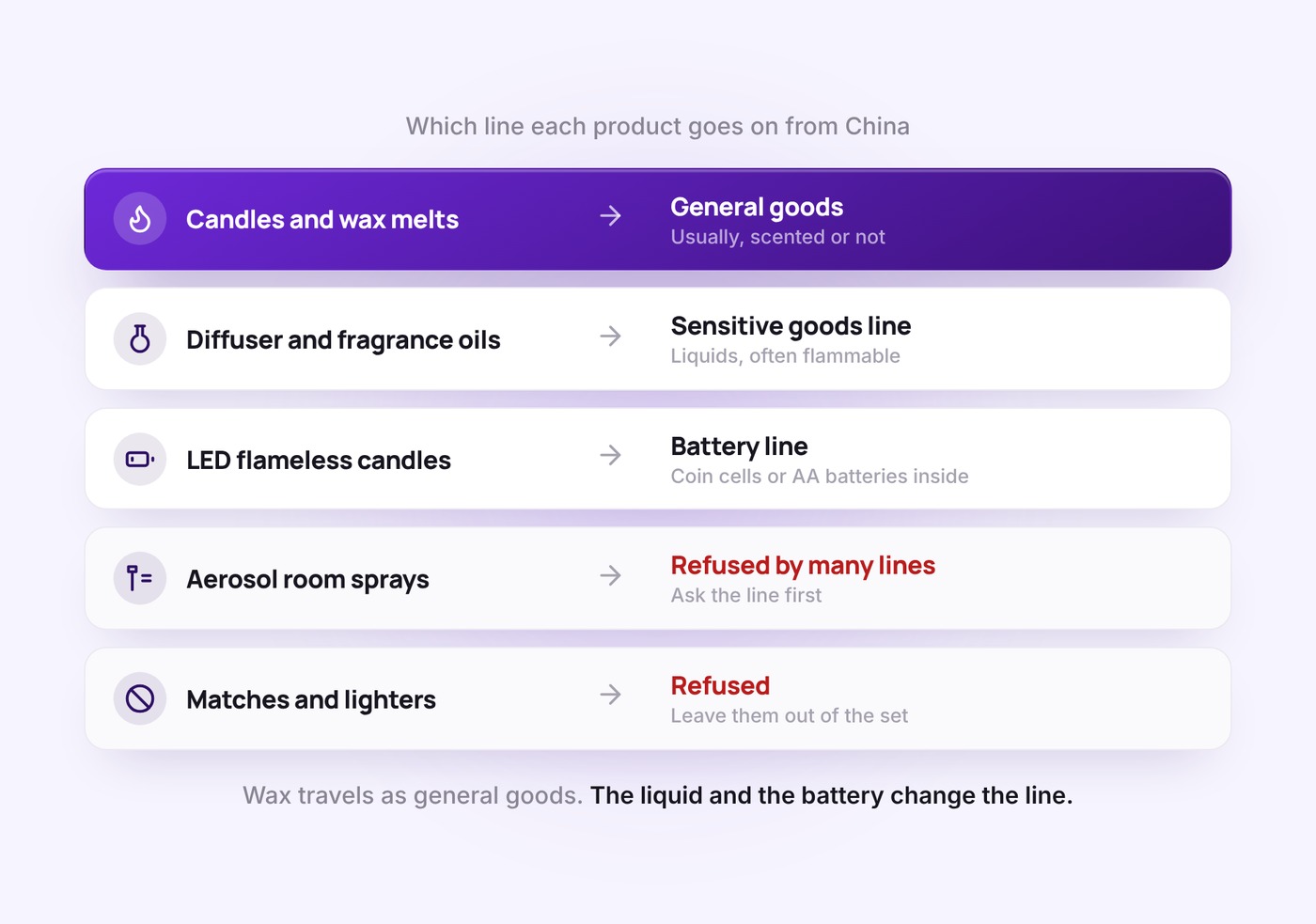
- Candles and wax melts, scented or not, usually ship as general goods. Some lines ask what the scent is in, so have the safety data sheet ready.
- Reed diffuser oils, fragrance oils and room sprays are liquids, and many are flammable or combustible. They go on a sensitive goods product, and aerosol sprays are refused by many lines. The same applies to perfume, covered in the guide to shipping cosmetics from China.
- LED flameless candles carry coin cells or AA batteries and go on a battery line, with the warning labels set out in the guide to selling products with button batteries from China.
- Electric wax warmers usually ship as general goods; the CE mark they need in the EU is covered in the guide to selling electronics from China.
- Matches and lighters are refused. Sell them separately from a local stockist, or leave them out of the gift set.
Tell the line exactly what is in the parcel and let it pick the product. A diffuser packed as general goods can be held or sent back, and the wait lands on your customer.
What the glass jar does to the shipping cost
Candles are dense, so on lines that bill the greater of the scale weight and the volumetric weight, a candle almost always bills on its scale weight. That makes the container the cost. As an example, the same 200 g of wax in a glass jar with a lid and a gift box packs at about 0.55 kg; in a tin it packs at about 0.30 kg. Its box, 9 x 9 x 11 cm, has a volumetric weight of only 0.11 kg on a divisor of 8,000, so the size of the box barely matters. The rules by line are in the guide to custom packaging for products shipped from China.
Glass is also where breakage comes from. Ask the factory whether the jars are annealed glass made for candles, which is what ASTM F2179 covers, and order a sample to check the packing before you order stock, as the guide to ordering product samples from China sets out.
How long candles take from China
Candle orders cannot be told apart in the parcel data, so the times here are for the line products they travel on. On YunExpress to the US, parcels with a first carrier scan in August 2026, the per-store median on the general goods Economy product ran 8.9 to 18.7 days, and 9 in 10 parcels arrived within 12.1 to 21.6 days depending on the store. On SDH, a lowest-cost line, the general goods product ran 14.3 to 15.2 days, and its sensitive goods product, the kind diffuser oils go on, ran 15.7 to 37.7 days on a smaller sample.
Candles and diffusers sell most in Q4, so the date that matters is the last day an order can leave and still arrive in time, worked out by destination in the guide to Q4 shipping dates from China.
What to do
- Ask the factory what the wick is made of, and for a lead test if it has a metal core
- Get the safety data sheet for each fragrance oil and each finished diffuser
- Put the fire safety label on every candle for the EU, and a warning label matching ASTM F2058 for US retail
- Have each scented product classified, and print the CLP label on the box, not the jar, when it is needed
- Notify the poison centre and print the UFI for anything classified as hazardous, in each EU country you sell to
- Copy the hazard information onto the product page, with the responsible person's details
- Drop "non-toxic" and similar claims from anything classified
- Sort your range by goods class: candles and wax melts, liquids, LED candles, and anything that cannot ship
- Weigh one packed candle in its jar and box before you set shipping rates
How we handle this at Commercive
Commercive is your all in one sourcing and fulfilment partner. We source from a product link or a photo across our vetted factories, or work with the supplier you already use, and we test products without holding you to the factory's minimum, which suits a store trying a few scents and jar sizes before it commits.
Your stock is received on our floor in China, and every order ships on the line that fits the product and the destination: a general goods line for candles and wax melts, a sensitive goods line for diffuser oils, a battery line for LED candles, and a check with the line before anything else goes out. Each parcel's scans and weights sit in our dashboard. We recommend frontier lines such as YunExpress to essentially everyone; a lower-cost line might suit low-price tealights with patient customers. Our measured delivery times by line and country are on our shipping status page.
If you're currently running a brand, just give us the product and your daily order volume. We'll get you a quote within the next 24 hours to hold up against what you're paying today.
Where these numbers come from. The US rules are from 16 CFR 1500.17(a)(13), the CPSC's list of voluntary candle standards and its June 2013 diffuser recall, read 2 November 2026. The EU rules are from the Irish Health and Safety Authority's 2023 guidance for candle and reed diffuser producers under REACH and CLP, and the January 2024 advice pack from UK Trading Standards and the British Candlemakers Federation on EN 15494 and CLP labels, read 2 November 2026. This is a summary, not legal advice. The packed weights are worked examples, not measurements. Line product names are the carriers' own. Delivery times are our own measurement: parcels to the US from stores we fulfil from China, first carrier scan 1 to 31 August 2026, test stores excluded, calendar days from the first scan to the first delivered scan, measured 2 November 2026, shown as the range of per-store medians and 90th percentiles for stores with at least 30 delivered parcels on that line product.
Do candles need a warning label?
In the EU, yes: every candle carries the EN 15494 fire safety label, with the general warning sign and three messages: never leave a burning candle unattended, keep away from things that can catch fire, and keep away from children and pets. In the US the label is voluntary under ASTM F2058, but large retailers usually ask for it.
Are lead wicks banned in the US?
Yes. Since October 2003, candles with metal-cored wicks are banned unless the metal core has no more than 0.06% lead and the outer shipping packaging is labelled as conforming to 16 CFR 1500.17(a)(13). Most candles use cotton, paper or wood wicks.
Do scented candles need a CLP label in the EU?
When the fragrance makes the candle hazardous under CLP, or the label has to name an allergen, yes. The CLP label goes on the packaging, not the wax, and an open glass jar does not count as packaging. Unscented candles need only the fire safety label.
Do reed diffusers need a UFI code?
A reed diffuser classified as hazardous under CLP needs a poison centre notification in each EU country where it is sold and a 16-digit UFI code on its label. Whether it is classified depends on the fragrance oil, so the safety data sheet is the place to start.
Can you ship reed diffusers from China?
Usually, but not as general goods. Diffuser oils are liquids and many are flammable or combustible, so they go on a sensitive goods product, and some lines refuse them. Aerosol room sprays are refused by many lines.
How long do candles take to ship from China to the US?
About as long as other general goods on the same line. On YunExpress in August 2026, the per-store median on the general goods product ran 8.9 to 18.7 days from the first carrier scan to delivery, and a lowest-cost line took 14.3 to 15.2 days.

Fulfillment from our own warehouses in China and the US.
Tell us what you sell and how much you ship. We reply with a quote within one business day.