Table of Contents
Shipping cosmetics and skincare from China: the lines that carry them, the US and EU rules for your brand, and how long they take
Creams and powders ship on a cosmetics line. Perfume, nail polish and sprays are the hard cases, and the label rules land on your brand.


Search how to ship cosmetics from China and you get sourcing agencies selling their service, a forum thread asking why liquid orders take so long, and compliance firms writing about rules without saying how a parcel actually travels. None of it puts the two halves together for a brand selling skincare or makeup online.
The short answer: creams, serums, lipsticks and powders ship on the cosmetics or sensitive goods products that parcel lines out of China run, and on a frontier line they arrive about as fast as general goods. Perfume, nail polish and aerosol sprays are the hard cases, because they count as flammable on a flight. The rules that matter most sit with whoever's name is on the label: in the US that is usually your brand, and in the EU you need a responsible person based there.
This guide covers:
- How parcel lines out of China sort cosmetics, and what they refuse
- What the US asks of the brand on the label under MoCRA
- What the EU asks before a cosmetic is sold there
- Whether a cosmetics line is slower, measured on real parcels
- How to pack liquids so they arrive in one piece

How lines sort cosmetics
Parcel lines out of China do not run one product for everything. They run separate products by goods class, and a parcel goes on the one its contents allow. The names on the carriers' own waybills show it:
- YunExpress runs a "Cosmetics Economy, Restricted" product beside its general "Economy, Unrestricted" and its "Economy with Battery" products.
- SDH, a lowest-cost line to the US, runs a sensitive goods line (敏感) beside its general one.
- LX grades its products slightly, very and extra sensitive.
Liquids, creams, gels and powders go on the cosmetics or sensitive product. Tools that hold no product, such as brushes, sponges, mirrors and empty bottles, are general goods. Anything with a battery, such as a cleansing brush or an LED mask, follows the battery rules, covered in the guide to shipping products with batteries from China.
What gets refused
Three kinds of beauty product are the hard cases, because the long leg from China is a flight and they count as flammable on it:
- Perfume and other alcohol-based sprays
- Nail polish and nail polish remover
- Aerosols, such as dry shampoo, setting spray or spray sunscreen
Many parcel lines refuse them outright, and the ones that take them do so on specific products. If a perfume or a nail range is the hero product, check that a line will carry it to each country you sell in before you spend on ads. A parcel packed as general goods with one of these inside can be held or sent back, and the wait lands on your customer.
What the US asks of your brand
The US changed its cosmetics law with the Modernization of Cosmetics Regulation Act of 2022, known as MoCRA. Most of its duties fall on the "responsible person", which the law defines as the manufacturer, packer or distributor whose name appears on the label. If your brand's name is on the label, that is most likely you.
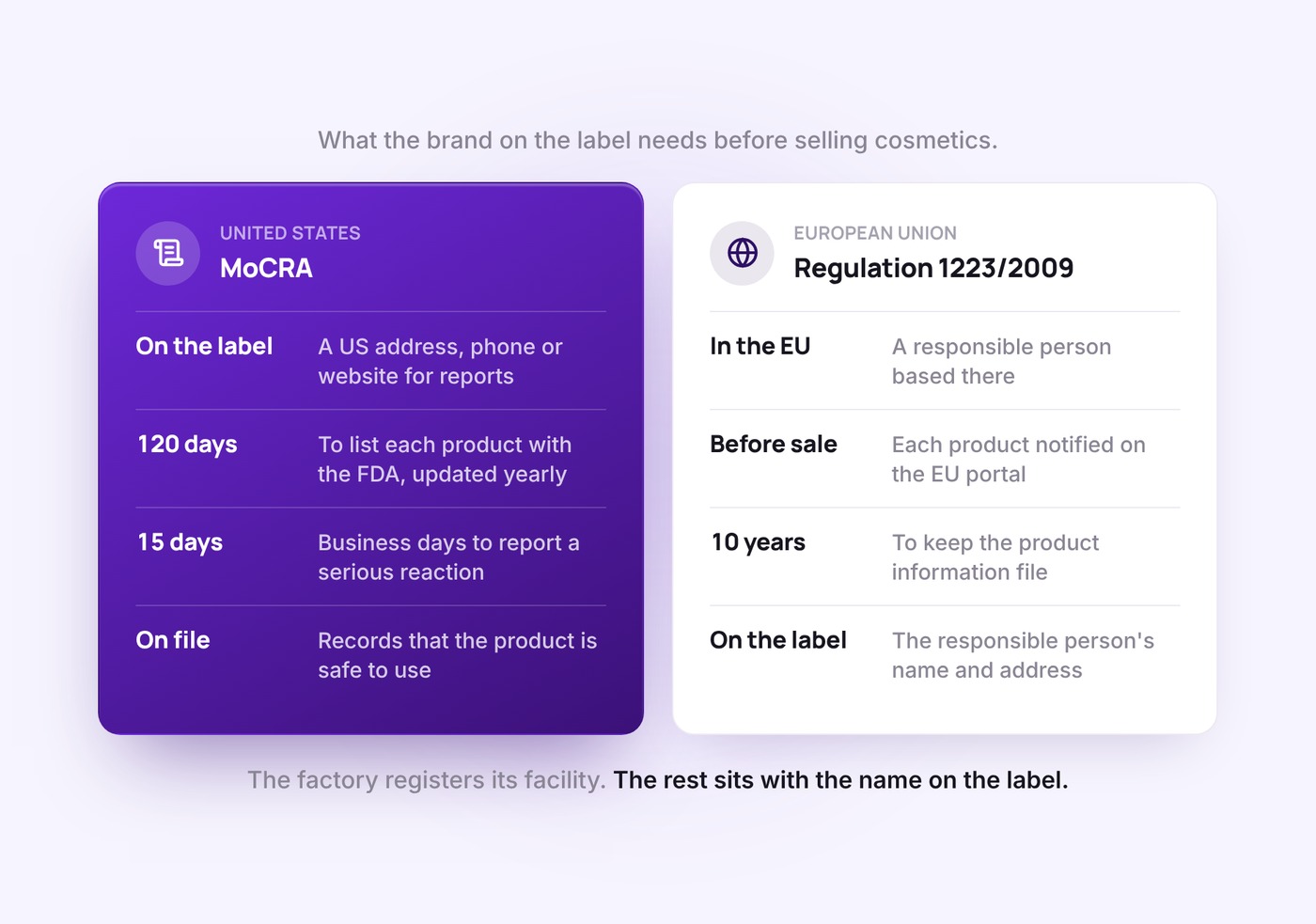
What the law asks, in plain words:
- A US contact on the label. Since 29 December 2024, every cosmetic sold in the US must carry a domestic address, a domestic phone number or electronic contact, which can be a website, so customers can report a reaction.
- Product listing. Each product is listed with the FDA within 120 days of going on sale and updated every year. The listing names the factory's registration number, the product, its category and its ingredients.
- Facility registration. The factory that makes the product registers with the FDA and renews every two years. A factory outside the US names a US agent. A contract factory needs one registration, which the factory or a brand it makes for can submit, so ask your supplier for its number before you list.
- Adverse events. A serious reaction reported to you goes to the FDA within 15 business days, with a copy of the label, and the records are kept for six years.
- Safety records. The responsible person has to be able to show the product is safe to use.
There is a small business exemption, and it is narrower than it sounds. A brand with average US cosmetics sales under $1 million a year, adjusted for inflation, over the previous three years is not subject to the registration, listing and manufacturing practice sections. It does not apply to products that touch the eye's mucous membrane, such as eyeliner or mascara, products for internal use, injected products, or products meant to change how you look for more than 24 hours. The label contact, adverse event reports and safety records apply to everyone.
MoCRA also requires fragrance allergens to be named on the label, once the FDA's rule sets the list.
What the EU asks before you sell there
The EU's cosmetics rules, Regulation 1223/2009, work through one person: a cosmetic can only be sold in the EU if a responsible person established in the EU is named for it.
- A responsible person in the EU. A manufacturer outside the EU appoints one by written mandate, and an importer is the responsible person for what it imports. Brands without an EU company usually pay a service to take the role.
- Notification before sale. The responsible person notifies each product through the EU's cosmetics portal before it is sold, with its category, where it is sold, its frame formula and any nanomaterials.
- A product information file, with a safety assessment, kept for 10 years.
- The responsible person's name and address on the label.
The UK has run its own version since it left the EU, with a UK responsible person and its own notification. Check with a compliance service or a lawyer for your exact product before you sell in either.
Is a cosmetics line slower? Measured
A common worry is that a restricted product means a slow line. On a frontier line, measured on parcels shipped from China in mid-2026, it did not.

On YunExpress, parcels with a first carrier scan in June and July 2026, the median delivery time per store on the Cosmetics Economy product ran 10.8 to 13.4 days to the US, 9.5 to 13.2 to Canada and 9.8 to 12.5 to Australia. On the general goods Economy product to the US, it ran 9.2 to 15.7.
So the cosmetics product sat inside the general product's range on the same line. If skincare orders are arriving slowly, the line they ship on is the first thing to check, not the fact that they are cosmetics. Per-store medians are used because a few large stores make up most of the parcels on some products, and a single parcel-weighted figure would describe those stores, not the line.
How to pack liquids from China
A leak ruins the parcel and often the ones beside it. A flight changes air pressure, and a bottle sealed at sea level can push out its cap at altitude.
- Seal every cap, with tape or a shrink band, before it is packed
- Bag each liquid unit on its own, so one leak stays in its bag
- Pad glass, and keep jars upright in a box rather than loose in a poly mailer
- Ask the supplier for the full ingredient list in English, which the label, the US listing and the EU notification all need
- Send one test order to yourself on the line you plan to use, and open it the way a customer would
What to do
- Sort your range by goods class: cosmetics, general, battery, or flammable
- Check a line takes perfume, nail polish or sprays before you build a launch around them
- Put a US contact on the label and list each product with the FDA within 120 days of sale
- Get the factory's FDA registration number before you list
- Appoint an EU responsible person and notify each product before you sell in the EU
- Tell the line what is in the parcel, every time
- Measure delivery on real orders, per line and per country
How we handle this at Commercive
Commercive is your all in one sourcing and fulfilment partner. We source from a product link or a photo across our vetted factories, or work with the supplier you already use, and we ask what a product contains before it is listed, not after the first order is stuck.
Your stock is received on our floor in China, and every order ships on the line that fits the product and the destination: a cosmetics or sensitive line when there is a liquid or a cream, a battery line when there is a battery, and a general goods line when there is neither. Each parcel's scans sit in our dashboard. We recommend frontier lines such as YunExpress to essentially everyone; a lower-cost line might suit a low-price product with patient customers. Our measured delivery times by line and country are on our shipping status page.
If you're currently running a brand, just give us the product and your daily order volume. We'll get you a quote within the next 24 hours to hold up against what you're paying today.
Where these numbers come from. The US rules are from the text of MoCRA as codified at 21 U.S.C. 364 to 364j (definitions, adverse events, registration and listing, labelling, small businesses), read 23 October 2026. The EU rules are from Regulation (EC) No 1223/2009, Articles 4, 13 and 19, read 23 October 2026. This is a summary, not legal advice. Line product names are the carriers' own. Delivery times are our own measurement: YunExpress parcels from stores we fulfil from China, first carrier scan 1 June to 31 July 2026, test stores excluded, calendar days from the first scan to the first delivered scan, measured 23 October 2026, shown as the range of per-store medians for stores with at least 30 parcels on that product and destination.
Can you ship cosmetics from China?
Yes. Creams, serums, lotions, lipsticks and powders ship on the cosmetics or sensitive goods products that parcel lines out of China run. Perfume, nail polish and aerosol sprays are harder, because they count as flammable for air, and many lines refuse them.
Can you ship perfume from China?
Often not on a standard parcel line. Alcohol-based perfume counts as a flammable liquid on a flight, so many lines refuse it and the ones that take it do so on specific products. Check with your line for each destination before you list a fragrance.
Do I need to register my cosmetics with the FDA?
The factory registers its facility, and the responsible person, usually the brand whose name is on the label, lists each product within 120 days of sale and updates it every year. Brands with under $1 million a year in average US cosmetics sales are exempt from listing, except for products such as eye makeup or long-wear products that change appearance for more than 24 hours.
What does MoCRA require on the label?
A US address, a US phone number or electronic contact such as a website, so customers can report a reaction. It has applied since 29 December 2024. Fragrance allergens will also have to be named once the FDA's rule sets the list.
Do I need an EU responsible person to sell cosmetics in the EU?
Yes. A cosmetic can only be sold in the EU if a responsible person established in the EU is named for it, on the label, and that person notifies the product before it is sold. Brands without an EU company usually appoint a service under a written mandate.
Do cosmetics take longer to ship from China?
Not by themselves, in our data. On YunExpress in June and July 2026, per-store medians on the Cosmetics Economy product to the US ran 10.8 to 13.4 days, inside the 9.2 to 15.7 range of the general goods product on the same line. The line matters more than the goods class.

Fill in the application form, and our team will reach out to you to help you with making the above happen.
• Sell 1 day post-production
• Scale worldwide with 3-10 days
• Slice your lead times
• Prevent inventory risk and overstocking
• Hide china due custom software and carrier agreements
• Work with a multilingual team in mainland China
• Decades of supply-chain experience.