Table of Contents
Product samples from China: how to order them, what they cost, how long they take and what they prove
A stock sample runs $0 to $30 plus $15 to $60 by courier. A custom one, $50 to $200. Ask before paying and the fee can come off the order.


Search how to order a product sample from China and you get guides that agree on the steps and disagree on every number. Sample fees from free to £600, shipping from $15 to $90, and timelines from a week to six. Most of them are written by sourcing agencies quoting their own range.
The short answer: a sample of a product the supplier already makes costs about $0 to $30, plus $15 to $60 to send it to the US by express courier, and reaches you in about 8 to 17 days. A custom sample costs $50 to $200 and takes longer, and a new mould can run into the thousands. Ask for the fee to come off your first order before you pay, and sample three suppliers, not one.
This guide covers:
- The four kinds of sample, and what each one proves
- What a sample costs, and what a full round across three suppliers adds up to
- How long it takes to get a sample in your hands
- How to order one on Alibaba.com or from a supplier directly
- What a sample does not prove, and the sample to keep for the batch

The four kinds of sample
A sample is not one thing. What you ask for decides what it costs and what it tells you.
- Stock sample. A unit of something the supplier already makes, as it is. It shows the material, the finish and the size. It costs least because nothing is made for you.
- Custom sample. Made to your specification: your logo, colour, size or packaging, on materials the factory already uses. This is the one that shows whether the supplier can make your version.
- Pre-production sample. The unit you approve before the batch is made, also called the approval or golden sample. It becomes the reference for everything that follows.
- Production sample. A unit pulled from the finished batch. It shows what the regular line actually made, not what the best technician made for you.
For a product you are testing as it is, a stock sample could be enough. For anything with your branding or your changes, the custom sample is the one that matters, and the pre-production sample is the one you keep.
What a sample costs
One US sourcing guide from August 2026 breaks the sample fee down by how much the factory has to make:
- Stock, no changes: $0 to $30, ready in 3 to 7 days
- Stock with a logo or colour change: $20 to $80, 5 to 10 days
- Custom on existing materials: $50 to $200, 7 to 15 days
- New mould or tooling: $300 to $2,000 or more, 15 to 30 days
Shipping comes on top: the same guide puts express courier to the US at $15 to $60 for a small parcel. Another guide notes that sending one unit by air can cost more than the product itself, so a "free sample" still has a bill.
The sample unit itself usually costs more than the price per unit on a bulk order. Alibaba.com's own buyer guide says you can ask for the sample cost to be taken off the price of a full order, and some suppliers charge nothing for the sample against the promise of one. The guides agree on the catch: the refund is not automatic. Ask for it, and get it in writing, before you pay.
What a full round costs: three suppliers, not one
Sampling one supplier tells you whether that supplier is good. Sampling three tells you which one is best, side by side, on the same brief. One UK guide says to request samples from 3 to 5 factories before committing.

Using the same guide's ranges, as an example:
- Stock product with your logo, three suppliers: $35 to $140 each with courier, so $105 to $420 for the round
- Custom product on existing materials, three suppliers: $65 to $260 each, so $195 to $780
- A second round with the supplier you picked, to check the fixes: another $65 to $260
The guide that recommends a second round on custom products calls skipping it to save $50 to $150 one of the most common mistakes first-time buyers make. Against a first order of a few thousand dollars, the round is a small share of the money at risk.
How long until it is in your hands
The sample's clock is making time plus courier time. One guide's ranges, to the UK:

- In-stock product: 3 to 7 days to dispatch, 5 to 10 days by courier, so 8 to 17 days
- Custom changes to a standard product: 7 to 14 plus 5 to 10, so 12 to 24 days
- Fully custom or tooled: 14 to 30 plus 5 to 10, so 19 to 40 days
Add a second round and a custom product can take five to ten weeks from the first message to an approved sample. If the product is meant for a seasonal peak, that time comes off the selling window.
How to order a sample
- Ask for it yourself. Alibaba.com's buyer guide says most suppliers will not suggest a sample. Some product pages have a sample option and price; otherwise, message the supplier.
- Send one brief to every supplier. The product, the quantity (one to three units), your changes, any logo files, your address and the date you need it. The same brief makes the samples comparable.
- Ask four questions before you pay: the sample price, the courier cost, the making time, and whether the fee comes off the first order.
- Pay through the platform on Alibaba.com rather than by a separate transfer, so the payment stays inside its protection. Check the supplier first: the guide to verifying a Chinese supplier before you pay covers the free checks.
- Choose who books the courier. A supplier booking it could add a margin; giving them your own courier account number is cheaper but means they could use it again. Either is a fair call on a one-off sample.
What a sample does not prove
A good sample is one unit, made once, often with extra care. Two things it cannot tell you:
- That the batch will match. Sourcing guides warn that a sample can be made by the factory's best technician while the batch runs on the regular line. The pre-production sample and a check of the batch close that gap; the guide to quality control for small batches from China covers what an inspection catches.
- How long your customers will wait. The sample came by express courier, in days. Your orders will most likely travel on a parcel line.
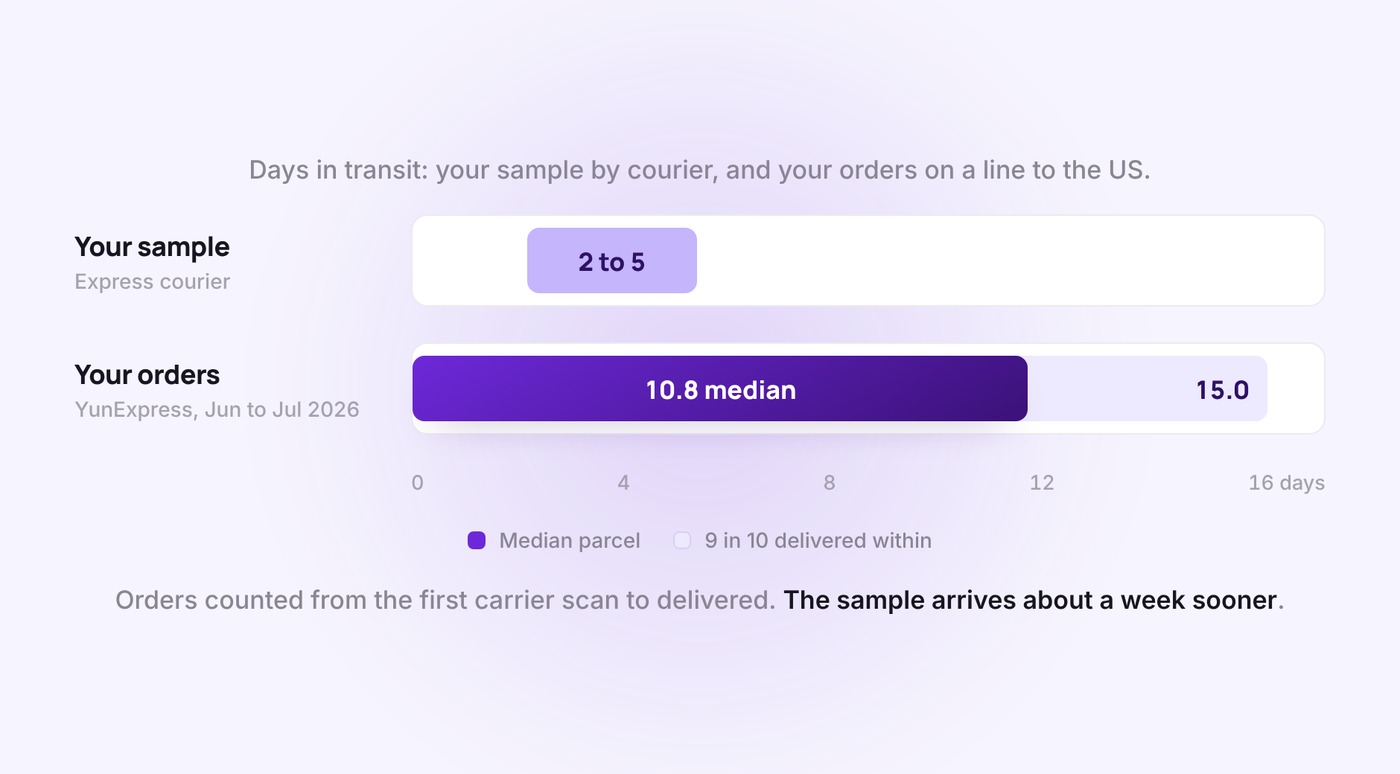
On YunExpress, a frontier line, the median parcel to the US took 10.8 days from the first carrier scan to the delivered scan in June and July 2026, and 9 in 10 arrived within 15.0. To the UK, 10.2 days at the median. Courier transit for a sample is usually 2 to 5 days. A sample that crossed in under a week stands in for orders that take about 11 days at the median and up to 15 for 9 in 10, so the packaging has to survive a longer trip than the sample made.
Keep the approved sample
The sample you approve is the reference for every batch after it. A Hong Kong trade body's sourcing guide says the final sample should be signed, dated and sealed, with one copy kept by the factory, one by the inspector and one by you.
- Photograph it from every side, next to a ruler, before you seal it
- Write down every change you asked for between rounds, and keep the supplier's written confirmation
- Ask the factory to keep a sealed copy, so "matches the sample" means the same unit to both of you
Without a kept sample, a complaint about the batch is your memory against theirs.
What to do
- Sample three suppliers on the same brief, not one
- Ask for the fee to come off the first order before you pay, in writing
- Budget a second round for anything custom
- Count the making time, not just the courier, when you plan a launch
- Keep one sealed, signed sample and photos of it
- Measure delivery on real orders, because the courier sample says nothing about the line
How we handle this at Commercive
Commercive is your all in one sourcing and fulfilment partner. We source from a product link or a photo across our vetted factories, or work with the supplier you already use, and we default to the no-minimum or lowest-minimum option, so a product can be tested from its first order. The guide to testing a product from China without an MOQ explains how that works.
Your stock is received on our floor in China and every order ships on the line that fits the product and the destination, with each parcel's scans in our dashboard, so you see the delivery your customers actually get. Our measured delivery times by line and country are on our shipping status page.
If you're currently running a brand, just give us the product and your daily order volume. We'll get you a quote within the next 24 hours to hold up against what you're paying today.
Where these numbers come from. Sample fees, making times and courier costs are published ranges from sourcing guides read on 21 October 2026, mainly one US guide (August 2026) and one UK guide (August 2026), plus Alibaba.com's buyer guide on requesting samples; the round costs are arithmetic on those ranges, as an example. Delivery times are our own measurement: every YunExpress parcel from stores we fulfil from China with a first carrier scan from 1 June to 31 July 2026, test stores excluded, calendar days from the first scan to the first delivered scan, measured on 21 October 2026.
How much does a product sample from China cost?
One 2026 sourcing guide puts a stock sample at $0 to $30, a stock product with a logo or colour change at $20 to $80, and a custom sample on existing materials at $50 to $200, plus $15 to $60 for express courier to the US. A sample needing a new mould can cost $300 to $2,000 or more.
Do Chinese suppliers refund the sample fee?
Often, but only if you ask. Many suppliers will take the sample fee off your first production order. Agree it before you pay and get it in writing, because it is rarely automatic, and samples needing new tooling are less likely to be credited.
How long does it take to get a sample from China?
About 8 to 17 days for a product the supplier already makes, counting dispatch and express courier. Custom changes take about 12 to 24 days, and a fully custom or tooled product 19 to 40 days, before any second round.
How many suppliers should I order samples from?
Three is a common starting point, and one UK guide says three to five. Send the same brief to each so the samples can be compared side by side, then run a second round with the supplier you pick if the product is custom.
What is a golden sample?
The sample you approve before the batch is made, also called an approval or pre-production sample. It is signed, dated and sealed, with copies kept by you and the factory, and the batch is checked against it.
Does a good sample mean the order will be good?
No. A sample is one unit and can be made with more care than the batch. Keep the approved sample as the reference, check the first batch against it, and measure delivery on real orders, since the sample came by courier.

Fill in the application form, and our team will reach out to you to help you with making the above happen.
• Sell 1 day post-production
• Scale worldwide with 3-10 days
• Slice your lead times
• Prevent inventory risk and overstocking
• Hide china due custom software and carrier agreements
• Work with a multilingual team in mainland China
• Decades of supply-chain experience.