
Table of Contents
Quality control for products made in China: what a pre-shipment inspection checks, what it misses on a small batch, and the checks to add
By the inspection standard's own maths, a 500-unit batch where 1 in 20 units is defective still passes about 3 times in 4.

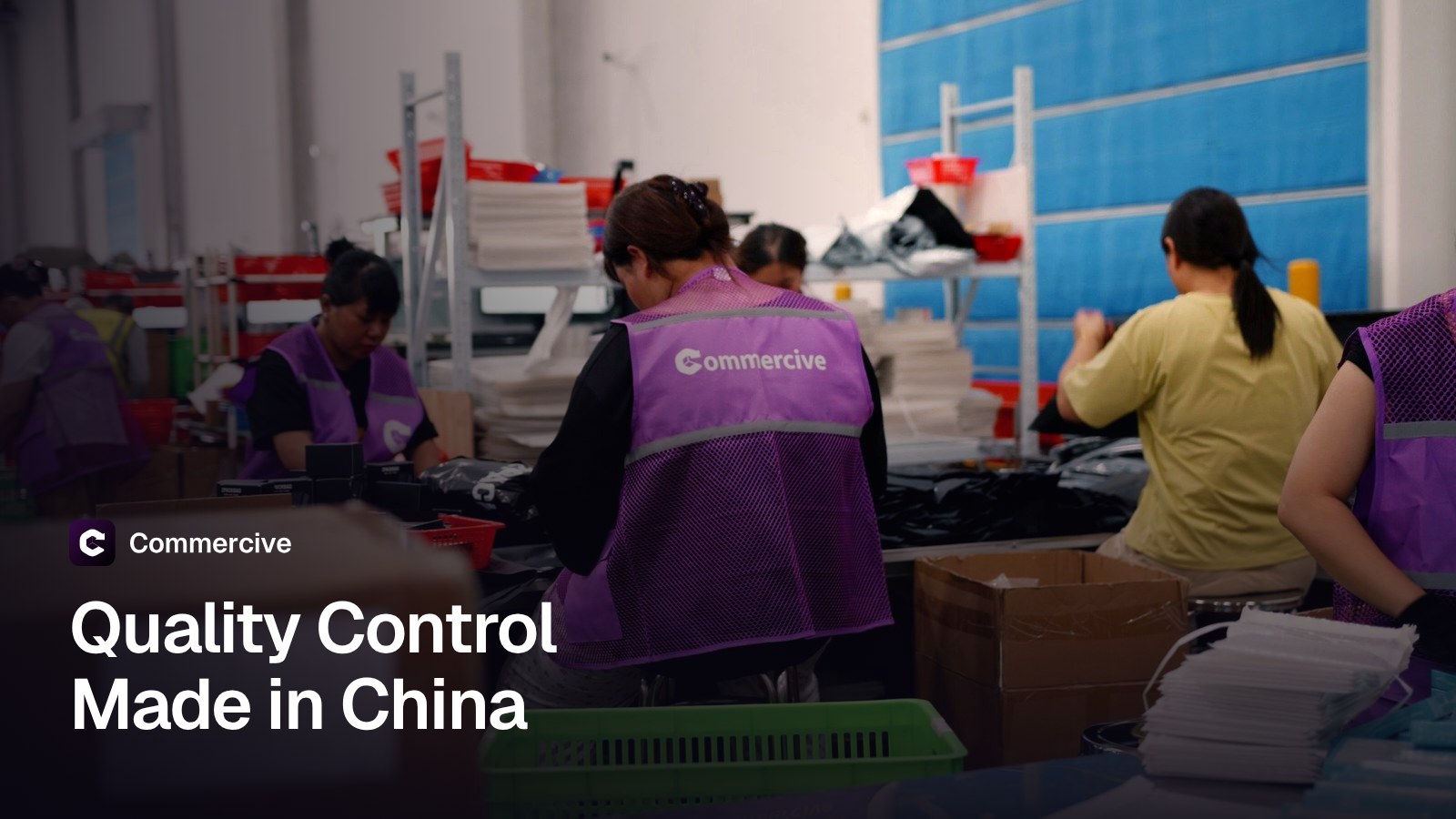
A pre-shipment inspection checks a sample, not the batch. On the batch sizes a growing brand reorders, a few hundred to a few thousand units, that sample is small, and the pass mark is wider than most people think.
By the inspection standard's own maths, a 500-unit batch where 1 in 20 units has a major defect still passes about 3 times in 4. The inspection is worth doing, but it is one check of five. The others happen before production starts and after the first orders reach customers.
This guide covers:
- What a pre-shipment inspection checks, and what "AQL 2.5" actually means
- How many units get looked at by batch size, and what that costs per unit
- Why a pass on a small batch is weaker than it looks
- Five checks that catch defects before your customers do
- What to do when you ship per order and there is no batch to inspect
What a pre-shipment inspection checks
An inspector from a third-party firm visits the factory once most of the batch is finished and packed. They pull cartons at random, open a set number of units, and check them against your spec: how the product looks, whether it works, size and weight, labels, packaging and the carton marks.
Every flaw they find is sorted into one of three classes:
- Critical. Unsafe, or breaks a legal requirement. The usual limit is zero.
- Major. A customer would likely send it back. A common limit is AQL 2.5.
- Minor. A flaw a customer would likely keep. A common limit is AQL 4.0.
How many units they open comes from a table in ISO 2859-1 (the same table as ANSI/ASQ Z1.4), read by batch size. Most inspections use its default column, General Inspection Level II, unless you ask for another.
How many units get looked at, and what it costs
At General Inspection Level II, the table gives:
- 500 units: 50 checked. Passes with up to 3 major and 5 minor defects.
- 1,000 units: 80 checked. Up to 5 major, 7 minor.
- 3,000 units: 125 checked. Up to 7 major, 10 minor.
- 10,000 units: 200 checked. Up to 10 major, 14 minor.
The sample grows much more slowly than the batch. On 500 units the inspector opens 10% of them; on 10,000 units, 2%.
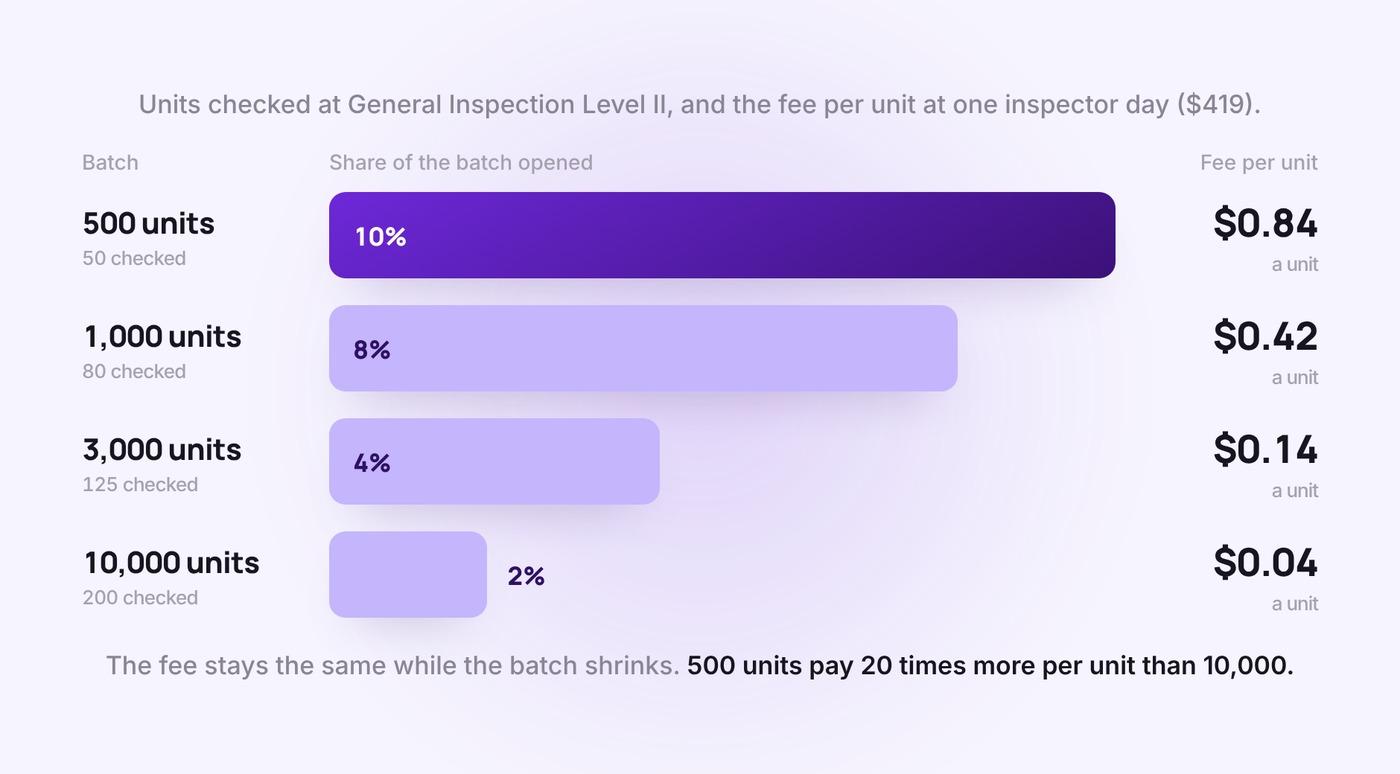
The fee does not shrink with the batch. QIMA lists product inspections from $419 per inspector day, travel included, as of 8 October 2026. If the job fits in one day, that is about 84 cents a unit on a 500-unit batch, 42 cents on 1,000, 14 cents on 3,000 and 4 cents on 10,000.
On a product that sells for $30, 84 cents is a real cost. It is still cheaper than the refunds from a bad batch, but it is the reason small brands skip the inspection, and the reason the other four checks below matter more for them.
What "AQL 2.5" does not mean
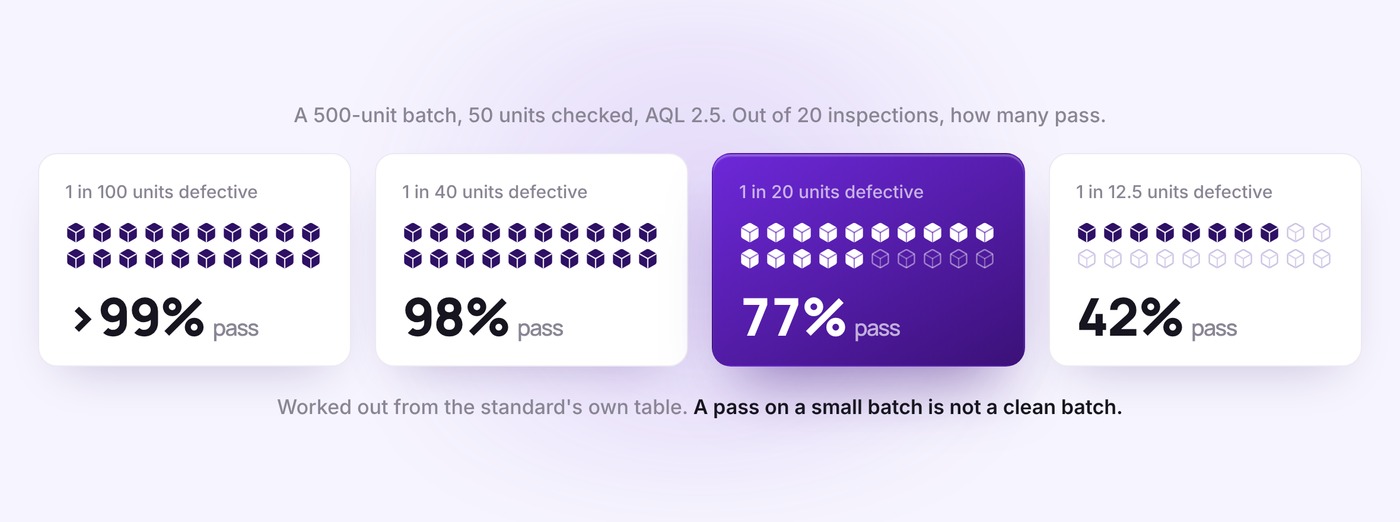
AQL 2.5 does not mean "at most 2.5% of the batch is defective". It names the sampling plan. On a 500-unit batch, the plan passes the batch with 3 major defects in the 50 units opened, which is 6% of the sample.
Worked through with the standard's own numbers, on a 500-unit batch:
- 1 in 40 units defective: passes 98% of the time
- 1 in 20 units defective: passes 77% of the time
- 1 in 12.5 units defective: passes 42% of the time
- 1 in 10 units defective: still passes about 1 time in 4
On a 10,000-unit batch the same 1-in-20 batch passes 58% of the time, and the 1-in-12.5 batch only 7%. A bigger batch gets a bigger sample, and a bigger sample is harder to slip past.
So a pass on a small batch tells you the batch is probably not terrible. It does not tell you the batch is good. A batch with 1 in 20 units defective means about 25 unhappy customers out of 500.
Where the inspection still earns its fee
The inspection is weaker on small batches, not useless. It catches the problems that hit every unit: the wrong colour, the wrong size chart, a missing part, a misprinted label, cartons packed wet. Those are the ones that turn a whole batch into refunds, and a sample of 50 finds them every time.
It also gives you a report with photos of each defect, dated, from someone who is not the factory. If the batch fails, that report is what gets the rework done at the factory's cost instead of yours.
Five checks before your customers find the defects
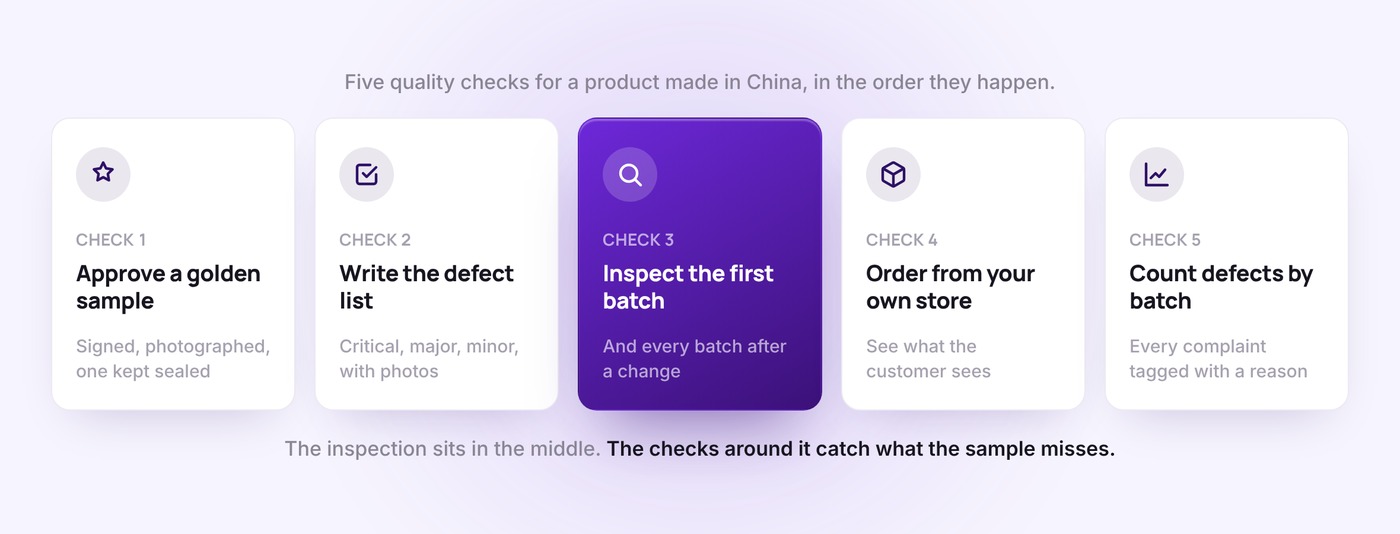
- Approve a golden sample and keep one. Sign off a finished unit, photograph it from every side, and keep it sealed. The factory makes to it and the inspector checks against it. Without one, "matches the sample" means whatever the factory remembers.
- Write the defect list before production. For this product, write down what counts as critical, major and minor, with a photo of each. A loose thread on a $15 t-shirt might be minor; a loose stitch on a bag strap is major. Without the list, the inspector uses a generic one.
- Inspect the first batch, and every batch after a change. A new factory, a new material, a new colour or a new size range is a new product as far as defects go. Once a factory has passed several batches in a row with no changes, inspecting every other batch could be a fair call.
- Order from your own store. Buy the product on your own site, shipped to your own address, as soon as the batch is live. You see what the customer sees: the packaging, the insert, the condition it arrives in after two weeks in transit.
- Count defects by batch. Tag every complaint and return with a reason and the batch it came from. If one batch runs above the limit you set, raise it with the factory with the reports and the photos.
When there is no batch to inspect
If your supplier or agent ships each order on its own, from their stock, there is no batch of yours to sample. A $419 inspection on a product you are testing with a few dozen orders could cost more than the test makes.
The checks that still work per order:
- Get a sample in your hands before the first order. One unit, from the same stock the orders will ship from.
- Ask for a photo of the item before it is packed on the first orders. It takes the packer seconds and shows you what is going out.
- Order from your own store in the first week, as in check 4 above.
- Count complaints per product from the first order. On a test, a few defect complaints in the first 20 or 30 orders is enough to stop or change supplier.
Once the product sells and you start holding stock, the batch checks above apply. The guide to testing a product from China without buying the MOQ covers that step from test to stock.
How to read an inspection report
Before you release the balance payment, check four things on the report:
- The sample size matches the table for the batch size. A 3,000-unit batch should show 125 units checked at Level II.
- The result per class: critical, major and minor, each with the number found and the limit.
- A photo of every defect, not only a list.
- "Pending" is not a pass. It usually means something needs your decision, such as a defect the spec did not cover.
What to do
- Approve a golden sample and keep one sealed unit for every product.
- Write a defect list with photos before the factory starts.
- Inspect the first batch and every batch after any change, and set the limits in writing.
- Read the report before you pay the balance: sample size, results per class, photos.
- Order from your own store every time a new batch goes live.
- Tag complaints and returns by batch, so you know which inspection missed what.
How we handle this at Commercive
Commercive is your all in one sourcing and fulfilment partner. We source products for brands and ship them from our warehouses in China, and you can test a product on real orders before you commit to a full batch.
Every order's tracking shows in our dashboard, and our measured delivery times by line and country are on our shipping status page.
If you're currently running a brand, just give us the product and your daily order volume. We'll get you a quote within the next 24 hours to hold up against what you're paying today.
How we worked this out. Sample sizes and pass limits are from the ISO 2859-1 / ANSI/ASQ Z1.4 single sampling table at General Inspection Level II, normal inspection, checked against two published copies on 8 October 2026. Pass rates are calculated exactly from that table for a batch with a given share of defective units (the hypergeometric distribution), so anyone can reproduce them. The inspection price is QIMA's published list price on 8 October 2026; other firms charge more or less, and the per-unit figures assume the inspection fits in one inspector day.
What does AQL 2.5 mean in a quality inspection?
It names the sampling plan for major defects, not a maximum defect rate. On a 500-unit batch at General Inspection Level II, the inspector checks 50 units and the batch passes with up to 3 major defects, which is 6% of the sample.
How much does a pre-shipment inspection in China cost?
QIMA lists product inspections from $419 per inspector day, travel included, as of 8 October 2026. Other firms quote more or less. On a 500-unit batch that fits in one day, that is about 84 cents a unit.
How many units does an inspector check?
It depends on the batch size. At General Inspection Level II: 50 units for a batch of 281 to 500, 80 for 501 to 1,200, 125 for 1,201 to 3,200 and 200 for 3,201 to 10,000.
Is a pre-shipment inspection worth it for a small order?
Usually yes for the first batch and after any change, because it catches problems that hit every unit, like the wrong colour or a missing part. It is weaker at catching a scattered defect rate on a small batch, so pair it with a golden sample, a written defect list and orders from your own store.
How do I do quality control when I dropship from China?
There is no batch of yours to inspect, so check per order: get a sample from the same stock first, ask for a photo of the item before it is packed on the first orders, order from your own store, and count defect complaints per product from the first order.
.png)
Fill in the application form, and our team will reach out to you to help you with making the above happen.
• Sell 1 day post-production
• Scale worldwide with 3-10 days
• Slice your lead times
• Prevent inventory risk and overstocking
• Hide china due custom software and carrier agreements
• Work with a multilingual team in mainland China
• Decades of supply-chain experience.

.png)