
Table of Contents
How to test a product from China without buying the MOQ first
We tracked 917 new products across 45 stores. The median one sold 3 units in its first 60 days, and 96 in 100 never reached 500.
Every guide on MOQs tells you how to get the factory's number down. Order samples, pay 10 to 20% more per unit, ask for 300 instead of 1,000, try a wholesale market. None of them tells you what happens to the units after you buy them.
Across 917 new products launched on 45 Shopify stores over the last year, the median new product sold 3 units in its first 60 days, and 96 in 100 never reached 500. Buying a 500-unit MOQ before launch means betting that your product is the 1 in 25 that gets there, before you have a single sale to go on.
This guide covers:
- Why factories set an MOQ, and which part of it you can actually move
- What new products really sell in their first 60 days, measured
- What a 500-unit test costs when the product does not sell, with example numbers
- The 14-day signal that tells you when to buy the MOQ
- How to test without a minimum, and when buying the minimum might be the right call
Why factories set an MOQ in the first place
A minimum order quantity is not a random number. It is the point where setting up the line, buying the raw material and booking the machine time pays the factory back. That is why it moves by product type:
- Kitchen and home goods: around 750 units per order
- Electronics and children's products: 750 to 1,000
- Clothing: 750 to 1,000 per custom colour, 150 to 300 per standard colour
- Factory-direct listings in general: 500 to 3,000+
Those ranges are from DocShipper and Trade Entrust's 2026 guides. Two things follow from them.
First, the MOQ only protects the factory when something has to be made for you. Your logo, your colour, your mould. An off-the-shelf product the factory already runs for other buyers has no setup cost for your order, so a minimum on it is a sales decision, not a production one.
Second, a lot of the "10 piece MOQ" sellers you find on domestic platforms are traders holding someone else's stock, not the factory. That is fine for a test. It just means the price you are paying is not the factory price yet.
What a new product actually sells in its first 60 days
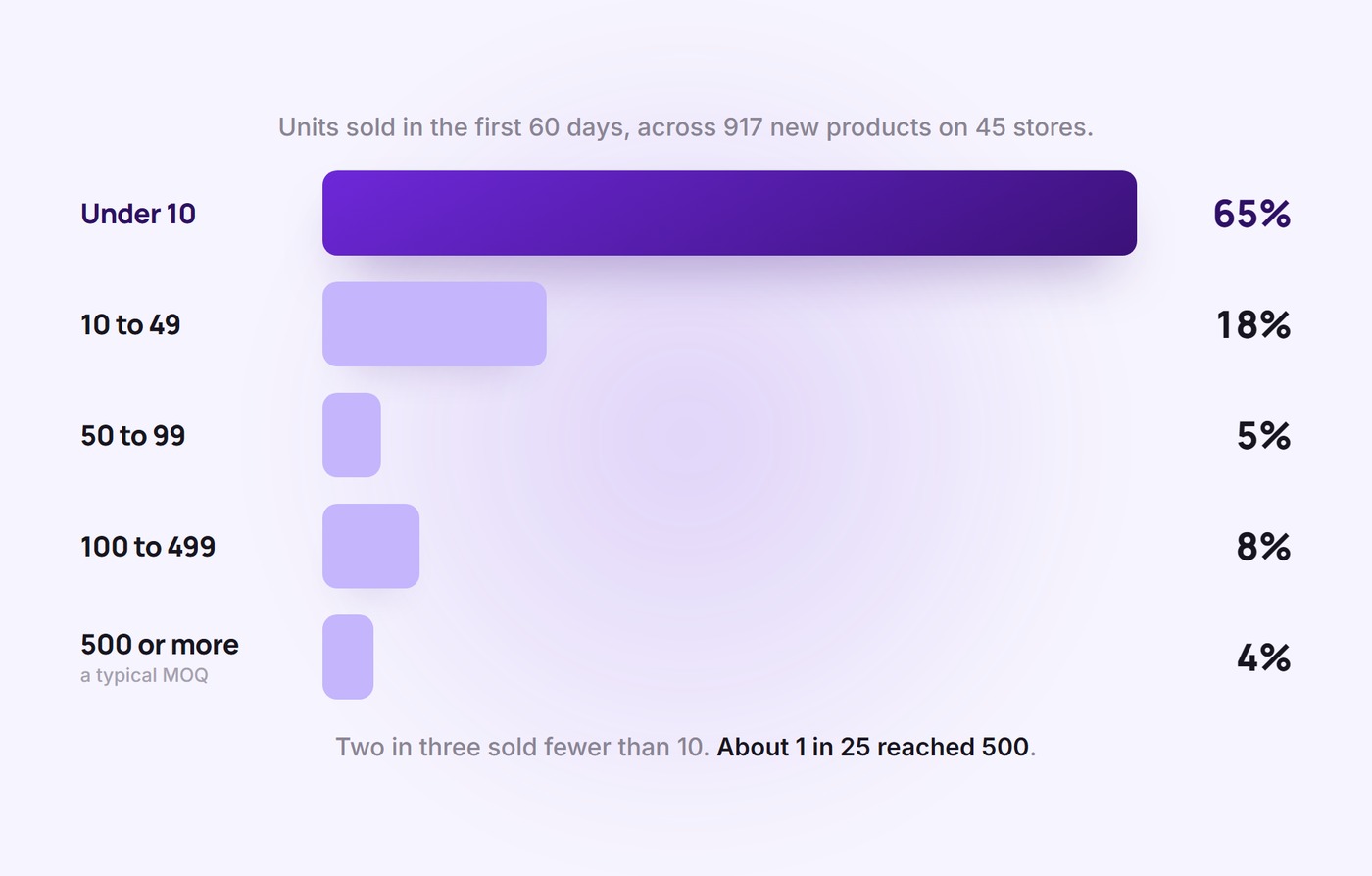
Here is what the 917 launches in this sample sold in their first 60 days on sale:
- 65% sold fewer than 10 units
- 18% sold 10 to 49
- 5% sold 50 to 99
- 8% sold 100 to 499
- 4% sold 500 or more
The median was 3 units. Three in four sold 22 or fewer. Nine in ten sold under 130.
This is not a sample of bad stores. These are brands with live order volume, adding products to stores that already sell. And the real picture is worse than this: a product that was listed and never sold once does not show up here at all.
The pattern is the same one every operator already knows from ad testing. Most products do not work, a few carry the store. The number just makes it hard to argue with: if you had bought 500 units of every product in this sample before the first sale, you would have been left holding stock on 96 of every 100.
What a 500-unit test costs when the product does not sell
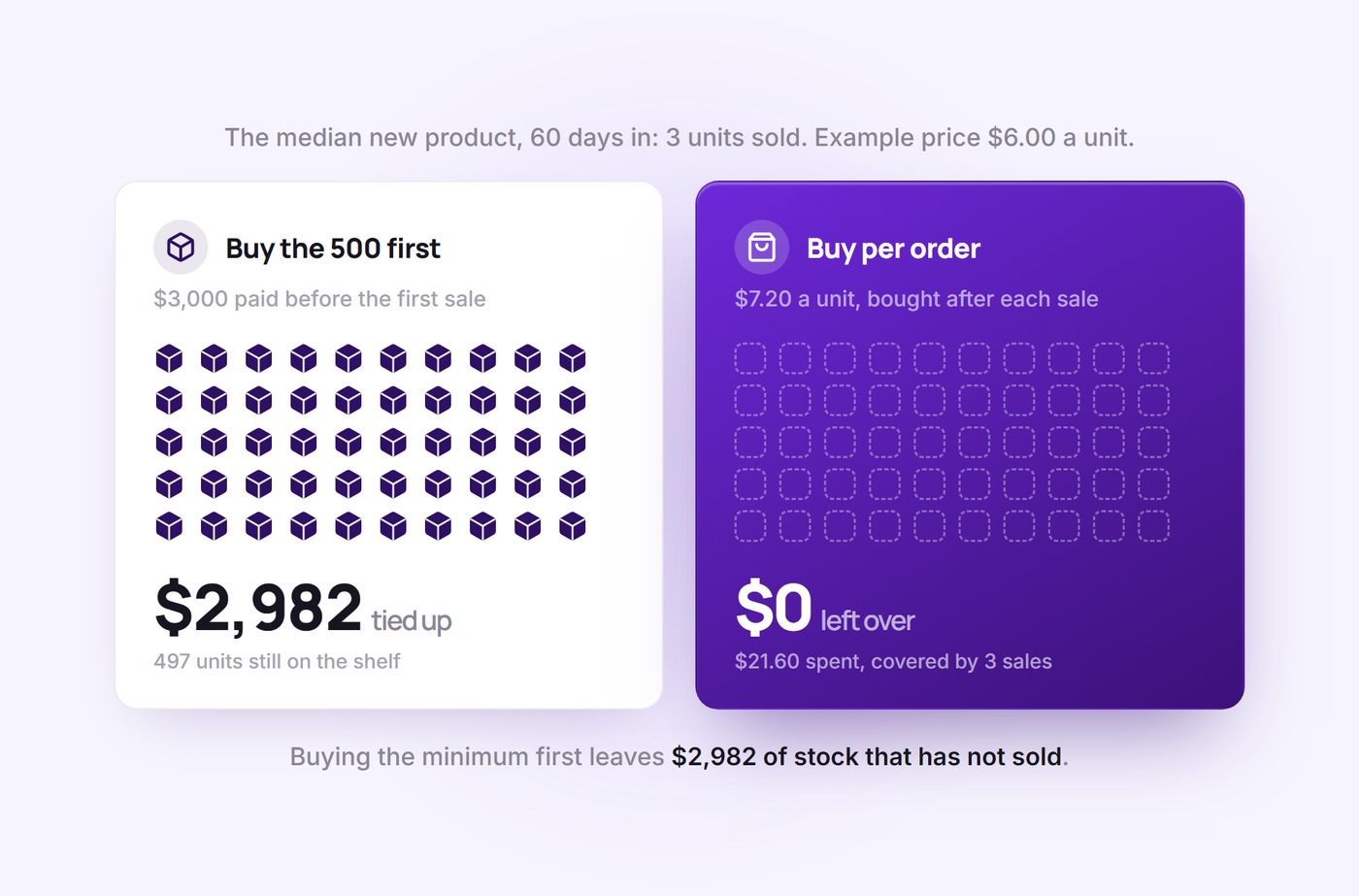
Take a product with a factory MOQ of 500 at $6.00 a unit. These are example numbers, not a quote.
- Buy the MOQ first: $3,000 of goods before freight and duty. The median launch sells 3. You have 497 units on a shelf and $2,982 of cash in them.
- Test per order instead: buy each unit after it sells, at 20% more (the top of the usual 10 to 20% low-quantity premium), so $7.20 a unit. The median launch sells 3. You have spent $21.60, and it was all covered by the sales.
The cost does not stop at the invoice. Stock that does not move eats storage, gets written down, and usually gets sold off below cost to free up the cash. That cash is the budget for your next product tests.
The first 14 days tell you when to buy the MOQ
What matters more than how many products fail is how early you can tell.
- Of 798 new products that sold fewer than 20 units in their first two weeks, 4 reached 500 units by day 60. About 1 in 200.
- Of 63 that sold 50 or more in their first two weeks, about half reached 500 by day 60.

Two weeks of real orders is enough to sort the products worth a production run from the ones that are not. Buy the minimum after that point, with sales numbers in hand, not before it.
Testing without a minimum is not free
The per-order route costs you money on a winner. In the example above, a product that sells 525 units in 60 days (the median of the fast-start group) costs $630 more bought per order than it would at the MOQ price.
So the honest trade is this: about $630 extra on the 1 product in 25 that wins, against roughly $3,000 tied up in each of the other 24. For most brands still finding their next product, that trade could be worth taking. Once a product is proven, it stops being worth it, and the MOQ price is where the margin is.
There are cases where buying the minimum first might be the right call:
- Custom products. Your own mould, print or formula almost always carries a factory minimum. The goal is the lowest one, not zero.
- Proven sellers. A product already selling every day on another store or channel is not a test.
- Pre-sold launches. If a waitlist or pre-orders already cover the run, the risk is gone.
How to check your own numbers
You can run the same check on your own store. In Shopify, open Analytics, then Reports, then Sales by product and set the window to the 60 days after each product's first sale.
- List every product you added in the last year and the date of its first sale.
- Note units sold in its first 14 days and its first 60 days.
- Count how many reached the MOQ you were quoted, or would have been quoted.
- Mark which ones you would have bought the minimum on before launch.
If the answer to step 3 is "almost none", your supplier's minimum has been costing you cash on every test.
What to do
- Ask the factory whether the product is made to order or already in production for other buyers. Off-the-shelf means the minimum can move.
- Buy samples first, usually 1 to 5 pieces, and check them yourself before anything is listed.
- Launch per order or at the lowest quantity you can get, and accept the higher unit price as the cost of the test.
- Read the first 14 days, not the first 3. Set your own threshold, then stick to it.
- Negotiate the production run only after the signal, with real sales numbers in hand. A factory takes a buyer with a sales history more seriously than one with a forecast.
- Negotiate the MOQ and the price separately. Asking for both at once usually gets you neither.
If you are also choosing who holds the stock once a product is proven, the five checks in our guide to the best China fulfillment companies work on any provider, minimums included.
How we handle this at Commercive
We can publish these numbers because the stores behind them run through us. We see every unit sold on the products we fulfil, including the products that stall.
We do not have a client-size minimum, and we do not add one on the product. When we source, we default to the no-MOQ or lowest-MOQ option across our 1,845+ vetted factories, so a brand can test a product from its first order. A minimum only appears when the factory itself requires one, which for a custom product it usually does. We keep that as low as we can get it, and we will not tell you it is zero when it is not.
When a product passes its first weeks and starts selling every day, we place the production run with the factory and hold the stock in our warehouse with no storage fee. Our FAQ covers how sourcing and minimums work in more detail, and our shipping status page shows how the parcels then move, per country and per line.
Commercive is your all in one sourcing and fulfilment partner. If you're currently running a brand, just give us the product and your daily order volume. We'll get you a quote within the next 24 hours to hold up against what you're paying today.
Measured on 917 products first sold between 23 September 2025 and 29 July 2026 across 45 Shopify stores fulfilled by Commercive, from our own order data. A product counts as a launch when its first sale came at least 30 days after the store's first sale in our data, and at least 60 days before 27 September 2026, so the full 60-day window is observed. Units are item quantities on orders that were not cancelled. Test stores and custom line items are excluded. Products that were listed but never sold are not in the sample. A second, independent read on a separate sales table agreed on the shape. MOQ ranges and the 10 to 20% premium are from Trade Entrust (July 2026) and DocShipper. The cost example uses illustrative prices, not a quote.
What is a normal MOQ from a Chinese factory?
Factory-direct listings usually ask for 500 to 3,000 units. Kitchen and home goods sit around 750, electronics and clothing 750 to 1,000, and standard colours in clothing can go as low as 150 to 300. A product the factory already makes for other buyers can often go lower.
Can I buy from a Chinese supplier with no minimum order?
Yes, for products that already exist. Samples, wholesale markets, trading companies and fulfilment partners that buy per order all let you start at one unit. Custom products with your own design or packaging almost always carry a factory minimum.
How many units should a test order be?
Small. In our sample the median new product sold 3 units in 60 days, so a test that starts per order, or at the lowest quantity a supplier accepts, tells you as much as 500 units would, without the cash on a shelf.
How do I know when to place the full production order?
Watch the first two weeks of real orders. In our data, products that sold under 20 units in their first 14 days reached 500 units by day 60 about 1 time in 200. Products that sold 50 or more reached it about half the time.
Does a lower MOQ always cost more per unit?
Usually. Sourcing guides put the premium at 10 to 20% per unit for a lower minimum. On a product that does not sell, that premium costs far less than a shelf of unsold stock. On a proven seller it is margin you give away, which is when the full run starts to make sense.
.png)
Fill in the application form, and our team will reach out to you to help you with making the above happen.
• Sell 1 day post-production
• Scale worldwide with 3-10 days
• Slice your lead times
• Prevent inventory risk and overstocking
• Hide china due custom software and carrier agreements
• Work with a multilingual team in mainland China
• Decades of supply-chain experience.

.png)