Table of Contents
How to verify a Chinese supplier before you pay: the registration code, the registry, factory or trader, and the bank account
Every Chinese company has an 18-character registration code, and its last character catches a made-up number before you look it up.


Search how to verify a supplier in China and you get checklists of 12 steps, most of them written by companies that sell the verification. Half of the steps cost money, and the order they come in rarely matters.
The checks that catch most problems are free and take minutes: read the supplier's 18-character registration code, look it up on China's national company registry, read the business scope, and check that the bank account belongs to the company you are buying from. Pay for an audit or an inspection after those pass, not instead of them.
This guide covers:
- What an Alibaba.com "Verified Supplier" badge proves, and what it does not
- How to read a Chinese registration code, and the arithmetic that catches a fake one
- How to look a company up on the national registry, and what to read there
- How to tell a factory from a trading company, and when a trader is fine
- What a sample, an audit and an inspection each prove, and what they cost

What a "Verified Supplier" badge proves
Most brands meet their first Chinese supplier on Alibaba.com, and the first thing they look at is the badge.
- Verified Supplier means a third-party inspection company checked the supplier. Alibaba.com says the checks and the factory filming are done by SGS and TÜV, not by Alibaba.com itself, and cover the business licence, production facilities, quality control and R&D.
- The supplier pays for it. It is a membership tier the supplier buys, and the inspection happens at one point in time.
- It is about the company, not your order. It does not tell you that the factory in the video is the one that will make your product, or that the quality on your batch matches the inspection.
The badge is a fair first filter. It is not a reason to skip the four free checks below, and on 1688 or a supplier found through a contact, there is no badge at all.
Check 1: read the 18-character registration code
Every company in China has a Unified Social Credit Code, 统一社会信用代码, introduced by the 2015 registration reform. It is printed on the business licence, 营业执照, which any real supplier will send you as a photo or PDF. Ask for it before you ask for a price.
The code is 18 characters, numbers and capital letters, and never uses I, O, Z, S or V. Each part means something:
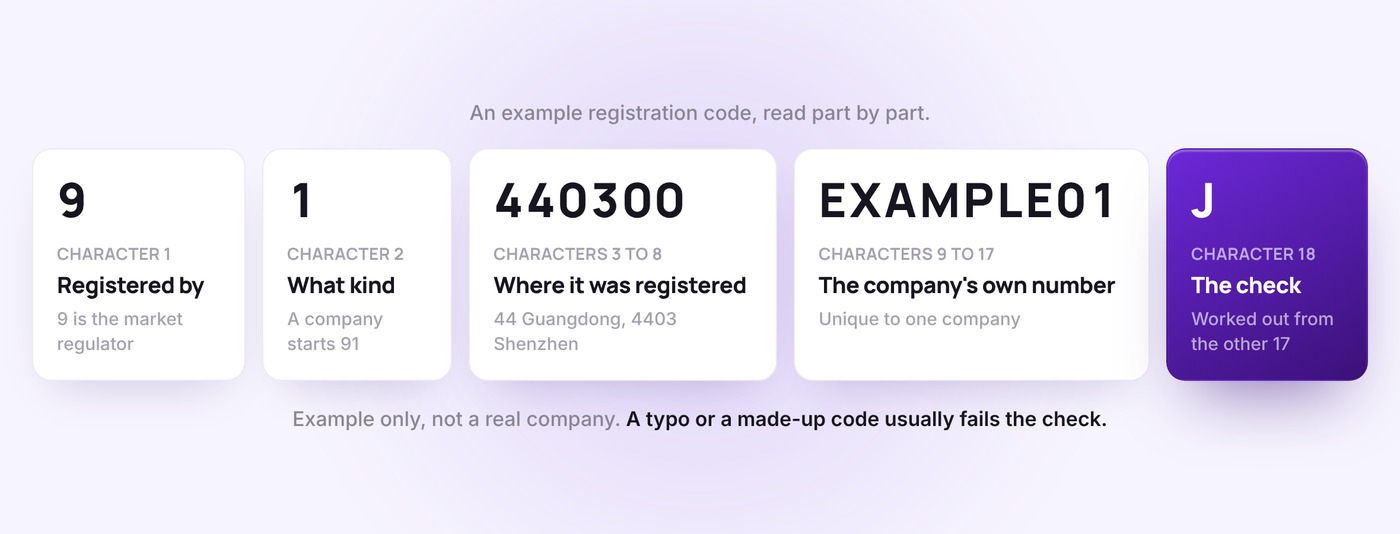
- Characters 1 and 2: who registered it and what kind of organisation it is. A company registered with the market regulator starts with 91.
- Characters 3 to 8: the area code of the office that registered it. The first two digits are the province, 44 for Guangdong; the first four are the city, 4403 for Shenzhen.
- Characters 9 to 17: the company's own identification number.
- Character 18: a check character, worked out from the other 17.
That last character is the part nobody uses. Each of the first 17 characters is turned into a number (0 to 9, then A is 10, B is 11 and so on, skipping the five banned letters), multiplied by a fixed weight, and added up. The remainder after dividing by 31 decides the last character. A free online code validator does the sum for you.
The check catches a typo or a made-up number in seconds. It does not prove the company exists or that it is the one you are talking to. The registry does that.
Check 2: look the company up on the national registry
China's official company register is the National Enterprise Credit Information Publicity System, 国家企业信用信息公示系统, at gsxt.gov.cn, run by the State Administration for Market Regulation. Search by the code or the company's Chinese name.
What to read on the record:
- Status. 存续 or 在业 means in operation. 吊销 means the licence was revoked, 注销 that the company was closed. Either of the last two is a stop.
- Name in Chinese. It should match the licence, the contract and the bank account exactly.
- Date founded. A company set up three months ago claiming ten years of export experience is worth a question.
- Business scope. Check 3 below.
- Abnormal operations list, 经营异常名录. A company lands here for missing its annual report (due between 1 January and 30 June of the next year) or for not being reachable at its registered address.
Two limits. Since 1 May 2025, a company can apply to have an abnormal-list record removed once it fixes the problem, so a clean record today does not prove there never was one. And the site can be hard to open from outside China: from a server outside China on 18 October 2026, it refused the request. If it will not load, ask someone in China to pull the record and send a screenshot with the code visible.
Check 3: factory or trading company
The business scope, 经营范围, on the licence and the registry record says what the company is allowed to do.
- A factory's scope usually includes words like 生产 (production), 制造 (manufacturing) or 加工 (processing).
- A trading company's scope has 销售 (sales) or 批发 (wholesale), and no making.
Two things that do not tell you much: the registered capital, and whether the office address matches the registered one. Workshops are often rented, and addresses go out of date.
A trading company is not a problem in itself. On a small test order, a trader holding stock could be the faster and cheaper route, as the guide to testing a product from China without an MOQ covers. The problem is a trader that says it is the factory, because the price, the minimum and the quality promises all come from someone else.
One more myth: you do not need to see an "export licence" for ordinary goods. China dropped the foreign trade operator filing on 30 December 2022, so any registered company can export.
Check 4: the bank account name
A real factory does not help if the money goes to the wrong account.
- The beneficiary name on the bank details must match the company name on the licence, character for character.
- A personal account, or a company with a different name, is a stop until the supplier explains it in writing.
- A Hong Kong account is common and not a red flag by itself, but a Hong Kong company is a separate legal entity. Ask how it is linked to the factory, and run the same checks on it.
- Bank details that change by email mid-order get a phone or video call to a number you already had, before any money moves.
On Alibaba.com, paying through the platform keeps the order under Trade Assurance. The guide to 1688 vs Alibaba for brands covers what that protection does and does not cover.
What the paid checks prove, and what they cost
Once the free checks pass, the paid ones test the product and the floor, not the paperwork.

- A sample proves one unit can be made right. One 2026 sourcing guide puts an off-the-shelf sample at about $0 to $30 and a custom one on existing materials at $50 to $200, plus $15 to $60 for express shipping to the US. The guide to ordering product samples from China covers the kinds, the costs and the timing.
- A supplier audit proves the floor, the staff and the processes on the day of the visit. One large inspection company lists audit programmes from $669 per inspector day.
- A pre-shipment inspection proves your batch, before it leaves. The same company lists product inspections from $419 per inspector day. The guide to quality control for small batches from China covers what an inspection catches and what it misses.
A good sample from a company that fails Check 2 is still a bad supplier. Run the free checks first.
The middleman is a supplier too
Sourcing agents, trading companies and fulfilment partners sit between you and the factory, and the same checks apply to them: the code, the registry record, the scope and the bank account name. That includes any company that sources for you, fulfilment partners among them. A partner that sources well will send its own licence and tell you which factory makes your product, and you can check both.
How to check a supplier yourself
- Ask for the business licence and the full company name in Chinese, before talking price.
- Run the code through a validator. If the last character fails, ask for the licence again.
- Look the code up on gsxt.gov.cn, or have someone in China do it, and read the status, the date founded, the scope and the abnormal list.
- Compare the names on the licence, the registry, the contract and the bank details. All four should match.
- Order a sample, then decide whether the order size justifies an audit or an inspection.
What to do
- Get the licence first, before samples, prices or a call
- Check the last character of the code, which takes a minute
- Read the registry record in Chinese, not a summary of it
- Pay only an account in the company's own name, and confirm any change by phone
- Treat badges as a filter, not a check
- Run the same checks on any agent or partner in the middle
How we handle this at Commercive
Commercive is your all in one sourcing and fulfilment partner. We source from a product link or a photo across more than 1,845 vetted factories, or work with the supplier you already use, and we default to the no-minimum or lowest-minimum option so you can test a product from its first order.
Your stock is received on our floor in China and shipped order by order on the line that fits each product and destination. Our measured delivery times by line and country are on our shipping status page, and our FAQ covers how sourcing works with us.
If you're currently running a brand, just give us the product and your daily order volume. We'll get you a quote within the next 24 hours to hold up against what you're paying today.
Where these facts come from. The code's structure is from national standard GB 32100-2015 as described by Chinese statistics bureau documents and the standard's public summaries; the check-character arithmetic (ISO 7064 MOD 31-3) was tested on the published codes of three large Chinese companies, and every one matched. Registry details are from guides to the National Enterprise Credit Information Publicity System and SAMR's abnormal operations list measures (updated 1 May 2025). The end of the foreign trade operator filing is the Foreign Trade Law amendment of 30 December 2022. The Verified Supplier description is Alibaba.com's seller page, read 18 October 2026. Audit and inspection prices are one inspection company's published list prices, read 18 October 2026; sample prices are one 2026 sourcing guide's ranges.
How do I check a Chinese company's business licence?
Ask the supplier for the licence, 营业执照, and read the 18-character code on it. Check that its last character is valid with a code validator, then search the code on the National Enterprise Credit Information Publicity System (gsxt.gov.cn) and confirm the name, status and business scope match what the supplier told you.
What is a Unified Social Credit Code?
It is the 18-character registration number every Chinese company has had since the 2015 reform. Characters 3 to 8 show where it was registered, and the last character is a check worked out from the other 17, so a mistyped or invented code usually fails.
How do I know if a supplier is a factory or a trading company?
Read the business scope. A factory's usually includes production, manufacturing or processing (生产, 制造, 加工). A trading company's says sales or wholesale (销售, 批发). A trader is fine for small orders; the warning sign is a trader saying it is the factory.
Is an Alibaba.com Verified Supplier safe to buy from?
The badge means SGS or TÜV inspected the company's licence, facilities and processes at one point in time, paid for by the supplier. It is a good filter, not proof about your order. Still check the registry record, the bank account name and a sample.
Is it safe to pay a supplier's Hong Kong bank account?
It is common, but a Hong Kong company is a separate legal entity from a mainland factory. Ask how the two are linked, check the Hong Kong company too, and only pay an account whose name matches a company you have checked.

Fill in the application form, and our team will reach out to you to help you with making the above happen.
• Sell 1 day post-production
• Scale worldwide with 3-10 days
• Slice your lead times
• Prevent inventory risk and overstocking
• Hide china due custom software and carrier agreements
• Work with a multilingual team in mainland China
• Decades of supply-chain experience.