Table of Contents
Selling products with button batteries from China: Reese's Law, the warning labels, the EU battery rules and how they ship
A product with a coin cell needs a locked battery door and warnings in three places. A new edition of the US standard could apply in 2027.


Search how to sell products with button batteries and you get the Federal Register, test lab pages and law firm notes written for manufacturers. None of them tells a Shopify brand sourcing from China which of its products are caught, what to ask the factory for, what its own box should show, or which line a parcel with a coin cell inside travels on.
The short answer: in the US, any consumer product that uses a button or coin battery, from a remote to an LED candle, falls under Reese's Law. The battery door has to need a tool or two separate movements to open, the product has to survive drop and crush tests, and warnings go on the product, the packaging and the instructions. In the EU, a brand selling products with batteries under its own name can count as the battery producer in each country it sells to. On the shipping side, a coin cell puts the parcel on a battery line.
This guide covers:
- Which products are caught, and the ones that are not
- The battery door, the tests and the certificate to ask the factory for
- The warnings on the product, the box, the instructions and spare cells
- The new edition of the standard, and when it could apply
- The EU producer duty, which line coin-cell products go on, and how long they take

Which products are caught
Reese's Law protects children six and under from swallowing button cell and coin batteries. A button or coin battery is any single cell battery that is wider than it is tall, so the rule reaches far past electronics:
- Remotes, key fobs and car keys
- LED candles, fairy lights and light-up decor
- Trackers, smart tags and fitness bands
- Kitchen and bathroom scales, thermometers and timers
- Watches, calculators and light-up cards or gifts
It applies whether or not the customer is meant to change the battery, so a sealed product with a coin cell inside is still caught. Two groups are outside it. Zinc-air cells, the kind in hearing aids, are not covered. Toys for children under 14 follow the toy rule instead, which has its own battery compartment test, covered in the guide to selling toys from China.
The battery door, the tests and the certificate
The rule makes a UL safety standard, UL 4200A, mandatory for every product it covers. For products made or imported since 23 October 2023, that means:
- A battery door a child cannot open. It needs a tool, such as a screwdriver or a coin, or at least two separate movements made at the same time.
- Screws that stay attached. Where the customer changes the battery, the screw holding the door stays on the product when it is undone.
- Abuse tests. The product is dropped, hit, crushed, twisted and pulled, and the battery door has to stay shut and the cell inside.
- A certificate. Products have to be tested and certified. For an everyday product, the importer usually issues a General Certificate of Conformity based on that test, and a brand selling under its own name can count as the importer. A product made for children needs a test at a CPSC-accepted lab and a Children's Product Certificate.
The useful questions for the factory are "which edition of UL 4200A was this tested to, can I see the report for this model, and does the door on my sample match the one in the report?". A cheaper battery door from a different batch is the usual way a product stops matching its report. The guide to verifying a Chinese supplier covers checking the company, and the guide to ordering product samples from China covers getting one in hand before you order.
The warnings on the product, the box and spare cells
The standard asks for warnings in three places: on the packaging, in the instructions, and on the product itself where it is practicable. The warning names the ingestion hazard, tells the buyer to keep new and used batteries away from children, and to get medical help straight away if one is swallowed.
If you sell spare cells, or put cells loose in the box, the battery packaging has its own rules:
- Child-resistant packaging for the cells, required since 12 February 2023.
- A warning on the front of the pack since 21 September 2024: the safety alert symbol and "WARNING", an ingestion icon at least 8 mm across with the full text, or a "keep out of reach" icon at least 20 mm across when space is short, with the text on the back.
- The text itself: the ingestion hazard, that a swallowed cell "can cause Internal Chemical Burns in as little as 2 hours", to keep batteries out of reach of children, to seek immediate medical attention, and the National Battery Ingestion Hotline, 1-800-498-8666.
- Two short instructions: keep cells in the original package until ready to use, and dispose of used cells straight away.
The CPSC proposed warnings on online listings too, but did not adopt them. Putting the same warning in the product description could still be worth it, because the buyer cannot read the box before ordering. This is a summary, not legal advice; a test lab can tell you what your product and pack need.
The new edition of the standard, and when it could apply
In August 2026, UL told the CPSC it had published a revised edition, UL 4200A-2026, and the CPSC asked for comments in a notice on 3 September 2026. Under Reese's Law, the CPSC has 90 days from UL's notice to reject the new edition. If it does not, the 2026 edition becomes the mandatory standard 180 days after that notice, which would put it in early 2027, unless the CPSC sets a later date.
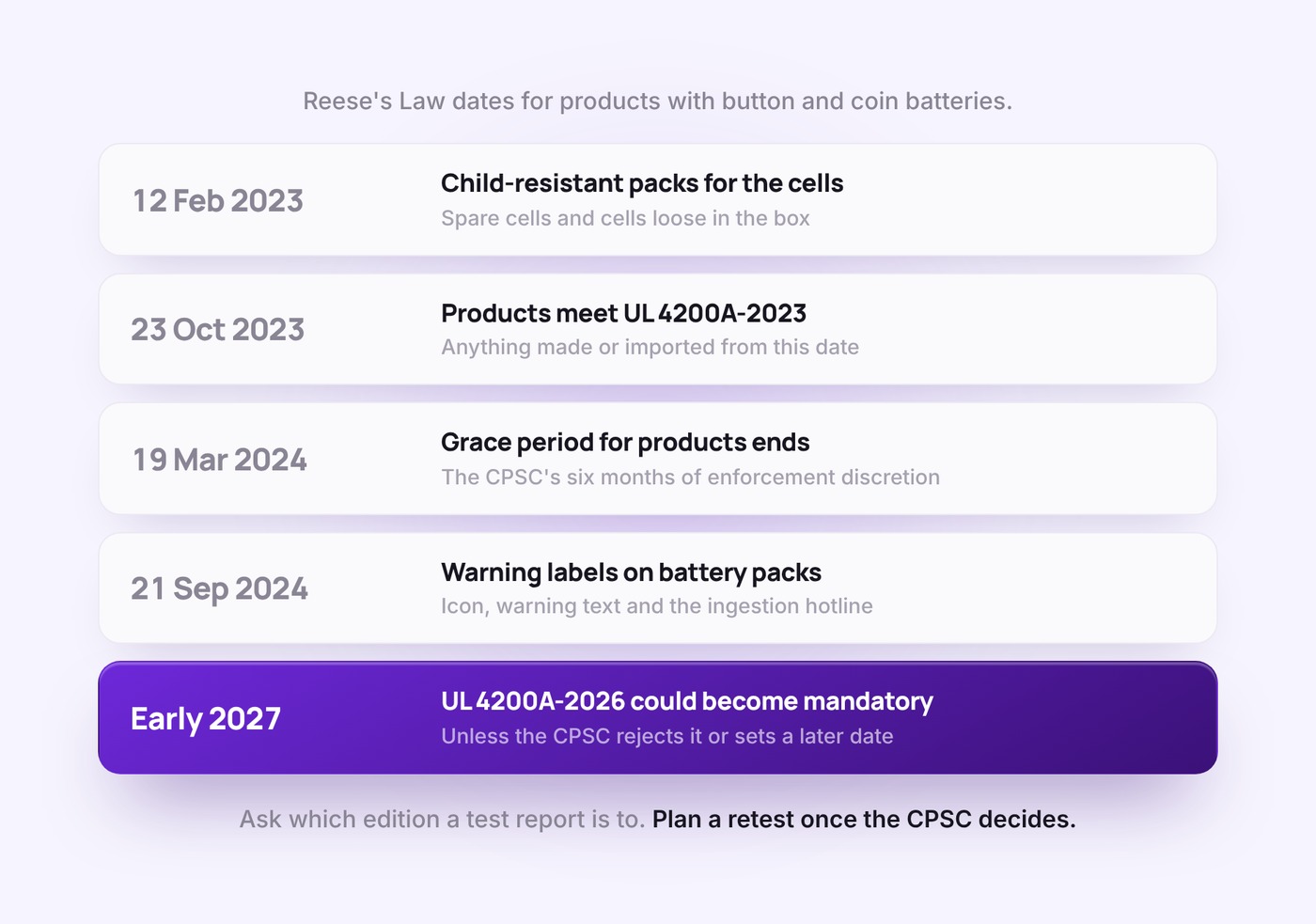
For a brand, the practical step is to ask which edition a test report is to, and to plan a retest of best sellers once the CPSC decides. A report to the 2023 edition covers what is made and imported before the new edition applies.
The EU producer duty and the product page
In the EU, the Batteries Regulation treats batteries inside products as batteries too. Since 18 August 2025, a company selling battery-containing products under its own brand in an EU country, including by shipping direct to customers, can count as the producer of those batteries there. In practice that means:
- Registering as a producer in each country you sell to, and paying into a battery collection scheme there
- Naming a representative in that country when your company is not based there
- Showing the registration number where a marketplace asks for it
Since 13 December 2024, every online offer in the EU also has to show the manufacturer's name and contact details, an EU responsible person when the manufacturer is outside the EU, a picture of the product and its warnings. The guide to selling electronics from China covers the CE mark and the separate rules for electrical waste. This is a summary, not legal advice; a compliance service can tell you which registrations your range needs.
Which line coin-cell products go on
Parcel lines out of China run separate products by goods class, and a parcel goes on the one its contents allow. YunExpress, a frontier line, runs a general "Economy, Unrestricted" product beside its "Economy with Battery" product. SDH, a lowest-cost line to the US, runs general goods, battery and sensitive goods lines.
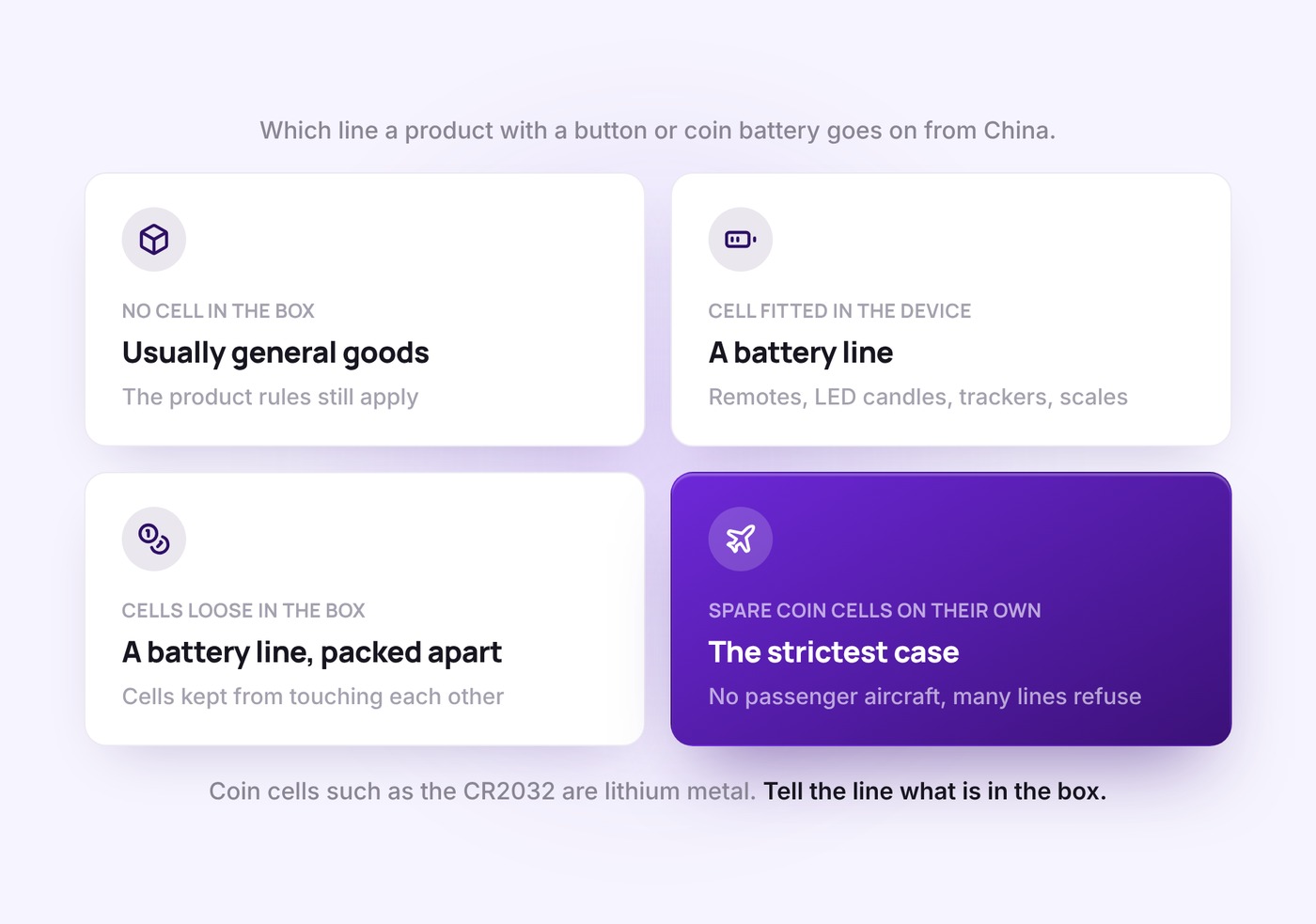
- A cell fitted inside the device puts the parcel on a battery line.
- Cells loose in the box also go on a battery line, packed so they cannot touch each other.
- Spare coin cells on their own are the strictest case. Coin cells such as the CR2032 are lithium metal, which air rules treat separately from the lithium ion in a phone, and lithium metal cells shipped on their own cannot go as cargo on passenger aircraft. Many parcel lines will not carry them.
- A device shipped with no cell usually goes as general goods. Reese's Law still applies to it, because it is designed to use one.
Button cells that are not lithium, such as alkaline LR44 or silver oxide cells, are worth checking with the line before the first order. The air rules for the lithium ion in phones, earbuds and power banks are in the guide to shipping products with batteries from China.
How long coin-cell products take from China
Products with coin cells cannot be told apart in the parcel data, so the times here are for the line products they travel on. On YunExpress to the US, parcels with a first carrier scan in August 2026, the per-store median on the battery product ran 11.0 to 14.0 days, and 9 in 10 parcels arrived within 14.6 to 22.1 days depending on the store. The general goods product, for devices shipped without a cell, ran 8.9 to 18.7 days. On SDH, a lowest-cost line, the battery line ran 18.3 to 19.2 days on a smaller sample, against 14.3 to 15.2 days for its general goods line.
LED candles, lights and light-up gifts sell most in Q4, so the date that matters is the last day an order can leave and still arrive in time, worked out by destination in the guide to Q4 shipping dates from China.
What to do
- List every product in your range that uses a button or coin cell, including sealed ones
- Ask for the UL 4200A test report for each model, and check which edition it is to
- Check the battery door on your sample needs a tool or two movements, and the screw stays on
- Issue a certificate for each product, and a Children's Product Certificate for anything made for children
- Put the warning on the product, the box and the instructions, and in the product description
- Use child-resistant, labelled packs for any spare or loose cells
- Register as a battery producer in each EU country you sell to, and show the responsible person on the listing
- Sort your range by goods class: no cell, cell fitted, cells loose, spare cells on their own
How we handle this at Commercive
Commercive is your all in one sourcing and fulfilment partner. We source from a product link or a photo across our vetted factories, or work with the supplier you already use, and we test products without holding you to the factory's minimum, which suits a store trying a few lights or gadgets before it commits.
Your stock is received on our floor in China, and every order ships on the line that fits the product and the destination: a battery line for anything with a cell fitted or packed in the box, a general goods line for devices sent without one, and a check with the line before spare cells go anywhere. Each parcel's scans sit in our dashboard. We recommend frontier lines such as YunExpress to essentially everyone; a lower-cost line might suit low-price gifts with patient customers. Our measured delivery times by line and country are on our shipping status page.
If you're currently running a brand, just give us the product and your daily order volume. We'll get you a quote within the next 24 hours to hold up against what you're paying today.
Where these numbers come from. The US rules are from 16 CFR 1263.1 and 1263.3, the CPSC's direct final rule and final rule of 21 September 2023 (88 FR 65274 and 88 FR 65296), and the CPSC's notice on UL 4200A-2026 published 3 September 2026, read 1 November 2026. The EU producer duties are from the Batteries Regulation (EU) 2023/1542 as summarised in a marketplace seller guide, and the listing rule from the General Product Safety Regulation (EU) 2023/988, read 1 November 2026. This is a summary, not legal advice. Line product names are the carriers' own. Delivery times are our own measurement: parcels to the US from stores we fulfil from China, first carrier scan 1 to 31 August 2026, test stores excluded, calendar days from the first scan to the first delivered scan, measured 1 November 2026, shown as the range of per-store medians and 90th percentiles for stores with at least 30 delivered parcels on that line product.
What products does Reese's Law apply to?
Any consumer product that uses a button or coin battery, meaning a single cell battery that is wider than it is tall, whether or not the battery is meant to be replaced. Remotes, LED candles, trackers, scales, watches and light-up gifts are all caught. Zinc-air hearing aid cells are not covered, and toys for children under 14 follow the toy rule instead.
What is UL 4200A?
It is the standard Reese's Law makes mandatory for products with button or coin batteries. It asks for a battery door that needs a tool or two separate movements to open, screws that stay attached, drop, impact, crush, torque, tension and compression tests, and warnings on the packaging, in the instructions and on the product where practicable.
Do I need a warning on my product page for button batteries?
It is not required. The CPSC proposed warnings on online listings but did not adopt them. The warning is required on the packaging and in the instructions, and on the product where practicable, so repeating it in the product description could still be worth it, because the buyer cannot see the box before ordering.
When does UL 4200A-2026 apply?
UL told the CPSC about the 2026 edition in August 2026. Under Reese's Law, the CPSC has 90 days to reject it; if it does not, the 2026 edition becomes the mandatory standard 180 days after UL's notice, which would put it in early 2027, unless the CPSC sets a later date.
Can coin cell batteries be shipped from China?
Yes, inside a device or packed with it, on a battery line. Spare lithium coin cells on their own are the hardest case: lithium metal cells shipped alone cannot go as cargo on passenger aircraft, and many parcel lines will not carry them.
How long do products with coin cells take to ship from China to the US?
On YunExpress in August 2026, the per-store median on the battery product ran 11.0 to 14.0 days from the first carrier scan to delivery. On a lowest-cost line, the battery product took 18.3 to 19.2 days on a smaller sample.

Fulfillment from our own warehouses in China and the US.
Tell us what you sell and how much you ship. We reply with a quote within one business day.