Table of Contents
Selling electronics from China: the FCC rules for each kind of gadget, the CE mark and USB-C rules in the EU, and how electronics ship
A cable needs nothing from the FCC. Earbuds need an FCC ID. A gadget with a chip and no radio needs a responsible party in the US.

Search how to sell electronics from China and you get import guides that say "get FCC and CE", a law firm warning about fines, and news about marketplaces pulling listings. None of them tells a Shopify brand which of its products need what, what has to be printed on the box, or which line a pair of earbuds travels on compared with a phone case.
The short answer: it depends on what is inside. A cable, a case or a stand is not a radio device and needs nothing from the FCC. Anything with a chip needs an FCC authorization before it is offered for sale, and a product page that offers it counts as offering. Anything with Bluetooth or Wi-Fi needs a certification and an FCC ID on the device. In the EU, the same products need the CE mark, phones and earbuds need a USB-C port, and a store shipping straight to EU households has recycling duties in each country it sells into.
This guide covers:
- The three FCC routes, and which one your product takes
- What has to be on the device, the box and the product page in the US
- What the EU asks of electronics sold under your brand, USB-C included
- Which line electronics go on, and the ones that need a different one
- How long electronics take from China, and what to do before you list
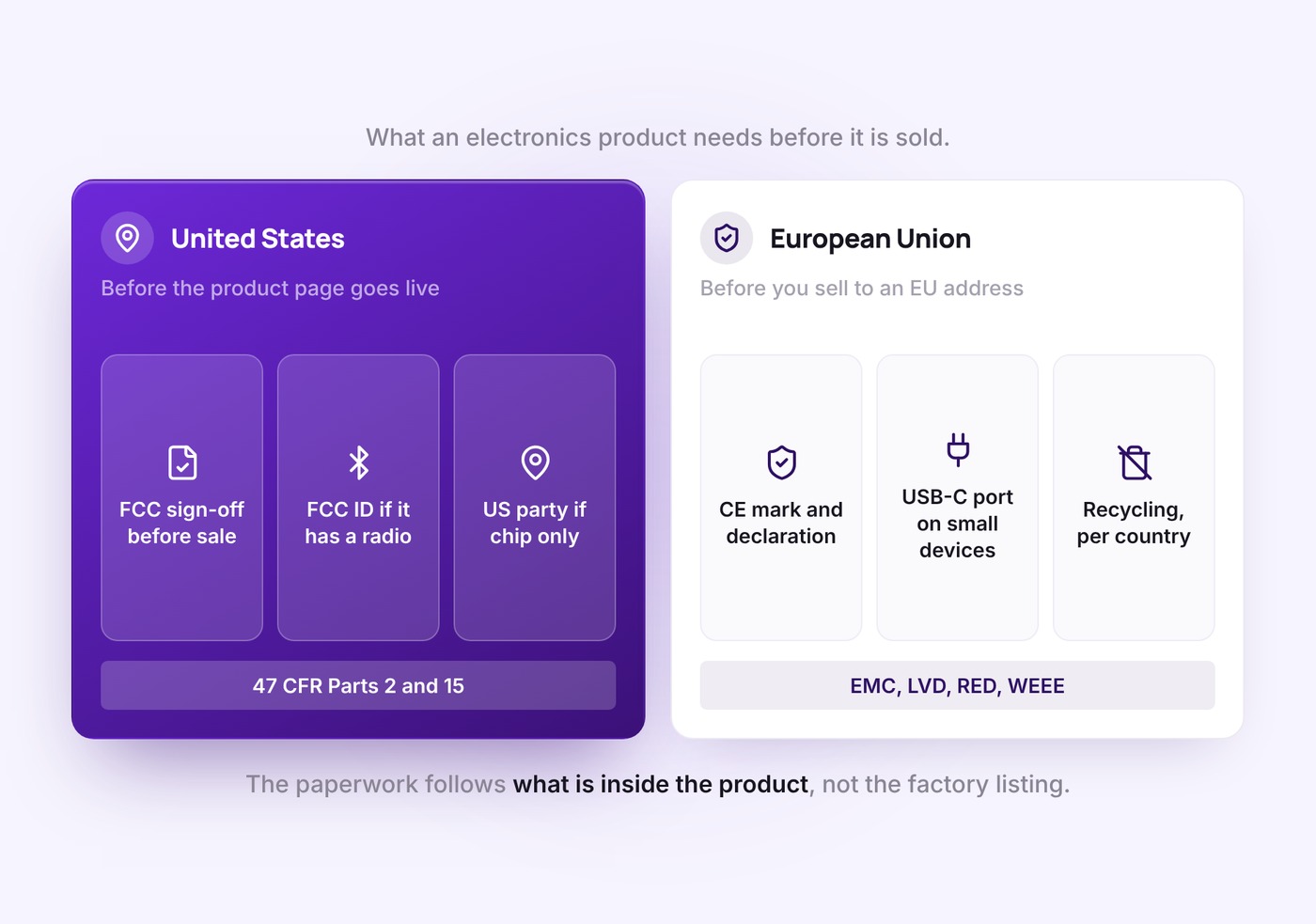
The three FCC routes, and which one your product takes
US rules sort electronics by what they give off. Anything that runs on a clock signal, which means almost anything with a chip, gives off radio noise even when it has no radio, and the FCC calls it an unintentional radiator. Anything built to send a signal, Bluetooth, Wi-Fi or a remote, is an intentional radiator. Each takes a different route:
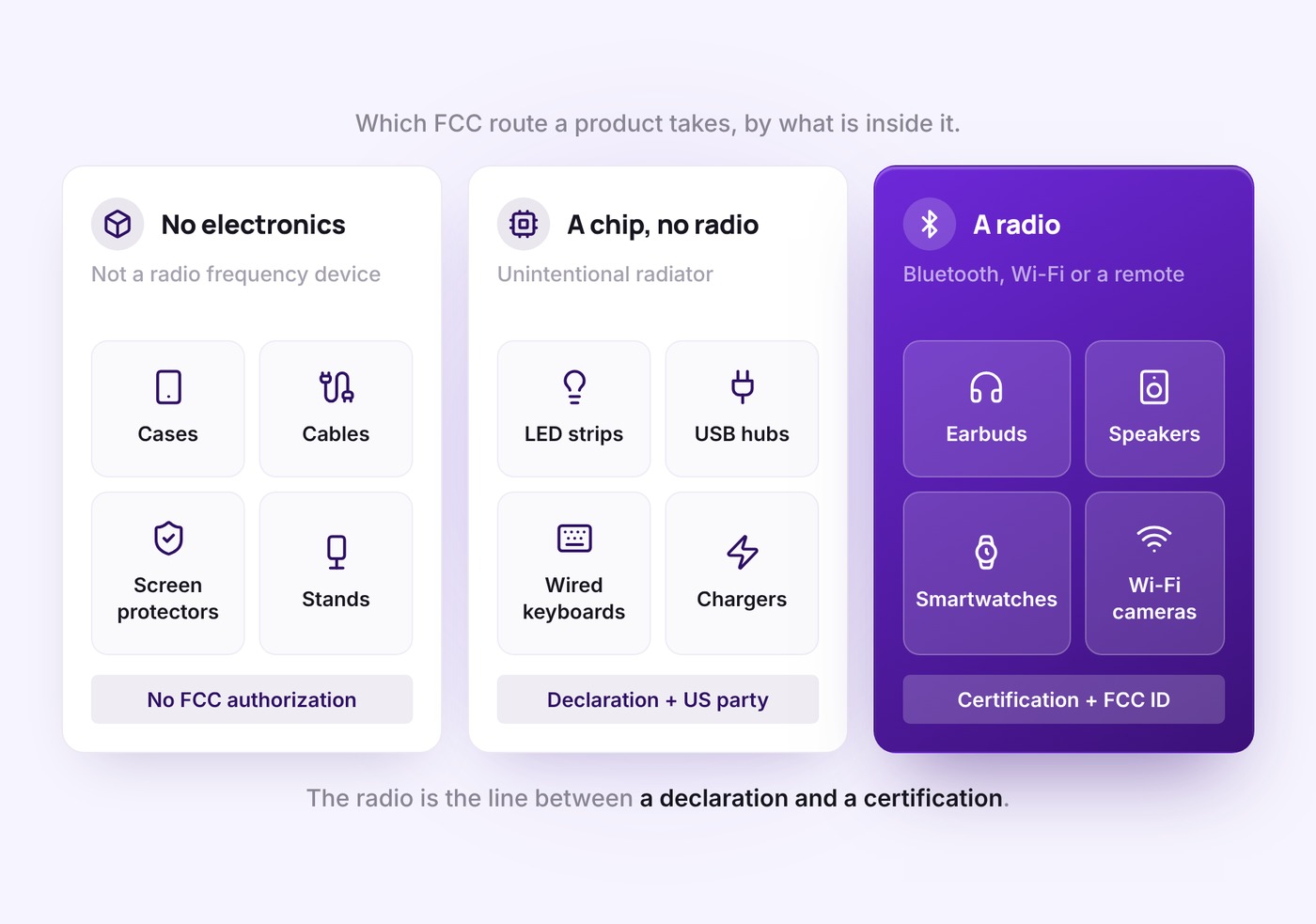
- No electronics. Cases, plain cables, screen protectors, stands and mounts are not radio frequency devices. No FCC authorization applies.
- A chip, no radio. LED strips, USB hubs, wired keyboards, digital scales and most chargers can use a Supplier's Declaration of Conformity: a test to the FCC limits, then a declaration by a responsible party. That party has to be located in the United States, so a factory in China cannot be it.
- A radio. Earbuds, Bluetooth speakers, smartwatches, trackers and Wi-Fi cameras need certification through an FCC-recognised body, and the device carries an FCC ID.
The rules apply before the sale, not after it. Under FCC rules, marketing a device includes offering it for sale and advertising it, so a Shopify product page that sells it is marketing. The authorization has to exist before the page goes live. This is a summary, not legal advice; an FCC-recognised lab can tell you which route a product takes.
What has to be on the device, the box and the page
For a device with a radio, the label reads "FCC ID" followed by the identifier, on one line, permanently on the device and visible to the buyer. When the device is too small, the ID can go in the manual and on the box or a removable label. Most also carry the standard Part 15 statement, which starts "This device complies with part 15 of the FCC Rules" and sets out the two conditions on interference.
For a device on the declaration route, the product ships with a short compliance sheet or manual page: the product name and model, the compliance statement, and the responsible party's name, US address and phone number or web contact.
Then check the paperwork the factory sends:
- Look the FCC ID up in the FCC's public database and check the photos and model match what you are buying. An ID granted to the factory can cover your branded unit only while the device is the same one that was certified.
- Check the lab. Since 2025 the FCC has withdrawn recognition from a number of test labs, so check the lab named on the report is on the FCC's recognised list today.
- Check the model. A report for the version the factory showed you does not cover a cheaper version with a different chip.
The guide to verifying a Chinese supplier covers checking the company behind the paperwork.
What the EU asks of electronics sold under your brand
Electronics sold in the EU carry the CE mark under every directive that applies: electromagnetic compatibility for anything with electronics, low voltage for anything that plugs into the mains (50 to 1,000 volts AC), and the Radio Equipment Directive for anything with Bluetooth or Wi-Fi. Each needs a declaration of conformity and a technical file. A product sold under your own brand makes you the manufacturer, so the declaration is yours, not the factory's. Since 1 August 2025, radio devices that connect to the internet also have to meet the EU's cybersecurity requirements under the same directive.
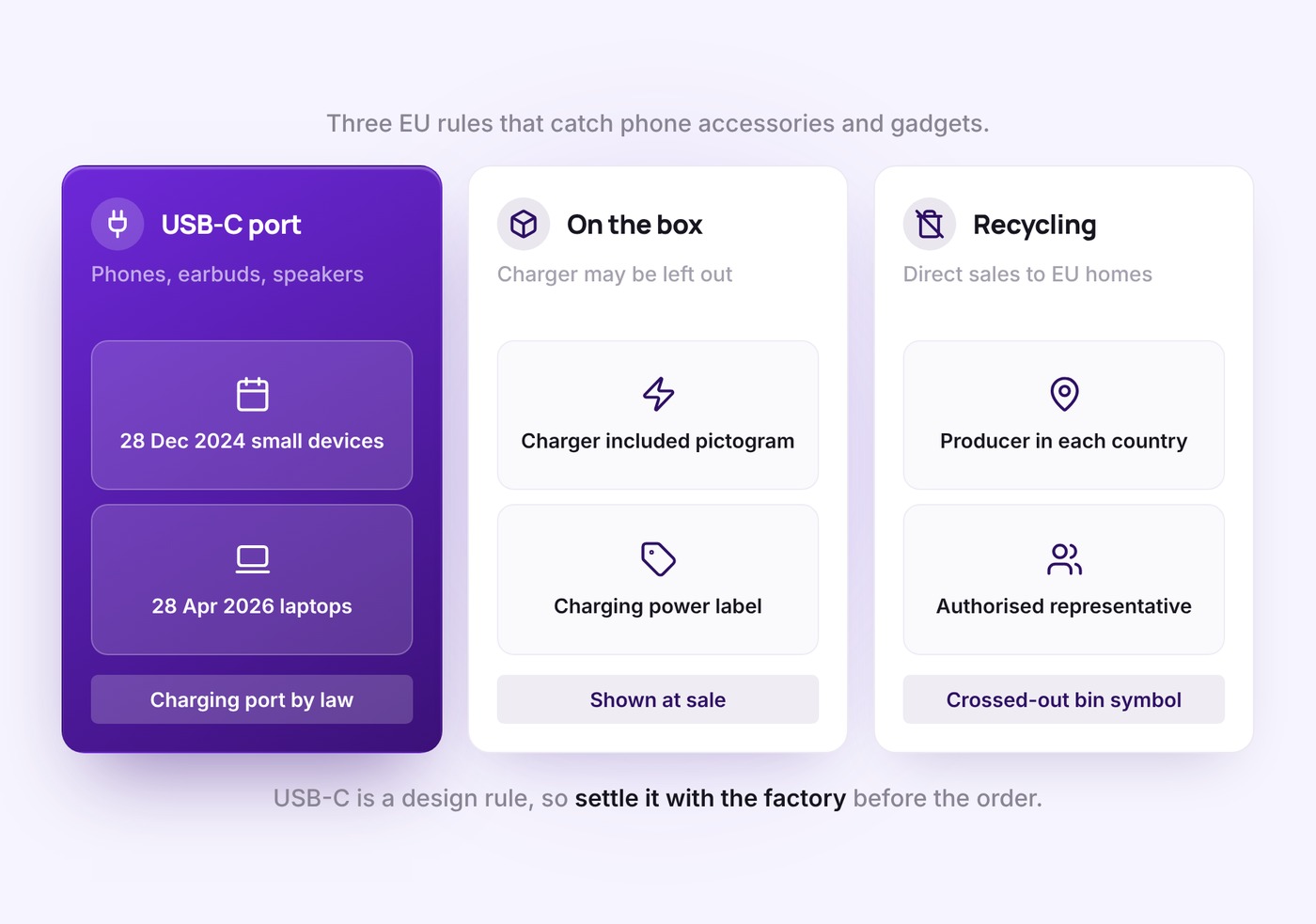
Three more rules catch phone accessories and gadgets:
- USB-C. Since 28 December 2024, phones, tablets, cameras, headphones, earbuds, portable speakers, handheld consoles, e-readers, keyboards, mice and portable navigation devices sold in the EU need a USB-C charging port. Laptops followed on 28 April 2026. The device can be sold without a charger, and the box has to show a pictogram saying whether one is included and a label on the power it needs.
- Recycling. Under the WEEE Directive, a seller that ships electronics straight to households in an EU country counts as a producer there, even from outside the EU. That means registering in each country, through an authorised representative, and the crossed-out bin symbol on the product.
- The listing. Since 13 December 2024, every online offer in the EU has to show the manufacturer's name and contact details, an EU responsible person when the manufacturer is outside the EU, a picture of the product and its warnings.
This is a summary, not legal advice. A compliance service can tell you which directives your range falls under.
Which line electronics go on
Parcel lines out of China run separate products by goods class, and a parcel goes on the one its contents allow. YunExpress, a frontier line, runs a general "Economy, Unrestricted" product beside its "Economy with Battery" product. SDH, a lowest-cost line to the US, runs general goods, battery and sensitive goods lines.
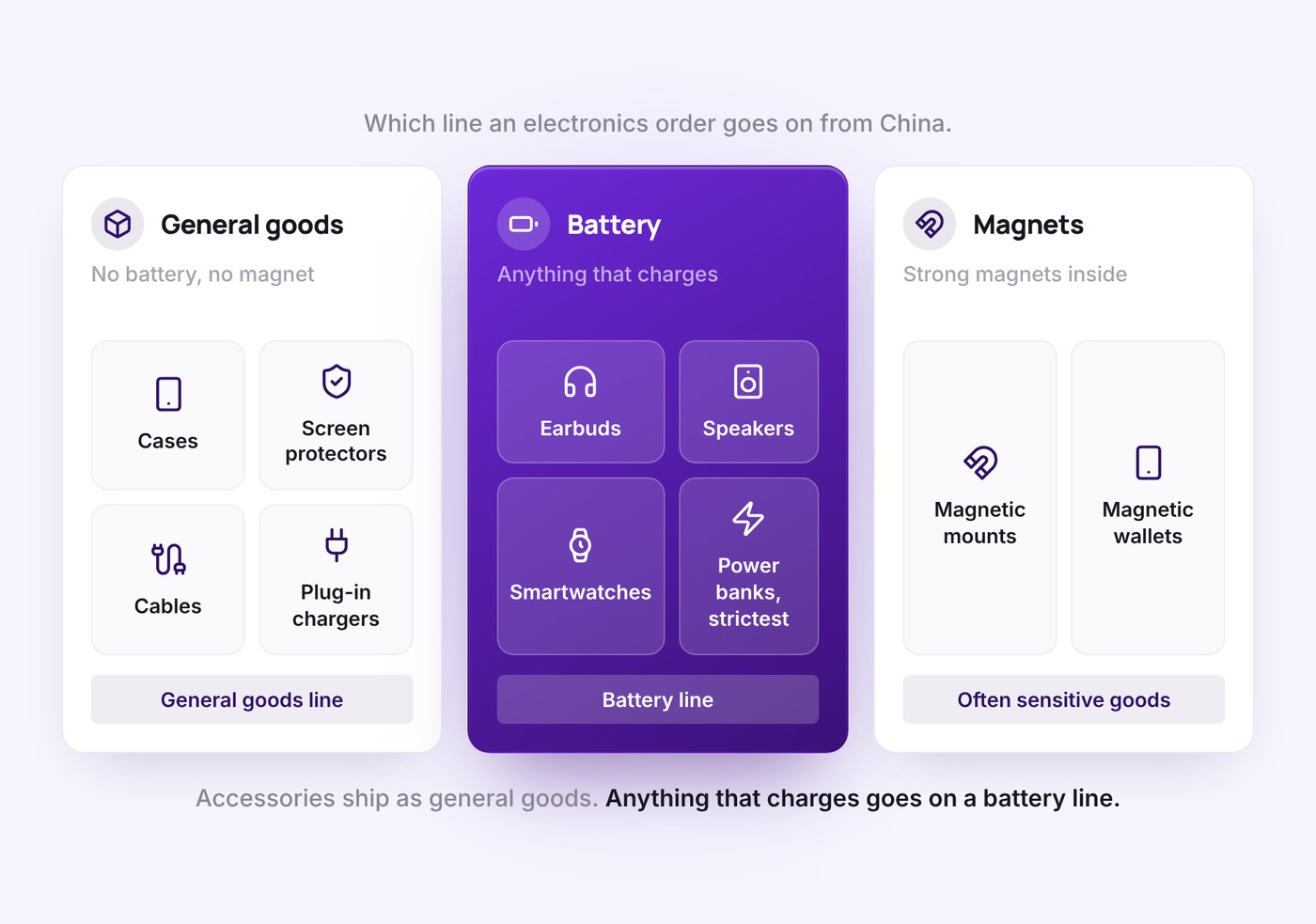
- Cases, screen protectors, cables, stands and plug-in chargers with no battery usually ship as general goods.
- Earbuds, headphones, speakers, smartwatches, trackers and anything that charges carry a battery and follow the rules in the guide to shipping products with batteries from China. Power banks are a battery on their own and get the strictest rules.
- Magnetic phone mounts and magnetic wallets are treated as sensitive goods by many lines because of the magnets.
Tell the line exactly what is in the parcel and let it pick the product. A battery packed as general goods can be held or sent back, and in Q4 that wait lands on a gift.
How long electronics take from China
Electronics orders are too mixed a set to give them a figure of their own, so the times here are for the line products they travel on. On YunExpress to the US, parcels with a first carrier scan in August 2026, the per-store median on the general goods Economy product ran 8.9 to 18.7 days, and 9 in 10 parcels arrived within 12.1 to 21.6 days depending on the store. The Economy with Battery product, for earbuds, speakers and watches, ran 11.0 to 14.0 days. On SDH, a lowest-cost line, the general goods product ran 14.3 to 15.2 days. The battery product sat inside the general goods range: the line made more difference than the goods class.
For gifts, the date that matters is the last day an order can leave and still arrive in time, worked out by destination in the guide to Q4 shipping dates from China.
What to do
- Sort your range into the three FCC routes: no electronics, a chip with no radio, a radio
- Get the authorization in place before the product page goes live, not after the first sale
- Look up every FCC ID and check the photos and model match your unit
- Name a responsible party in the US for anything on the declaration route
- Check the test lab is on the FCC's recognised list today
- Hold your own EU declaration of conformity, with the CE mark, the crossed-out bin symbol and recycling registration for each country you ship to
- Confirm the USB-C port and the charger pictogram with the factory before you order for the EU
- Sort your range by goods class: general, battery, or magnets
How we handle this at Commercive
Commercive is your all in one sourcing and fulfilment partner. We source from a product link or a photo across our vetted factories, or work with the supplier you already use, and we test products without holding you to the factory's minimum, which suits a gadget store trying a few models before it commits to one.
Your stock is received on our floor in China, and every order ships on the line that fits the product and the destination: a general goods line for cases and cables, a battery line for anything that charges, and a check with the line for magnets and power banks. Each parcel's scans sit in our dashboard. We recommend frontier lines such as YunExpress to essentially everyone; a lower-cost line might suit low-price accessories with patient customers. Our measured delivery times by line and country are on our shipping status page.
If you're currently running a brand, just give us the product and your daily order volume. We'll get you a quote within the next 24 hours to hold up against what you're paying today.
Where these numbers come from. The US rules are from 47 CFR 2.803 (marketing before authorization), 15.101 (authorization of unintentional radiators), 2.909 and 2.1077 (the responsible party and compliance information), 2.925 (the FCC ID label) and 15.19 (the Part 15 statement), read 29 October 2026, with the FCC's test lab withdrawals as reported by Broadband Breakfast. The EU rules are from Directive 2014/35/EU, Article 1, the European Commission's common charger page (Directive (EU) 2022/2380) and the WEEE Directive 2012/19/EU, Articles 3 and 17, read 29 October 2026. This is a summary, not legal advice. Line product names are the carriers' own. Delivery times are our own measurement: parcels to the US from stores we fulfil from China, first carrier scan 1 to 31 August 2026, test stores excluded, calendar days from the first scan to the first delivered scan, measured 29 October 2026, shown as the range of per-store medians and 90th percentiles for stores with at least 30 delivered parcels on that line product.
Do I need FCC certification to sell electronics from China?
It depends on what is inside. Cases, cables and stands need no FCC authorization. A device with a chip and no radio needs a Supplier's Declaration of Conformity with a responsible party in the US. A device with Bluetooth, Wi-Fi or another transmitter needs certification and an FCC ID. Either way, it has to be in place before you offer the product for sale.
Can I use the factory's FCC ID for my own brand?
An FCC ID granted to the factory can cover a unit sold under your brand while the device is the same one that was certified. Look the ID up in the FCC's database and check the photos and model match. A changed chip, antenna or board can need a new or changed grant.
Do phone accessories sold in the EU need USB-C?
Since 28 December 2024, phones, tablets, cameras, headphones, earbuds, portable speakers, handheld consoles, e-readers, keyboards, mice and portable navigation devices sold in the EU need a USB-C charging port. Laptops followed on 28 April 2026. Cases, cables and stands are not covered, because they are not charged.
Do I need WEEE registration if I ship from China to EU customers?
Under the WEEE Directive, a seller that ships electronics directly to households in an EU country counts as a producer there, even when it is based outside the EU. That means registering in each country you sell into, usually through an authorised representative, and putting the crossed-out bin symbol on the product.
How long do electronics take to ship from China to the US?
About as long as other goods on the same line. On YunExpress in August 2026, the per-store median ran 8.9 to 18.7 days on the general goods product and 11.0 to 14.0 days on the battery product, from the first carrier scan to delivery. A lowest-cost line took 14.3 to 15.2 days.

Fulfillment from our own warehouses in China and the US.
Tell us what you sell and how much you ship. We reply with a quote within one business day.