Table of Contents
Shipping policy for a store that ships from China: what to write, and the delivery times to put in it
Counted from the order, 9 in 10 parcels arrived within 18 days to Canada, 22 to the US and 24 to Australia. That is the number to write.


Most shipping policy templates say the same thing: orders are processed in 1 to 2 business days and delivered in 5 to 7. For a store whose products ship from China, the second number is wrong for almost every order, and the shipping policy is the page your customer, your payment provider and a dispute reviewer all read.
Measured on tracked parcels with a first carrier scan from May to July 2026, counted from the customer's order, 9 in 10 parcels arrived within 18 days to Canada, 22 days to the US and 24 days to Australia. A policy built on those numbers, with a clear rule for parcels that run late, holds for about 9 in 10 orders.
This guide covers:
- The six things a shipping policy has to say when orders ship from China
- Processing time: how long it takes from the order to the carrier's first scan
- Delivery times by country to put in the policy, measured from the order
- When a late parcel counts as lost, and what the policy should promise
- A fill-in template, plus the US and EU rules that make the numbers matter

What a shipping policy has to say
A shipping policy for a store that ships from China needs six things. Leave one out and the customer fills the gap with the number they expected, which is usually a domestic one.
- That orders ship internationally. One plain sentence, so nobody is waiting for a parcel from down the road.
- Processing time. How long from the order until the parcel is with the carrier.
- Delivery time per country, in calendar days from the order, not one number for the world.
- Shipping costs, or a link to where they show at checkout.
- Tracking. When the tracking number arrives and why it can look quiet for a few days.
- What happens if a parcel is late or does not arrive, with a day count, plus a link to your returns policy.
The rest of this guide puts a measured number in each of those.
Processing time: about 9 in 10 orders scanned within 3 days
Processing is the time from the order until the carrier has the parcel, which is the carrier's first scan. On parcels from May to July 2026, the median order got its first carrier scan 0.8 days after it was placed.
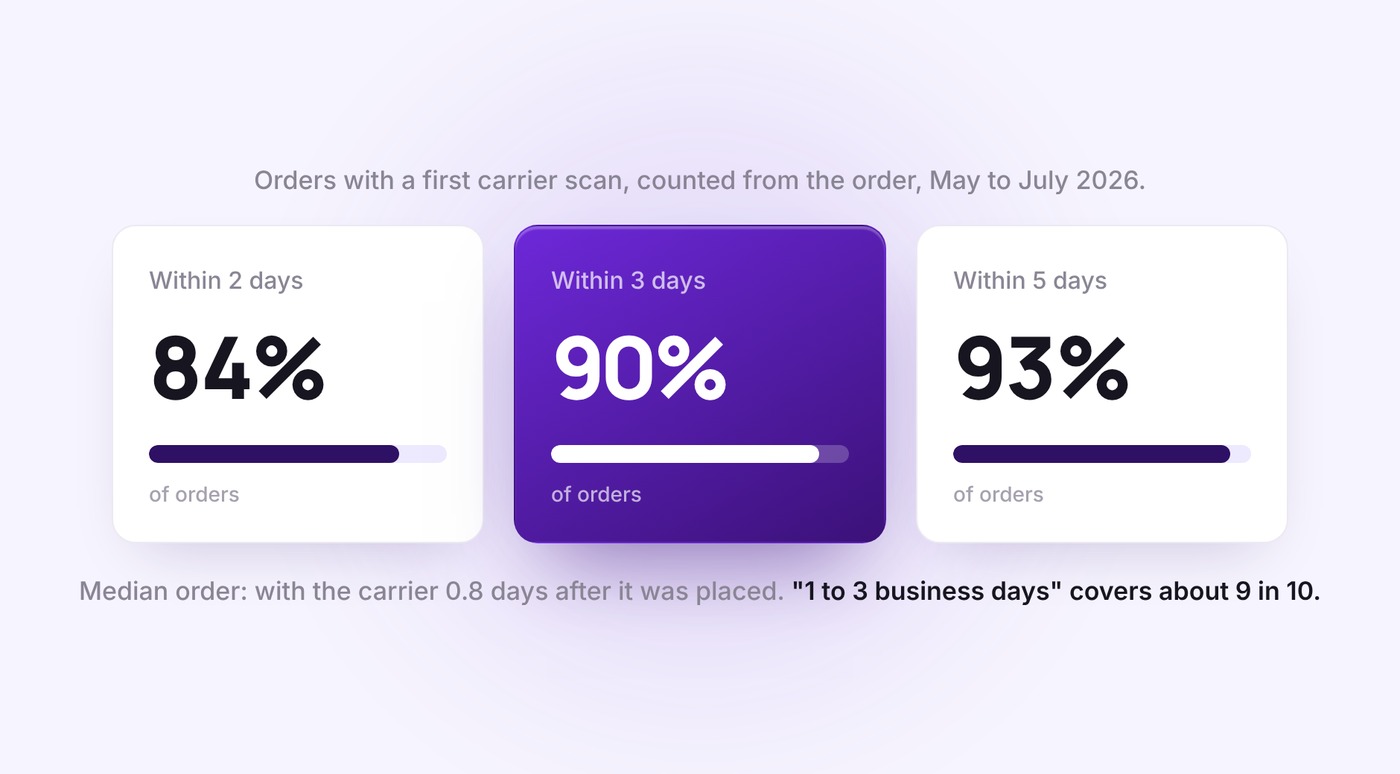
- Within 2 days of the order: 84% of orders had a first carrier scan
- Within 3 days: 90%
- Within 5 days: 93%
So "orders are processed within 1 to 3 business days" holds for about 9 in 10 orders.
In the US, this is the number the FTC cares about. Its Mail, Internet, or Telephone Order Merchandise Rule says a seller needs a reasonable basis for any shipping time it states, and with no stated time, a reasonable basis to ship within 30 days. "Ship" means the carrier has the parcel, not that it was delivered. If an order will miss the stated time, the seller has to tell the customer, give a new date, and offer a full refund if they would rather cancel. That is from the FTC's business guide to the rule, and it is information, not legal advice.
Delivery times by country: print the slow end, not the median
The median is the parcel in the middle. A policy that prints the median is wrong for half of your customers. Print the day by which about 9 in 10 orders arrive, counted from the order, in calendar days.
From May to July 2026, all lines:
- Canada: median 12.1 days. 9 in 10 within 17.9. Policy: 10 to 18 days.
- New Zealand: median 12.6 days. 9 in 10 within 18.2, on a smaller sample. Policy: 9 to 18 days.
- United Kingdom: median 11.8 days. 9 in 10 within 19.2, on a smaller sample. Policy: 9 to 19 days.
- EU, all countries together: median 13.3 days. 9 in 10 within 20.6, on a smaller sample. Policy: 10 to 21 days.
- United States: median 13.2 days. 9 in 10 within 21.6. Policy: 9 to 22 days.
- Australia: median 13.4 days. 9 in 10 within 24.0. Policy: 10 to 24 days.
The line changes these numbers. The US range above pools every line. On a frontier line such as YunExpress, the US range was closer to 9 to 17 days; the guide to YunExpress shipping times has it by country. A mid-tier or lowest-cost line could take longer, so check which line your orders go on before you copy a number.
Two more rules for the numbers you print:
- Calendar days, not business days. Your customer counts weekends. "7 to 15 business days" is about 9 to 21 calendar days.
- One line per country, or a link to a table. The same text sits in your checkout rate names; the guide to Shopify shipping settings for a store that ships from China shows where.
Late is not lost: about 2 in 100 arrive after 30 days
Every policy needs a day after which you treat a parcel as a problem. Set it too early and you refund parcels that were about to arrive. Set it too late and the customer files a dispute first.

- More than 30 days after the order: about 2 in 100 of the parcels that were delivered. Australia was highest at 3.8%, the US 2.1%, Canada 1.7%.
- More than 45 days: about 1 in 200.
- Never got a delivered scan: about 2 in 100 overall, and 1.7% to the US. The UK is the exception: its tracking often stops at the handover to the local delivery company, so a missing delivered scan there is usually a tracking gap, not a lost parcel.
A rule that fits those numbers could be: if the order has not arrived 30 days after it was placed, the customer contacts you and you check the tracking and the local carrier; if it has not arrived by day 45, you reship or refund. Refunding at day 30 pays out on about 2 in 100 parcels that would still have arrived. Whatever day you pick, keep the tracking: it is your evidence if the customer disputes the charge, as the guide to proof of delivery for parcels from China explains.
In the EU and the UK, the stated time matters for another reason. Under the EU Consumer Rights Directive (Article 18) and the UK Consumer Rights Act 2015 (section 28), if no delivery time was agreed, goods are due within 30 days of the order. If the trader misses the agreed time, the customer can set an extra period, and if that passes too, cancel and get a refund. A delivery time in your policy is the time you agreed, so it should be one you can meet.
A shipping policy template, with the numbers filled in
Change the store name, the countries and the days to match your own orders. Every number here is from the measurements above.
Shipping policy. Our products ship internationally. Orders are processed within 1 to 3 business days, and you get a tracking number by email when your parcel is with the carrier.
Delivery times, from the day you order: United States 9 to 22 days. Canada 10 to 18 days. United Kingdom 9 to 19 days. European Union 10 to 21 days. Australia 10 to 24 days. New Zealand 9 to 18 days. These are calendar days and cover about 9 in 10 orders. Orders placed in December take longer.
Tracking. Tracking can stay on the same status for a few days while your parcel is between countries. Near the end, a local delivery company takes over and may show its own name on the delivery scan.
Late parcels. If your order has not arrived 30 days after you placed it, email us with your order number and we will check it with the carrier. If it has not arrived by day 45, we will send a replacement or refund you.
Returns. See our returns policy.
For the returns page, the guide to returns when your products ship from China sets out the three options and the costs.
December needs its own line
These numbers are from May to July. Last year, US orders placed in early November took a median 10.7 days from order to door, and orders placed 8 to 14 December took 17.1 days. Canada, Australia and the EU were closer to 19 to 20 days for orders placed 1 to 15 December.
Add a seasonal line to the policy from mid-November: an order-by date for Christmas and a note that delivery takes longer. The guide to Q4 shipping dates from China has last year's numbers week by week.
How to check the numbers for your own store
- Export three months of orders that are at least six weeks old, with the country, order date, tracking number and delivered date.
- Work out the days from order to first carrier scan. The share within 3 days is your processing promise.
- Work out the days from order to delivered per country, then the median and the day by which 9 in 10 arrived. The second number goes in the policy.
- Count the share delivered after 30 days. That is how many customers your late-parcel rule will touch.
- Repeat every quarter, and when you change line or supplier.
What to do
- Replace the template's "5 to 7 days" with a range per country, counted from the order
- Print the day by which 9 in 10 orders arrive, not the median
- State processing as the time to the carrier's first scan, about 1 to 3 business days
- Write a late-parcel rule with a day count, such as check at day 30 and reship or refund at day 45
- Add a December line from mid-November, with an order-by date
- Check your own orders every quarter, because the line and the product mix move the numbers
How we handle this at Commercive
Commercive is your all in one sourcing and fulfilment partner. We ship from China on frontier lines like YunExpress, Yanwen and 4PX, and every parcel's scans show in our dashboard from the first carrier scan to the delivered scan, so the numbers for your policy come from your own orders, not a template.
Our measured delivery times by line and country are public on our shipping status page, and they are the same kind of number this guide uses: calendar days, with the slow end shown.
If you're currently running a brand, just give us the product and your daily order volume. We'll get you a quote within the next 24 hours to hold up against what you're paying today.
How we measured this. Every parcel shipped from stores we fulfil from China with a first carrier scan between 1 May and 31 July 2026, all lines and all destinations, test stores excluded, measured on 12 October 2026 so every parcel had at least 72 days. Delivery times are calendar days from the customer's order to the first delivered scan, on parcels that got one. Processing is the time from the order to the carrier's first scan. The EU, UK and New Zealand samples are smaller than the others; UK figures cover the parcels whose delivered scan reached the tracking. December figures are from orders placed in November and December 2025. The FTC, EU and UK rules are summarised from the FTC's business guide to the Mail, Internet, or Telephone Order Merchandise Rule, Directive 2011/83/EU Article 18 and the Consumer Rights Act 2015 section 28, read on 12 October 2026. This guide is not legal advice.
What should a shipping policy say when products ship from China?
That orders ship internationally, the processing time, a delivery time per country counted from the order, the shipping costs, how tracking works, and what happens if a parcel is late or does not arrive, plus a link to the returns policy. Use calendar days and print the slow end, not the median.
What processing time should I put in my shipping policy?
On parcels from May to July 2026, the median order had a first carrier scan 0.8 days after it was placed, and about 9 in 10 within 3 days. "Processed within 1 to 3 business days" holds for about 9 in 10 orders.
How long should a shipping policy say delivery from China takes?
Counted from the order, 9 in 10 parcels arrived within about 18 days to Canada and New Zealand, 19 to the UK, 21 to the EU, 22 to the US and 24 to Australia, on all lines from May to July 2026. Frontier lines can be quicker; check your own orders.
When should a parcel from China count as lost?
Not at day 30. About 2 in 100 delivered parcels arrived more than 30 days after the order and about 1 in 200 after 45 days. A rule that checks the tracking at day 30 and reships or refunds at day 45 could fit those numbers.
Do I have to ship within 30 days?
In the US, the FTC's Mail Order Rule says a seller needs a reasonable basis to ship within the time it states, or within 30 days if it states none, and must offer a refund if it cannot. In the EU and UK, goods are due within 30 days of the order unless another delivery time was agreed. This is not legal advice.

Fill in the application form, and our team will reach out to you to help you with making the above happen.
• Sell 1 day post-production
• Scale worldwide with 3-10 days
• Slice your lead times
• Prevent inventory risk and overstocking
• Hide china due custom software and carrier agreements
• Work with a multilingual team in mainland China
• Decades of supply-chain experience.