
Table of Contents
Shopify shipping settings for a store that ships from China: zones, rates and the delivery time to show
A "7 to 14 days" promise held for 57% of US orders. Here is the number to put in each rate name, measured by country.


Most Shopify shipping guides tell you where the buttons are. Few tell you what to type into them when your orders ship from China, and the field that matters most is the one they skip: the delivery time in the rate name.
Shopify cannot work out a delivery date for an order that leaves from China, so the rate name is the only promise your customer sees at checkout. Measured on orders placed in June and July 2026, a "7 to 14 days" promise held for 57% of US orders. A promise built on the time 9 in 10 orders arrive within, about 23 days for the US and 17 to 19 for the UK, Canada and the EU, holds for almost everyone.
This guide covers:
- Why Shopify shows no delivery date for orders shipped from China, and what shows instead
- How many days to put in each rate name, measured by destination
- Why zones should group countries by delivery time, not by map
- Flat, free or weight-based rates: which might fit your store
- The settings in order, and how to check them against your own orders

Why Shopify shows no delivery date for orders from China
Shopify can turn a processing time plus a transit time into a delivery date at checkout ("Arrives Oct 14 to Oct 17"). That only works for fulfillment locations in eight countries: the United States, Canada, the UK, France, Germany, Italy, Spain and Australia. Shopify's help also says delivery dates are not supported by third-party dropshipping apps.
For a store whose orders leave from a warehouse in China, that leaves two fields at checkout:
- The rate name. Shopify shows it to the customer as the shipping option, for example "Tracked shipping (12 to 23 days)".
- The delivery details. An optional line under the rate, such as "Tracked to your door".
So the delivery promise is plain text you write yourself. Nothing updates it, and nothing warns you when it is wrong.
How many days to put in the rate name, by country
Here is the time from the customer's order to the delivered scan, on orders placed from 1 June to 31 July 2026, every one at least 66 days old when measured. The second figure is the slow end: 9 in 10 orders arrived within it.
- UK: median 11.3 days, 9 in 10 within 16.6
- Canada: median 12.0 days, 9 in 10 within 17.4
- New Zealand: median 12.3 days, 9 in 10 within 17.4
- EU, 15 countries together: median 12.9 days, 9 in 10 within 18.6
- US: median 13.0 days, 9 in 10 within 22.7
- Australia: median 13.2 days, 9 in 10 within 22.6

The medians are close, 11 to 13 days everywhere. The slow end is not. US and Australian orders have a longer tail, so the last tenth waits about five days longer than in the UK or Canada.
These are calendar days counted from the order, which is how your customer counts. A carrier quote usually runs from its first scan and is often in business days, so it reads shorter. There is more on that gap in why shipping time estimates from China run short.
Group zones by delivery time, not by map
A shipping zone in Shopify is a group of countries that share the same rates. Most stores build zones by continent: North America, Europe, Oceania. With parcels from China, that puts Canada (9 in 10 within 17.4 days) in the same zone and the same promise as the US (22.7).
Grouping by the slow end could look like this, on the orders above:
- Zone A, about 10 to 19 days: UK, Canada, New Zealand, the EU countries you sell to
- Zone B, about 12 to 23 days: US, Australia
Two zones, two honest promises. Your numbers will differ by line and by product, so build the zones from your own orders, and use these as a starting point.
One thing to watch in the UK: only about 8 in 10 UK parcels reached a delivered scan, because the UK delivery company's final scan often does not reach the first carrier's tracking. The UK times above cover the parcels that did. If a UK customer says the tracking stopped, the parcel has most likely been handed to the local carrier.
What a short promise costs
A promise that is too short does not cost you at checkout. It costs you on day 15.
On a "7 to 14 days" rate, about 4 in 10 US orders in this sample arrived after the date the customer was given. Each one is a customer who might email to ask where the order is, open a dispute, or not buy again. On a "12 to 23 days" rate, about 9 in 10 arrived inside it.
The trade is real in both directions. A longer number at checkout could cost some sales, and there is no measurement here of how many. That is worth testing on your own store, for example by running the longer promise in one zone for a month and comparing conversion and tickets. What the data does show is how often each promise was kept.
Rates: flat, free over a threshold, or by weight
Shopify gives each rate one condition: none (a flat rate), the order price, or the item weight. A single rate cannot use both price and weight.
- Flat rate per zone. Might fit a store whose products are light and similar, which is most stores shipping parcels from China. One rate per zone, the days in the name.
- Free shipping over a threshold. A free rate with an order price condition, next to a paid rate for smaller orders. Could suit a store trying to raise its average order value.
- Weight-based rates. Could be the better fit when products range from a phone case to a lamp, so a heavy order does not ship at a loss. Put the weight bands in the same zone, with the same days in each name.
Whichever you choose, keep the delivery time in every rate name in the zone. A customer who sees "Free shipping" with no days next to "Standard (12 to 23 days)" might assume free means slower.
The settings, in order
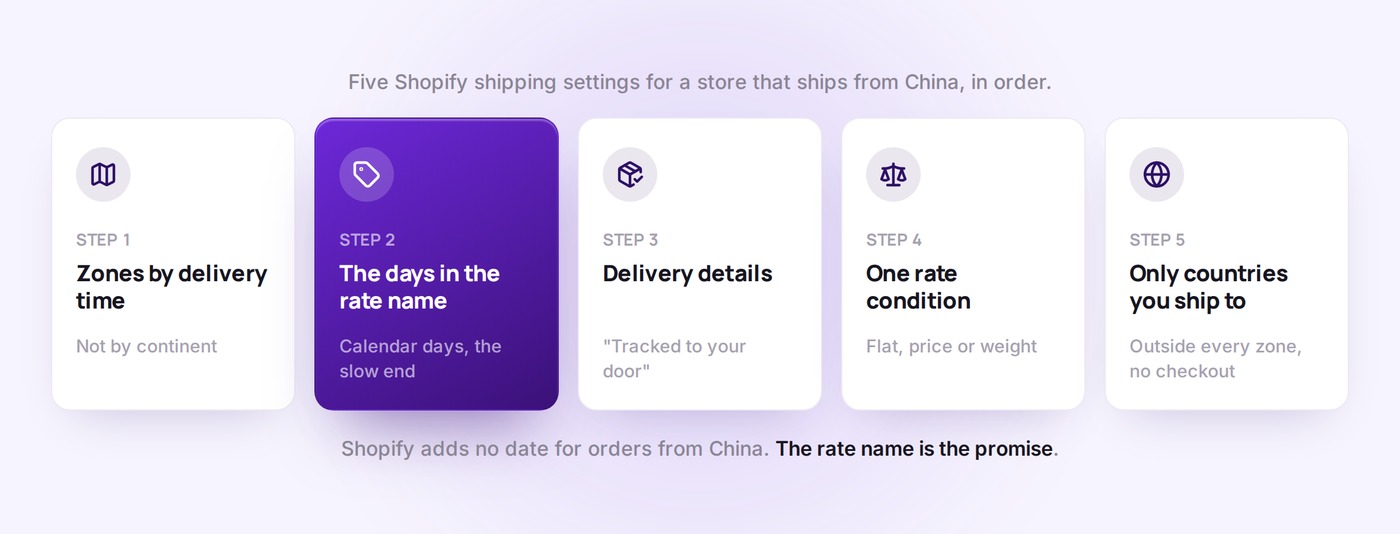
All of this sits under Settings, then Shipping and delivery, then your shipping profile.
- Zones grouped by delivery time. Build them from your slow end per country, as above.
- The days in the rate name. Calendar days, counted from the order, built on the time 9 in 10 orders arrive within. For example "Tracked shipping (12 to 23 days)".
- Delivery details. One short line such as "Tracked to your door, tracking number by email". It shows under the rate at checkout.
- One condition per rate. Flat, price-based or weight-based, as above.
- Only countries you can ship to. A customer whose address is outside every zone sees that no shipping rate is available and cannot check out. That is better than taking an order your line cannot deliver, so leave out countries your line does not serve.
Then repeat the same numbers in your shipping policy page and in the order confirmation email, so the customer sees one promise everywhere.
How to check your own numbers
You need two to three months of orders that are at least six weeks old, so the slow ones have landed.
- Export orders with the country, the order date and the delivered date.
- Work out calendar days from order to delivered for each one.
- Per country, find the median and the time 9 in 10 arrived within.
- Count the share that arrived inside the promise in your current rate name.
- Rebuild the zones and rate names from step 3. Check again each quarter, and separately for December, when every figure stretches.
What to do
- Put the days in the rate name. Shopify will not add a date for an order shipped from China.
- Count calendar days from the order, not business days from the carrier's scan.
- Promise the slow end, the time 9 in 10 orders arrive within, not the median.
- Group zones by delivery time. Canada and the US might not belong in the same zone.
- Keep one promise everywhere: checkout, shipping policy, confirmation email.
- Re-measure every quarter on orders old enough to have landed.
How we handle this at Commercive
Commercive is your all in one sourcing and fulfilment partner. We ship from China on frontier lines like YunExpress, Yanwen and 4PX, and the line is chosen per product and per destination.
Every order in our dashboard shows its order date, first carrier scan and delivered scan, so the per-country check above runs on your own orders without an export. Our measured delivery times by line and country are public on our shipping status page, and they are a fair starting point for your rate names before you have your own history. For the full breakdown of where the days go, see how long shipping from China takes.
If you're currently running a brand, just give us the product and your daily order volume. We'll get you a quote within the next 24 hours to hold up against what you're paying today.
How we measured this. Every parcel we shipped on orders placed between 1 June and 31 July 2026 that got a first carrier scan, across all our lines, measured on 5 October 2026 so every order had at least 66 days to arrive. Days are calendar days from the customer's order to the first delivered scan, on parcels that got one. The EU figure pools 15 member states; New Zealand and the EU carry smaller samples and wider error. For the UK, the figures cover the 8 in 10 parcels whose delivered scan reached our tracking. Shopify settings are from Shopify's help center as of 5 October 2026 and can change.
Why does Shopify not show a delivery date for my China-shipped orders?
Shopify calculates delivery dates only for fulfillment locations in the US, Canada, the UK, France, Germany, Italy, Spain and Australia, and not for third-party dropshipping apps. For orders that ship from China, the rate name and the delivery details are the only delivery information the customer sees at checkout.
What shipping time should I put in my Shopify rate name for orders from China?
Use calendar days counted from the order, built on the time 9 in 10 orders arrive within. On orders placed in June and July 2026, that was about 23 days for the US and Australia and 17 to 19 days for the UK, Canada, New Zealand and the EU. Replace these with your own figures once you have them.
Should Canada and the US be in the same Shopify shipping zone?
Not necessarily. On parcels from China, 9 in 10 Canadian orders arrived within 17.4 days of the order, against 22.7 days for the US. Putting both in one zone means one promise that is too long for Canada or too short for the US.
Is "7 to 14 days" a realistic shipping time from China to the US?
For the median order, roughly. In June and July 2026, 57% of US orders arrived within 14 days of the order, so about 4 in 10 arrived after a "7 to 14 days" promise.
Can I offer free shipping over a set order value on Shopify?
Yes. Add a free rate with an order price condition and a minimum amount, next to a paid rate for smaller orders. A single rate takes one condition, price or weight, not both.
.png)
Fill in the application form, and our team will reach out to you to help you with making the above happen.
• Sell 1 day post-production
• Scale worldwide with 3-10 days
• Slice your lead times
• Prevent inventory risk and overstocking
• Hide china due custom software and carrier agreements
• Work with a multilingual team in mainland China
• Decades of supply-chain experience.

.png)