
Table of Contents
Shipping time estimates from China: why quoted delivery times run short, and how to read one
Measured on the same parcels, the median read 8.3 days at day 10 and 11.3 days once every parcel had landed.

Your supplier said 7 to 12 days. Your customers are emailing on day 14. Usually nobody lied: the quote and your customer are measuring different things.
A shipping time estimate from China runs short for three reasons you can check: the clock starts when the carrier gets the parcel, the range is often in business days, and the number was worked out before the slow parcels arrived. Measured on the same parcels, the median read 8.3 days ten days in and 11.3 days once they had all landed.
This guide covers:
- The three reasons a quoted delivery time reads shorter than what customers get
- What happens to a median when you measure it too early, shown on real parcels
- Where a typical "7 to 12 days" quote lands against measured delivery times
- How to turn a supplier or carrier quote into a date you can show customers
- How to check any estimate yourself in about ten minutes
Reason 1: the clock starts at handover, not at the order
A carrier's transit time runs from the moment it has the parcel, usually its first scan, to the delivered scan. Your customer's clock starts when they press buy.
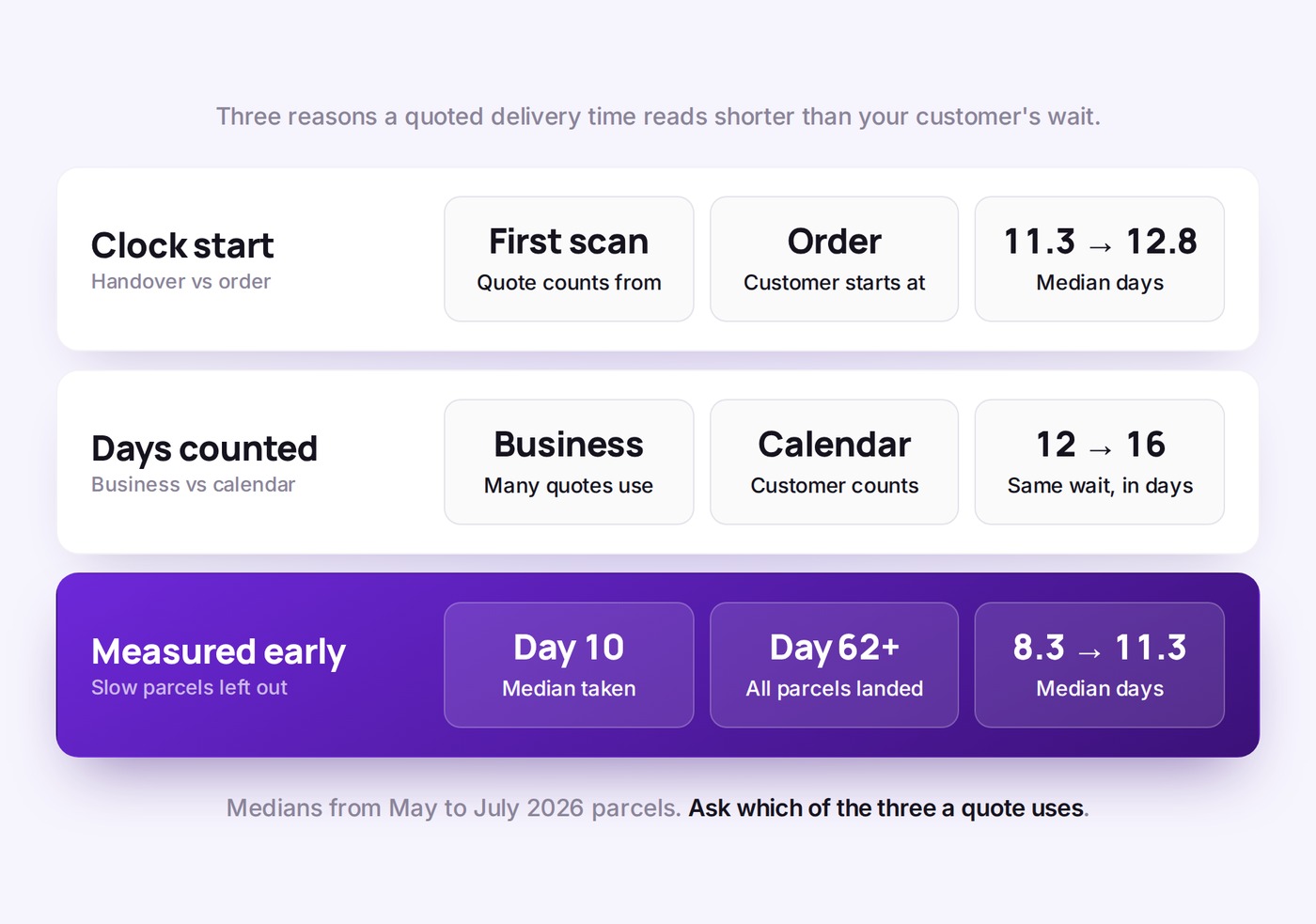
Between those two points sits everything before the carrier: the supplier picking and packing, the label printing, the van to the carrier's facility. On parcels shipped from China between May and July 2026, the median from first carrier scan to delivered was 11.3 days. Measured from the customer's order on the same parcels, it was 12.8 days.
That gap moves with the supplier, not the carrier. A supplier that ships the same day keeps it small. One that batches orders for a weekly pickup can add most of a week before any transit quote applies. There is a full measurement of that stage in how long order processing actually takes.
Reason 2: business days are not calendar days
Many carrier pages and third-party guides quote China to US parcel lines in business days: 5 to 8, 6 to 12, 8 to 15. Your customer counts calendar days, weekends included.
- 8 business days is 10 to 12 calendar days, depending on the day it ships
- 12 business days is about 16 calendar days
- 15 business days is 19 to 21 calendar days
So a "6 to 12 business days" line and a "7 to 12 days" line on your product page are not the same promise. The second one is about four days shorter at the slow end, and nothing about the parcel changed. Every figure in this guide is in calendar days.
Reason 3: the estimate was measured before the slow parcels landed
This is the one almost nobody explains, and it is the biggest.
To work out a delivery time, someone takes a batch of parcels and looks at the ones that have arrived. If they look early, the only parcels that have arrived are the fast ones. The slow ones are still in the air and are not in the number at all. Statisticians call this censoring. In plain words: an early median is the median of the fast parcels.
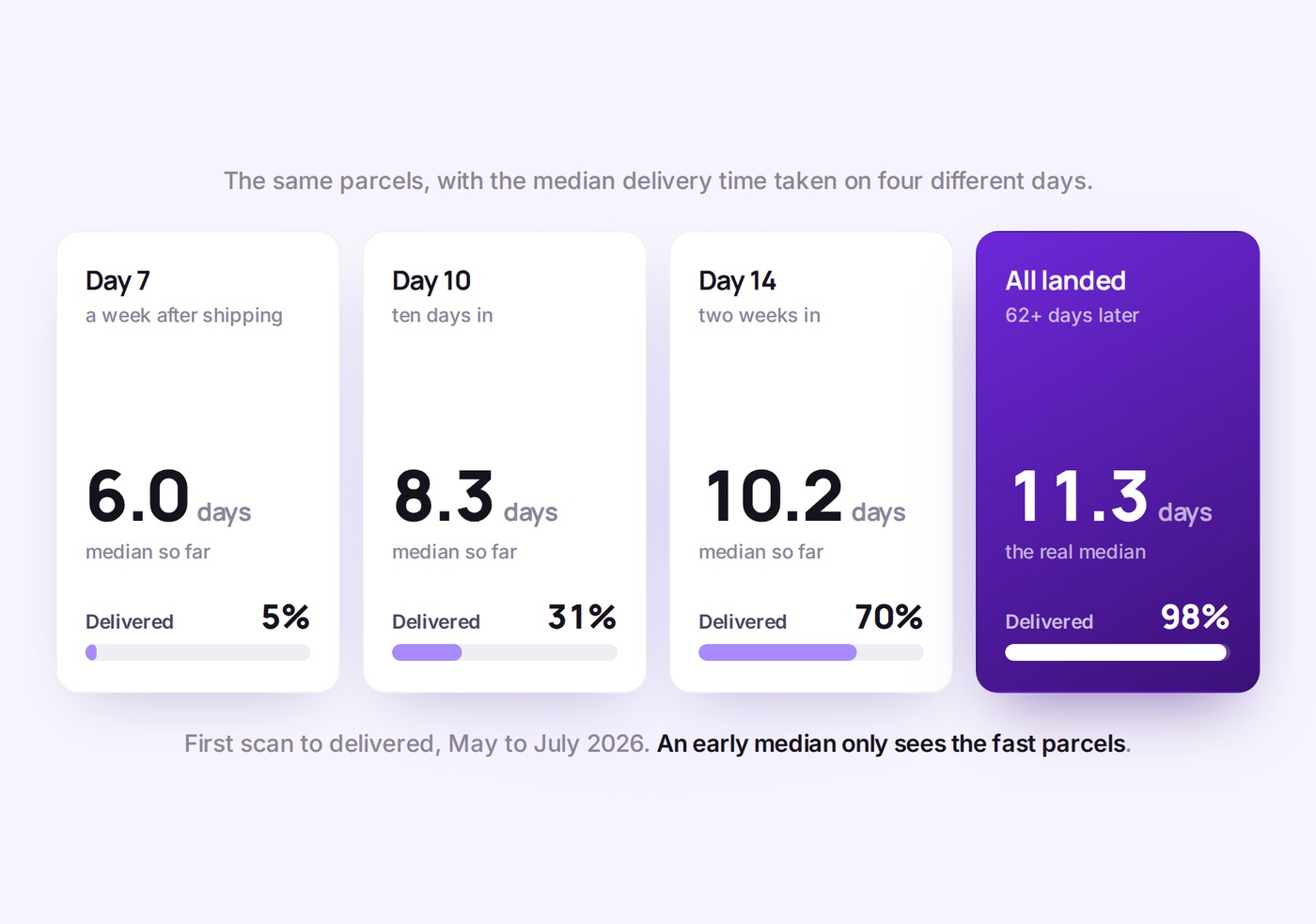
Here is what it does on one cohort, every parcel with a first carrier scan from 3 May to 31 July 2026, all lines and destinations:
- Day 7: 5% delivered, median of those 6.0 days
- Day 10: 31% delivered, median 8.3 days
- Day 14: 70% delivered, median 10.2 days
- Day 21: 92% delivered, median 11.1 days
- Final, 62+ days later: 98% got a delivered scan, median 11.3 days
Same parcels, same lines, same customers. The number climbed by about 3 days between day 10 and the end, purely because the slow parcels were finally allowed to count.
Any delivery time worked out from a live batch has this problem: a supplier's "recent orders" figure, a dashboard showing "average delivery time, last 14 days", a test order or two. Recent and fast look the same until the batch is old enough.
Where a "7 to 12 days" quote actually lands
A median on its own also hides the slow end, which is the part that creates tickets. Here is the full spread for the same cohort, first carrier scan to delivered, in calendar days.
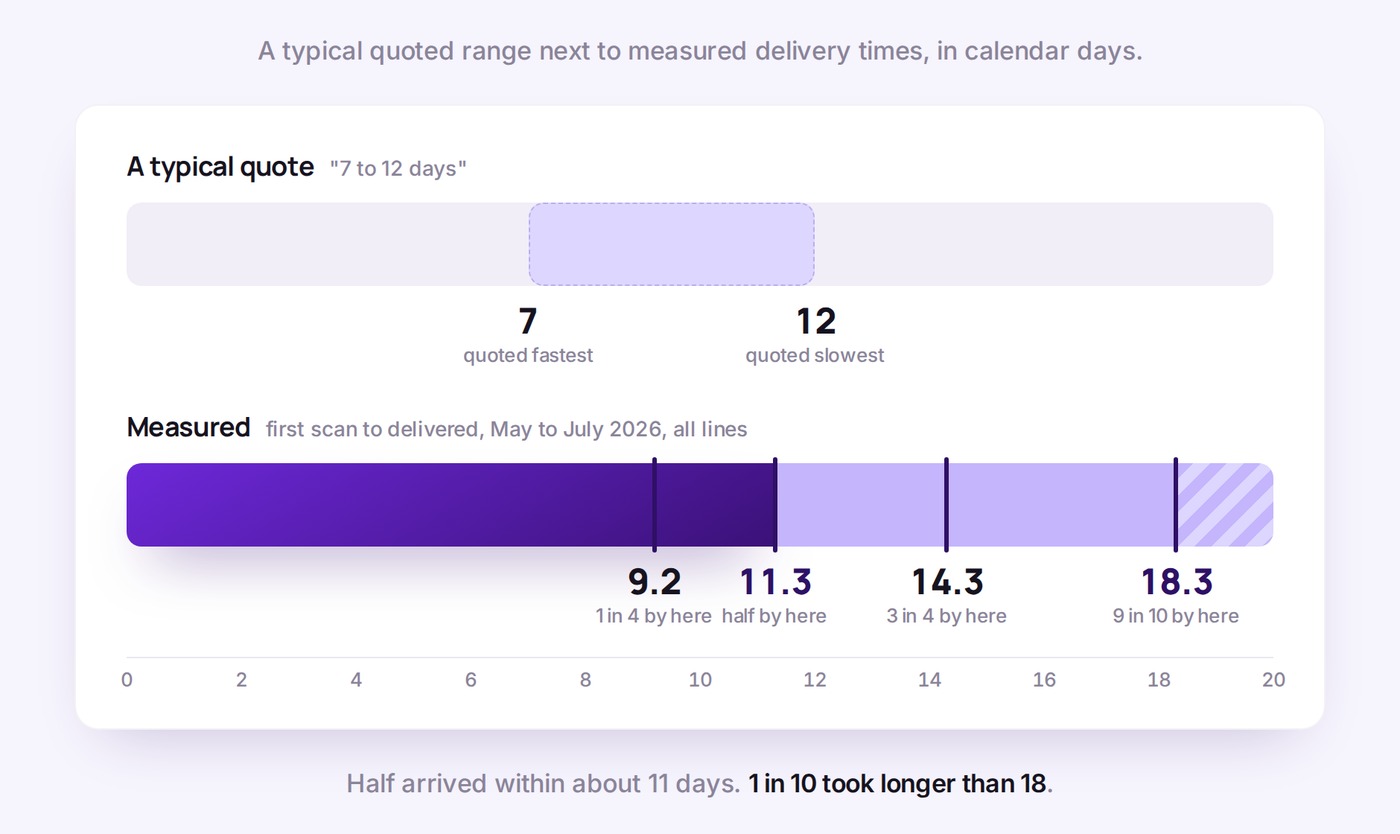
- 1 in 10 arrived within 7.9 days
- 1 in 4 within 9.2 days
- Half within 11.3 days
- 3 in 4 within 14.3 days
- 9 in 10 within 18.3 days, and 1 in 20 took longer than 21.6
Read against a "7 to 12 days" quote: about half of parcels arrived inside that window. Read as 12 business days, about 16 calendar days, about 8 in 10 did. The quote was not wrong. It just described the middle of the pack, and a product page promise needs to describe the back of it.
The US looked almost identical to the whole book (median 11.3 days, 9 in 10 within 18.3). Other destinations together ran about half a day slower at the median.
The nuance: a longer estimate is not a slower line
None of this means a line that quotes 7 to 12 days is worse than one that quotes 10 to 18. It might be the same line, measured later, or in calendar days, or from the order instead of the handover. Two estimates are only comparable when you know three things about each: where the clock starts, whether weekends count, and how old the parcels were when it was measured.
One fact against the obvious reading: the honest version of a number is usually the bigger one. A provider that publishes the slow end is not slower than one that does not. It is showing you more of the same picture.
How to check any estimate yourself
You need a spreadsheet and one export of your own orders.
- Take every order that shipped in one month, at least six weeks ago, so the slow parcels have had time to land.
- For each, record the order date, the first carrier scan date and the delivered date. Leave delivered blank if there is none.
- Work out days from first scan to delivered and from order to delivered, in calendar days.
- Sort and read off the median and the 90th percentile of each. Count the blanks as a share of the month.
- Do it again on last week's orders and watch the median come out lower. That is reason 3 on your own data.
If your supplier or agent cannot give you those dates per order, that is worth knowing too. It is one of the signs covered in when to switch dropshipping agents.
What to do with a quote
- Ask where the clock starts. First carrier scan, label created, or customer order. Write it next to the number.
- Ask business or calendar days. Convert to calendar days before it goes anywhere near a product page.
- Ask for the slow end. "What do 9 in 10 parcels arrive within?" is a better question than "how long does it take".
- Add your own pre-scan time. Your supplier's real time from order to first scan, on top of the transit figure.
- Promise the slow end, not the median. A product page date built on the 90th percentile might cut tickets more than a faster headline wins sales. Test it on your own store.
- Re-measure on old batches only. Six weeks after shipping, not last week.
How we handle this at Commercive
Commercive is your all in one sourcing and fulfilment partner. We ship from China on frontier lines like YunExpress, Yanwen and 4PX, which scan the parcel at every handover, so each of the three clocks above can be measured parcel by parcel.
The delivery times we publish on our shipping status page are measured in calendar days, from first carrier scan to delivered, on parcels old enough to have landed, with the median and the slow end shown side by side. Every order you ship with us shows its own order date, first scan and delivered scan in our dashboard, so you can run the check above without asking anyone for an export. If you want the bigger picture on transit, start with how long shipping from China takes.
If you're currently running a brand, just give us the product and your daily order volume. We'll get you a quote within the next 24 hours to hold up against what you're paying today.
How we measured this. Every parcel we shipped with a first carrier scan between 3 May and 31 July 2026, across all our lines and destinations, measured on 1 October 2026 so each parcel had at least 62 days to arrive. Delivery time is calendar days from the first carrier scan to the first delivered scan. "Delivered by day N" is a share of all parcels in the cohort; the median at day N is the median of the parcels delivered by then. "Got a delivered scan" is a floor on how many arrived, because some last-mile carriers never pass the delivered scan back. Medians do not add up across stages, and the order-to-door figure is its own median, not the transit median plus a processing time.
Why does my supplier's shipping time not match what customers get?
Usually three reasons stack: the quote starts at the carrier's first scan rather than the customer's order, it is often in business days, and it was worked out from parcels that had already arrived, which leaves out the slow ones. On parcels measured from May to July 2026, the median was 11.3 days from first scan and 12.8 days from the order.
Is 7 to 12 days a realistic delivery time from China?
For about half of parcels on tracked lines, yes. In the measured cohort, about half arrived within that window, and about 8 in 10 arrived within 16 calendar days. A product page promise that has to hold for most customers might need the slower figure.
What delivery time should I show on my product page?
Use calendar days, count from the customer's order, and build it on the time 9 in 10 parcels arrive within rather than the median. Add your supplier's real order-to-first-scan time on top of any transit figure.
How many calendar days is 12 business days?
It depends on the start day, but 12 business days is about 16 calendar days, and 8 business days is 10 to 12 calendar days. Convert any business-day quote before you show it to customers.
Why did my shipping times look faster last month than this month?
Possibly because last month's batch was measured early. A median taken on recent orders only includes the parcels that have already arrived, which are the fast ones. Re-measure a batch that shipped at least six weeks ago and compare like with like.
.png)
Fill in the application form, and our team will reach out to you to help you with making the above happen.
• Sell 1 day post-production
• Scale worldwide with 3-10 days
• Slice your lead times
• Prevent inventory risk and overstocking
• Hide china due custom software and carrier agreements
• Work with a multilingual team in mainland China
• Decades of supply-chain experience.

.png)