
Table of Contents
How Long Shipping From China Actually Takes
We measured 155,768 delivered parcels. Over half the wait happens before the parcel leaves China, and the flight is the fastest part.


Ask how long shipping from China takes and you get an answer about freight: 30 to 40 days by sea, 8 to 10 by air. If you sell to customers one parcel at a time, none of that is your question. Those numbers describe containers moving through ports.
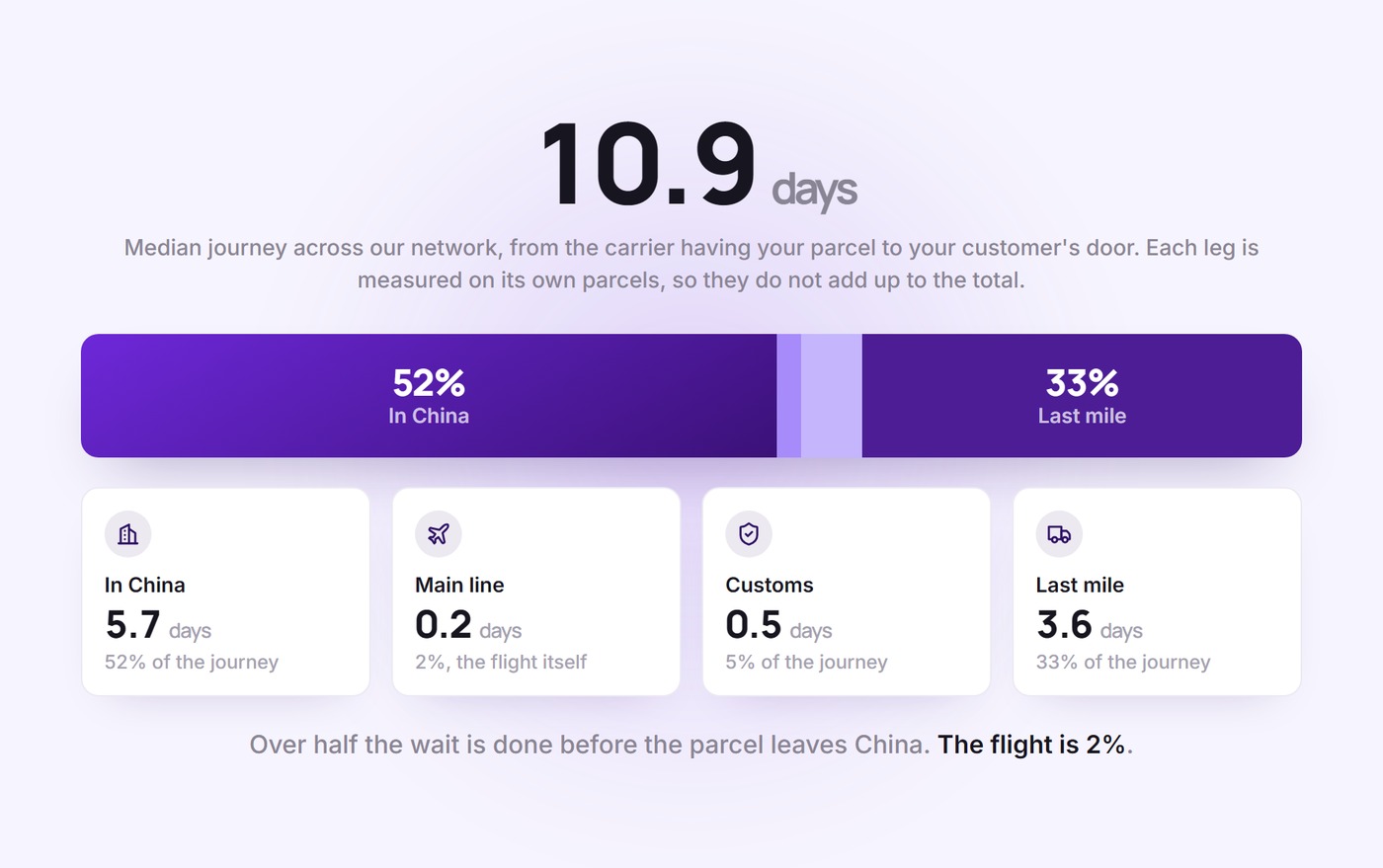
We measured ours instead. 155,768 parcels delivered over the last 180 days, split into the legs of the journey. The median took 10.9 days from the carrier having it to the customer holding it.
Almost none of that was the flight.
This guide covers:
- Where the 10.9 days actually goes, leg by leg
- Why the international leg is the fastest part of the journey
- What customs really costs you, on a normal parcel and on a bad one
- Why parcels sit in China, and the two very different reasons lines are slow
- The days before the carrier even sees the parcel, and how to delete them without buying in bulk
Where the time actually goes
Every number below is the median parcel.
- 5.7 days in China, from the carrier having the parcel to it leaving the country
- 0.2 days on the main line, China to landing in the destination country
- 0.5 days in customs, from landing to being released
- 3.6 days on the last mile, from release to the customer's door
- 10.9 days in total
Read that again. The flight is 0.2 days. Customs is half a day. The two things every brand worries about, and the only two things most guides discuss, come to less than a day out of nearly eleven.
Over half the journey happens in China, before the parcel has gone anywhere.
Each leg is measured on every parcel that reached both ends of it, so they do not add up to exactly 10.9. Treat them as roughly half, roughly a third, and two slivers.
The flight is not your problem
A parcel leaving China lands in the United States in 0.2 days on our main carrier. Hours.
That is the leg with an aeroplane in it, and it is the fastest part of the journey by a wide margin. It is also the only part anyone advertises, because it is the only part that sounds impressive.
This is why freight guides mislead brands so badly. Sea freight really does take 30 to 40 days and air cargo really does take 8 to 10, but those numbers describe pallets and containers being grouped together, queued at ports, and broken back down at the other end. Your parcel crosses the ocean overnight in a bag with a few hundred others.
If you are choosing a supplier on how fast they cross the Pacific, you are picking at a leg that is already nearly instant.
Customs is not your problem either, until it is
Days spent in customs:
- The middle parcel: 0.5 days
- The slowest 1 in 10: 1.9 days
- The slowest 1 in 100: 5.1 days
Half a day, on a normal parcel. Customs is not where your delivery time goes.
But look at the tail. One parcel in a hundred sits for five days or more, and those are exactly the ones that produce the support ticket, the "where is my order" email and sometimes the chargeback.
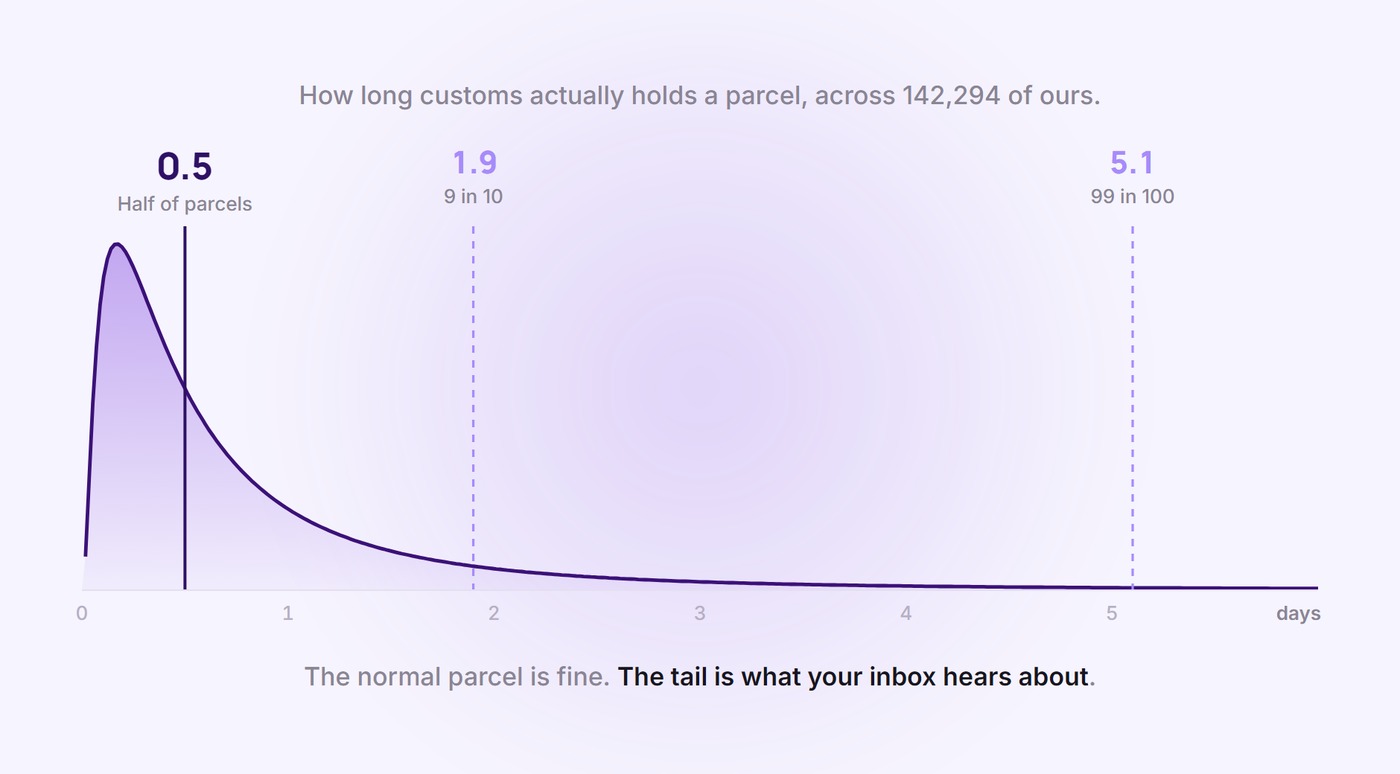
So customs is not a speed problem, it is a consistency problem, and the two need different fixes. Nothing makes the middle parcel faster. What a better line buys you is fewer parcels in that tail.
Over half the wait happens in China
5.7 days. That is the gap between a carrier having your parcel on its books and that parcel leaving the country.
It is the biggest block of time in the journey, it is invisible on most tracking pages, and almost nobody measures it. So we split it up.
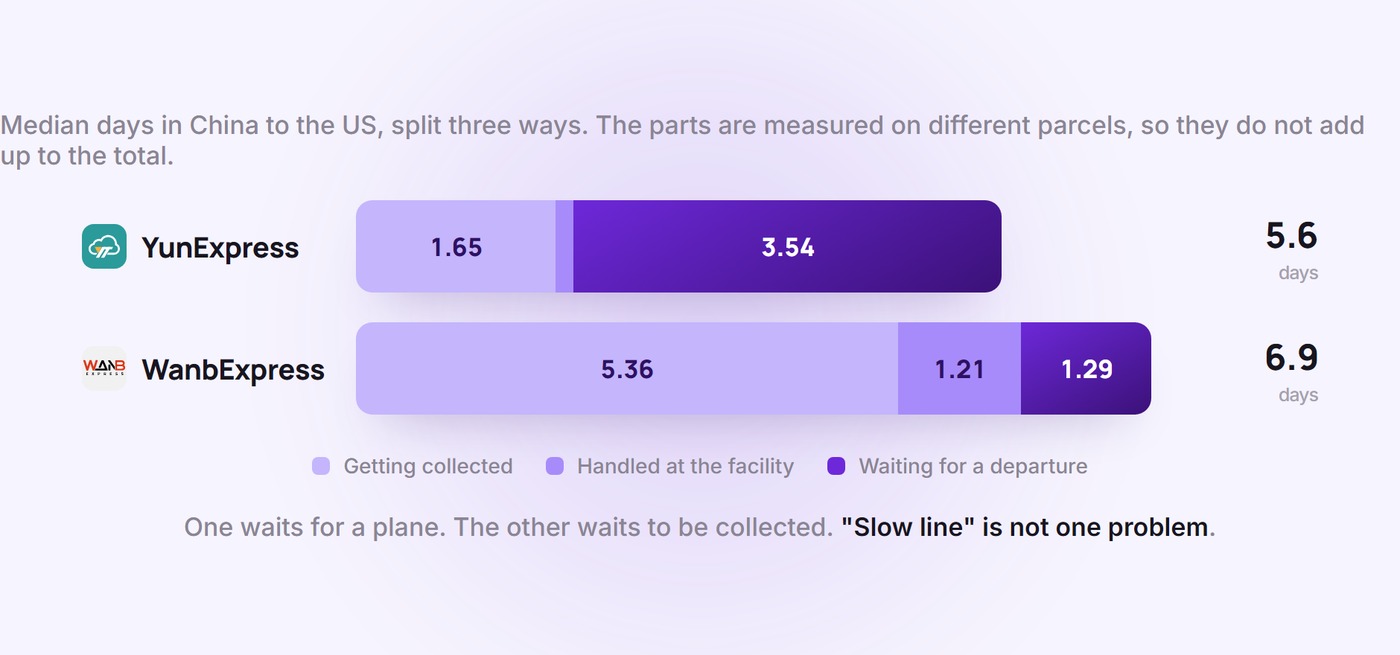
Two lines, similar total, completely different problems.
YunExpress collects quickly and then waits for a plane. Once the parcel is in the building it moves in about four hours. Then it sits for three and a half days waiting for a departure with room on it.
WanbExpress is the other way round. It takes more than five days just to get the parcel into the network, then gets it onto a line quickly.
This matters because "that line is slow" is not one problem, and the two versions do not have the same fix.
Why a parcel waits for a plane
Because the plane is not there every day.
YunExpress publishes its route frequencies. The Shenzhen to Paris lane runs six flights a week. The Xiamen to Miami lane runs three.
Three departures a week means a parcel arriving just after a cut-off waits two or three days for the next one, having done nothing wrong. That is not a slow carrier. That is a thin schedule, and it is the single largest chunk of the largest leg of the journey.
When you compare lines, how often they fly your lane is worth more than almost anything else you could ask about.
The days before the carrier even sees the parcel
Everything above starts when the carrier records your parcel. Your customer's clock started earlier.
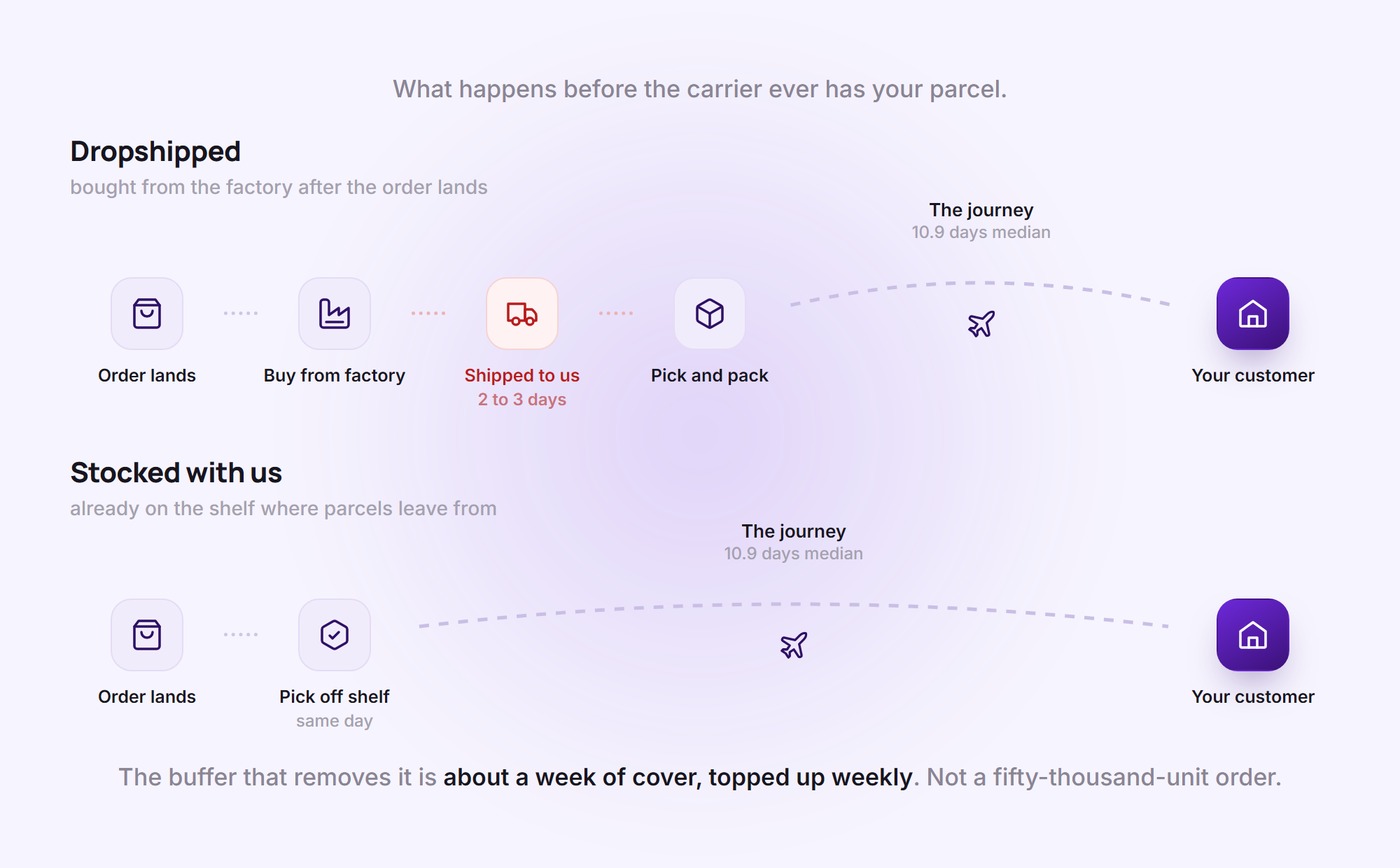
If you are dropshipping, the order lands, we buy the item from the factory, the factory ships it to us, we pick and pack it, and only then does the carrier have it. Most guides put that gap at three to five days for buying it in and moving it, with another 24 to 72 hours of warehouse processing on top. It is why most of them quote two to four weeks end to end.
If we already hold your stock, the order lands, we pick it off our own shelf, and the carrier has it the same day.
That is two to three days deleted from every single order, before any of the eleven days above even begins. Nothing about the carrier, the flight or customs changed. You simply stopped waiting for a factory on every order.
You do not need to buy in bulk to get that
This is where most brands stall, because the standard advice is to hold about thirty days of cover, and thirty days of cover on a real catalogue is a lot of money sitting still.
That advice is not wrong, it is just written for somebody else. Thirty days assumes you are restocking by sea from the other side of the world, on a six to nine week cycle. If your stock sits a few hours from the factory that made it, restocking is not six weeks. It is about three days.
So you do not need a fifty thousand unit minimum order. You need a few days of cover, topped up regularly.
Hold roughly a week of stock where the parcels actually leave from. Top it up weekly. Every order that lands ships within twenty four hours instead of waiting on a factory, and the money you have committed is one week of goods rather than one quarter of them.
Stock is cheap next to shipping. A week of it is a small repeating commitment, not a bet.
The last mile is your second biggest bill
3.6 days, from customs releasing the parcel to somebody handing it over.
That is a third of the total, and it happens entirely inside your customer's country, handled by a local carrier that neither you nor your supplier chose.
It also swings more by destination than any other leg. In our book it runs from 2.0 days into the Netherlands to 4.7 into France. Same parcels, same origin, everything upstream identical. The difference is whoever does the final delivery.
Worth knowing, because this is the leg your customer experiences as your brand and the one you have least control over.
What you can actually change
- Stop picking at the flight. It is 0.2 days. Anyone selling you on ocean crossing speed is selling you the wrong leg.
- Ask how often they fly your lane. Not transit time, departures per week. Three a week instead of six is days of your customer's wait, and it is a question with a factual answer.
- Ask what happens between the label and the departure. That is 5.7 days. If your supplier cannot tell you how long a parcel sits before it leaves, they are not measuring the biggest block in the journey.
- Hold a few days of stock where the parcels leave from. It removes two to three days from every order and it does not require a bulk buy. A week of cover, topped up weekly.
- Treat customs as a consistency problem. Do not pay for faster clearance. Pay for fewer parcels in the slowest one percent.
- Ask how many parcels a quoted number is measured on, and how many of those actually arrived. A median taken over only the parcels that have landed is a median of the fast half.
How we handle this at Commercive
We measure every leg because we route on it. Where a carrier gives us an API we read every scan, and that is what produced every number above.
We can publish a leg breakdown at all because we run several lines and can compare them. An operation on one contract has one number and no way to know whether it is any good.
We also hold stock for brands that want the dropship days gone, which is the same conversation as above: how much cover, how often we top it up, and what that does to your delivery promise.
Our shipping status page is the live version of this: per country, per line, updated automatically, including the lanes where we do not have enough finished parcels yet to give a number. You can look up individual parcels on it too, including the ones that went wrong.
If you want to know where your own days are going, get in touch. That conversation starts with which lines you are on and where you ship, not a rate card.
Measured on 155,768 parcels delivered in the 180 days to 30 July 2026, from our own carrier tracking. Each leg is the median gap between two scan types on the same parcel. Legs are measured independently across every parcel that reached both ends, so they do not sum exactly to the total. Carriers that do not report customs or last mile scans are left blank rather than shown as zero. The clock starts when the carrier records the parcel, not when the order was placed. Route frequencies are YunExpress's own published figures.
.png)
Fill in the application form, and our team will reach out to you to help you with making the above happen.
• Sell 1 day post-production
• Scale worldwide with 3-10 days
• Slice your lead times
• Prevent inventory risk and overstocking
• Hide china due custom software and carrier agreements
• Work with a multilingual team in mainland China
• Decades of supply-chain experience.

.png)