
Table of Contents
China Shipping Lines Compared: How to Choose the Right Carrier for Your Product
Three tiers of shipping line come out of China. The difference isn't speed. It's what happens when a parcel goes missing.

Most brands pick a shipping line the way they pick a courier at home: by price and quoted speed.
Out of China, those are the two least useful signals. The lines differ far more in what happens when something goes wrong than in how fast they move when everything goes right.
This guide covers:
- The three tiers of shipping line out of China, and what separates them
- What you get back when a parcel goes missing
- Which tier fits your business today
- How much speed changes between tiers, and inside them
- How to tell whether a quoted transit time means anything
The three tiers, and what separates them
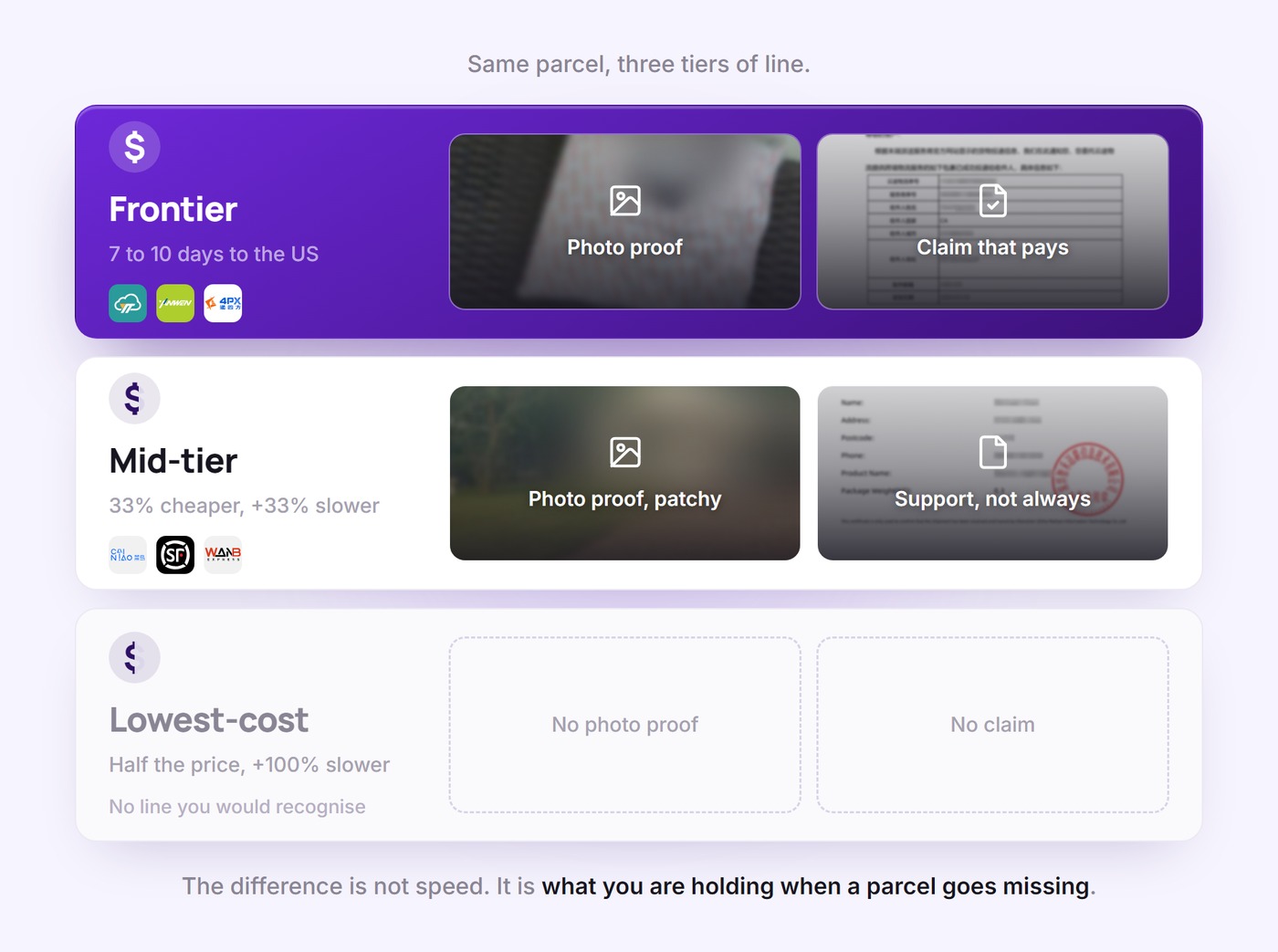
If you use AI models, you already understand the shape of this. A frontier tier that costs the most and can be trusted with work that matters. A middle tier that is cheaper and handles most things well. A lowest-cost tier that is perfectly good until the job has real consequences.
Nobody thinks the cheap model is bad. They think it is wrong for some jobs.
Shipping lines out of China work the same way, and people make the same mistake: putting something that matters on the cheapest option because the per-parcel price looked good.
Frontier lines. YunExpress, Yanwen, 4PX.
- Fastest and most accountable, and the most expensive per parcel
- A real claims process when a parcel is lost or damaged, and it usually pays
- Proof of delivery comes back
- Customs is predictable enough to plan around
Mid-tier lines. Cainiao, SF Express, Wanbang and similar.
- Cheaper, and slower by about a third
- After-sales support on most of them, but not all, and which ones changes
- Proof of delivery is patchy rather than missing
- A price decision rather than a quality one
Lowest-cost lines. The cheapest parcels you can buy out of China.
- Little or no claim when a parcel goes missing
- Usually no proof of delivery at all
- A lot more time sitting in customs
- Grouped in with other sellers' parcels, so one bad clearance holds up a batch of your orders at once
None of these tiers is wrong. They are three different trades, and the only real mistake is being on one without knowing it.
What you get back when it goes wrong
Ask what a line costs and you get a rate. Ask what it covers and you find out what you actually bought.
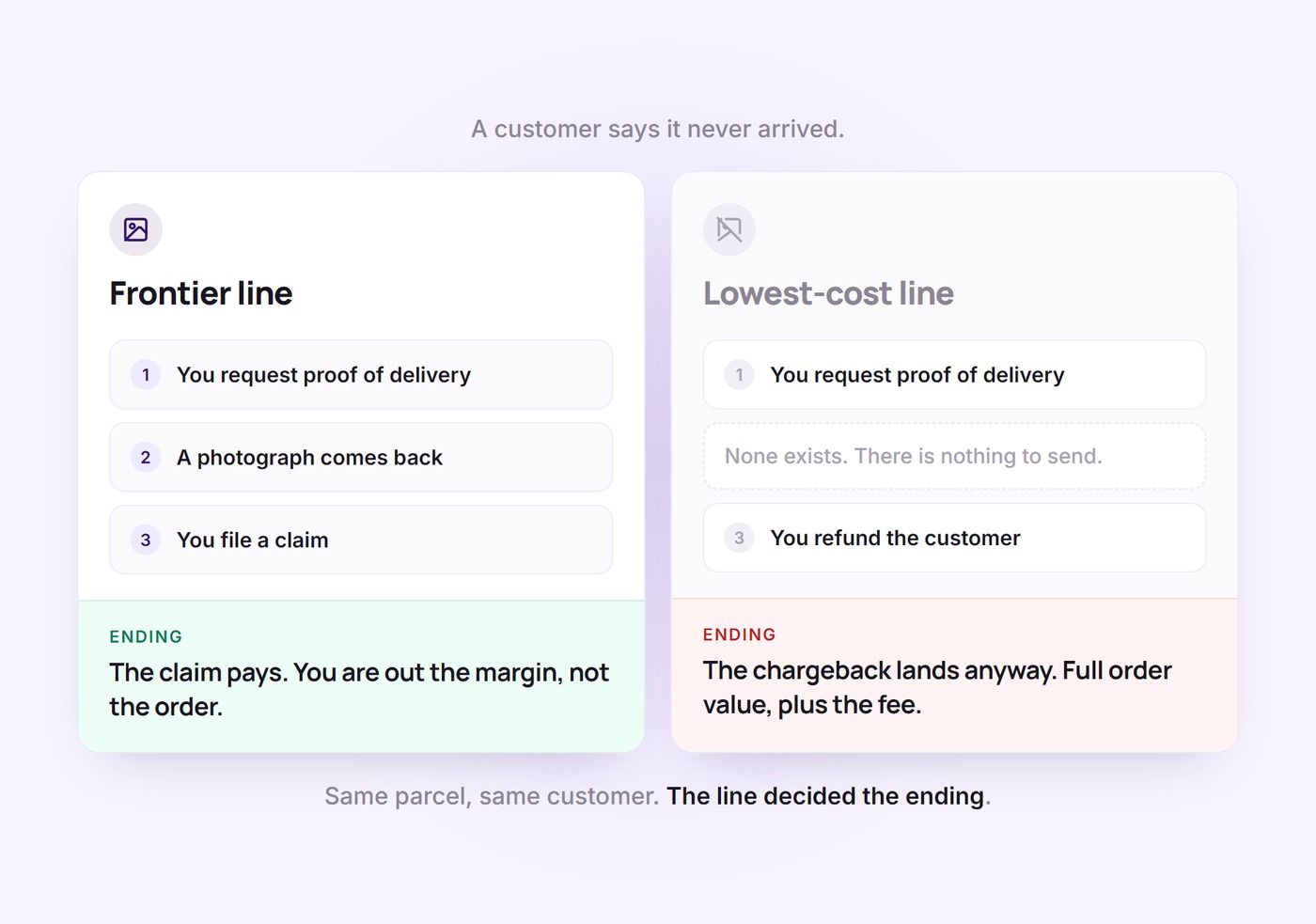
Here is the test. A customer says their parcel never arrived. What happens next?
We measure this rather than assume it. We pull real deliveries through each carrier's own API and check what comes back:
- Frontier lane to the US. Proof on effectively every delivery we sampled, about two-thirds of them with an actual photo
- Mid-tier lane to the US. Proof on about two-thirds of deliveries
- Lowest-cost lines. None at all, because there is no proof-of-delivery service to ask
That last one is not a carrier having a bad month. There is nothing to call.
One more number worth knowing. We check how many deliveries are backed up by a second, independent carrier scan instead of just one source. On our frontier US lane that is above 90%. On our mid-tier US lane it is under 40%.
Both carriers say the parcel was delivered. Fewer than four in ten of the second one's have anything backing that up.
Which tier you should be on
Our recommendation, for almost everyone, is frontier lines.
We mean it. Frontier lines are what we put brands on by default, because they are the tier that does not cause problems. Proof comes back. Claims pay. Customs is predictable enough to plan around. You pay more per parcel, and what you get for it is never having to deal with any of this.
It matters most if you are building a brand. A brand is a promise about what happens when something goes wrong, and a customer who got a photo, a claim and a replacement tells a very different story about you than one who got an apology. If people search for your name, if your email list is worth something, if you expect a second order, this is not where you save money.
Testing a product, or running a dropshipping store? Mid-tier might be enough.
This is a price decision rather than a quality one, and it is worth being straight about that. You are finding out whether a product sells, not protecting a name, and a few extra days on something you might not be selling next month could cost you very little. Some brands just want the cheaper number, and that is a fair call to make as long as you know what you are giving up.
These lines can be genuinely good. In our own book, the mid-tier lane into the United Kingdom is one of the fastest we run anywhere, ahead of several frontier lanes. But can be is the important part. The good weeks are nearly as good. The bad weeks are much worse, and you do not get to pick which one you get.
Only care about price? The lowest-cost tier exists.
It just has to be a decision rather than a default. You are giving up proof, claims and predictable customs, and the time to work out what that costs is before the first dispute, not after.
The mistake is not choosing a cheaper tier while you were testing. It is still being on it two years later, with a real brand and a full support inbox.
The same carrier can be fast and slow
This is where most of these comparisons go wrong, including ours if we are not careful.
Measured across our own book of 179,264 parcels over 180 days, to 65 countries:
- Frontier lines to the US. Mostly 7 to 10 days
- Mid-tier lines. About a third longer
- Lowest-cost lines. Roughly double the frontier tier, with a long tail. On one of them, more than four parcels in ten land well outside the normal window
Every range on this page comes from our own measured numbers. None of it is a carrier's estimate, which is the difference between this and most of what gets published about China transit times.

But the tier is not the whole story, because a carrier is not one service.
YunExpress alone runs several different lines. To the United States we measure them from about 7 days on a general-goods line up to the low teens on the specialist ones, with almost every parcel riding one line in the middle of that range.
Which line you are on is not a preference. Every line is certified for certain kinds of goods:
- General goods
- Battery
- Cosmetics
- Clothing
- Sensitive items
A product with a lithium battery in it cannot go on a general-goods line at any price, on any carrier. So two brands shipping the same volume to the same countries can see very different times, and both be on the right line.

It works the other way too. If you sell general goods but everything in your supplier's warehouse ships on one battery-certified line, you are paying for a certification you do not need and adding days for nothing. In our own book that gap is about three days to the US.
Your parcels are travelling with strangers
Budget lines work by grouping parcels together. Yours clear customs alongside a lot of other sellers' parcels, from sellers whose paperwork and declared values you know nothing about.
Most of the time you never notice, and it is exactly why the line is cheap.
When you do notice, it goes wrong for a lot of orders at once. One bad clearance does not hold up a single parcel. It holds up however many of yours were in that batch, and you watch twenty stop moving on the same day for reasons that have nothing to do with you.
That risk never shows up when you compare rates, because it does not cost anything per parcel. It costs you in the one week a quarter when it all goes at once.
How to read a transit time anyone quotes you
One follow-up question settles whether a quoted number means anything.
Out of how many parcels, and how many of them have actually arrived?
Here is a real batch from our own tracking: several thousand parcels to the United States on one line, and fewer than one in ten had a delivered scan when we looked. The median of that tenth was about twelve and a half days.
That number is publishable. It is roughly what any site quoting a transit time for that line is working out.
It is also wrong, and not because anyone is lying. A parcel that shipped ten days ago and will take twenty-five has not arrived yet, so it is not in the count, so it cannot drag the number up.
A median taken over only the parcels that have landed is a median of the fast half.
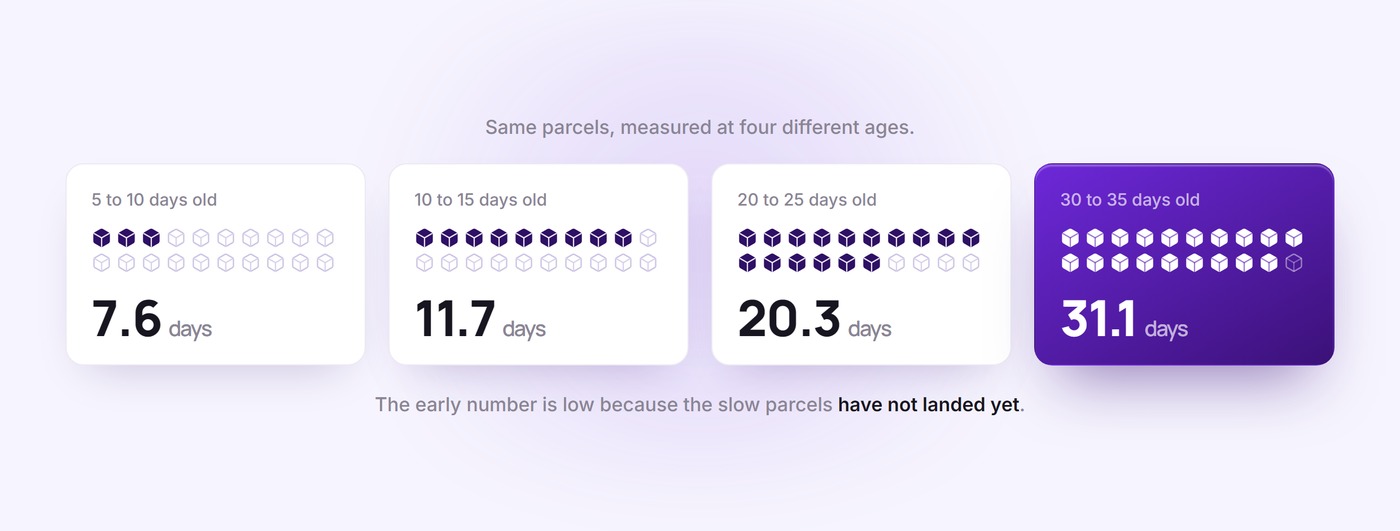
Same parcels. Four answers. Each one looked right on the day, and all of them are wrong.
The fix is not clever, it is just honest. Count every parcel in the batch, and put the ones that have not arrived at the back of the queue.
- If more than half have arrived, the middle number is exact, and nothing still in the air can change it
- If they have not, the answer is still out there somewhere, and the honest thing to say is that we do not know yet
That is why we publish a number for some lanes and refuse to for others, on our own carriers as much as anyone else's.
What to do with this
- Find out which tier your line sits in. Ask your supplier one question: if a parcel goes missing on this line, is there a claim, and does it pay? A supplier who cannot answer that quickly has not thought about what happens to you when it goes wrong.
- Ask whether proof of delivery exists on your line. Not whether they will chase it, but whether the carrier sends one back at all, and whether it includes a photo. If the answer is no, that is money you will lose to chargebacks and nobody has counted it.
- Check that your line matches what you sell. If you sell general goods and everything ships on a battery-certified line, you are adding days for a certification you do not need.
- Treat any quoted transit time as unverified until you know the denominator. How many parcels, and how many have actually arrived. A supplier who can answer both is measuring. One who cannot is reading you a carrier's brochure.
- If in doubt, take the frontier line. The cheaper tiers are a price decision, and they can be the right one. But if you are not sure, the tier that does not cause problems is worth more than the difference in the rate.
How we handle this at Commercive
We run lines across all three tiers rather than putting every client on one contract, and we route by what the product is, where it is going, and how much a lost parcel would actually cost the brand. Our default recommendation is the frontier tier, and most brands we work with stay there.
That is also why we can write this. An operation running one line has nothing to compare.
Where a carrier gives us an API, we measure it constantly and publish what we find: per country, per line, updated automatically, including the lanes where we do not have enough finished parcels yet to give a number.
That is on our shipping status page, and it is the same measurement that runs our own routing rather than a marketing page built next to it.
You can also look up individual parcels there. It is the real tracking our clients use, running against real shipments: the fastest, the typical, the slowest, and the ones that went wrong. We left the bad ones in, because a page showing only the deliveries that worked is telling you about the fast half again.
If you want to know what your current setup looks like measured this way, get in touch. The useful version of that conversation starts with where you ship, what you sell and how often you get disputes, not a rate card.
Measured on 179,264 parcels shipped over the 180 days to 30 July 2026, across every carrier in our network with an API we can read. Transit is calendar days from fulfilment to the first delivered scan. We only publish a lane once enough of its parcels have arrived for the middle number to be real. Where they have not, we say so rather than quote the ones that happen to have landed. Proof-of-delivery rates come from a rolling sample of real deliveries pulled through each carrier's own API, and are published with the sample size attached.
.png)
Fill in the application form, and our team will reach out to you to help you with making the above happen.
• Sell 1 day post-production
• Scale worldwide with 3-10 days
• Slice your lead times
• Prevent inventory risk and overstocking
• Hide china due custom software and carrier agreements
• Work with a multilingual team in mainland China
• Decades of supply-chain experience.

.png)