
Table of Contents
When to switch dropshipping agents: seven signs you can measure, none of them price, and how to move without losing orders
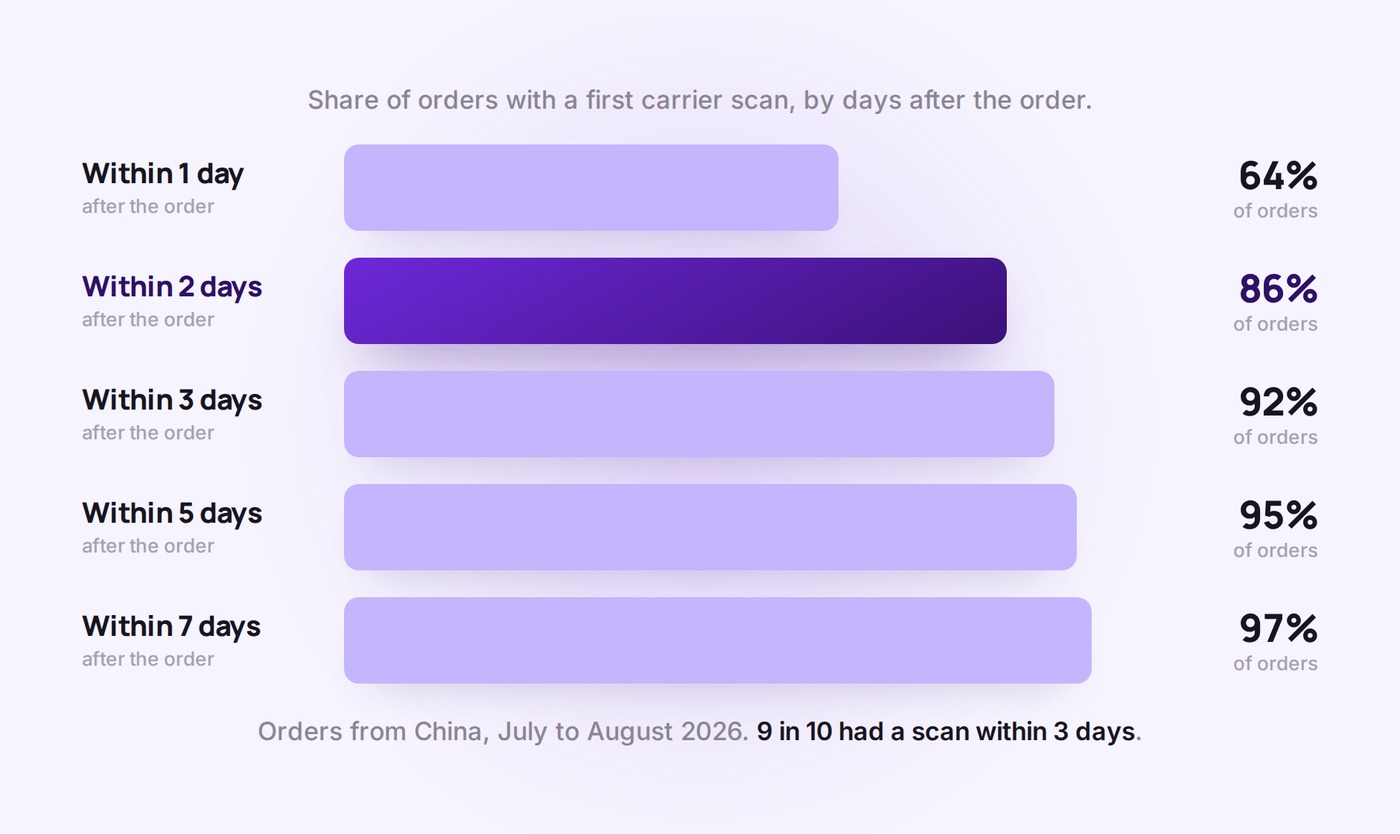
86% of orders had a first carrier scan within 2 days. If yours take longer, that is the first sign to check, before price.


Most sellers start looking for a new dropshipping agent because of price. Price is the easiest thing to compare and the least useful reason to move, because a cheaper agent with slow handling costs you more in tickets, refunds and disputes than it saves per order.
The better reasons are things you can measure on your own orders: how long until the carrier scans the parcel, whether you know which line it ships on, and whether the tracking ends with a delivered scan. On orders shipped from China in July and August 2026, 86% had a first carrier scan within 2 days of the order. That is a number you can hold your agent against this afternoon.
This guide covers:
- Seven signs it is time to leave your agent, each with a benchmark from real orders
- Which signs point at the agent, and which point at the line or the factory
- What is not a reason to switch, even when it feels like one
- How to move to a new agent product by product without losing orders in flight
- How to check your current agent in an afternoon
Signs 1 and 2: the days before the parcel moves
Sign 1: orders wait more than 2 to 3 days for a first carrier scan. The first carrier scan is the moment the parcel is actually in the network. Everything before it is the agent buying, checking, packing and handing over. Across orders placed from 1 July to 31 August 2026, the median order had its first carrier scan 0.8 days after the customer paid. 86% had one within 2 days, 92% within 3, and about 1 in 20 took more than 5.
If many of your orders sit 4 or 5 days before the first scan, no faster line fixes that.
Sign 2: tracking numbers reach your store late, or the label never moves. A tracking number in Shopify sends the shipping email. On the same orders, the median tracking number reached the store in under a day, and 9 in 10 within 2.5 days.
The other half of this sign is a label with no scan. A tracking number issued but never scanned by the carrier looks like progress to the customer and is not. On the measured orders, the first carrier scan usually came within about an hour of the tracking number, and fewer than 1 in 25 parcels went more than 2 days between the two. If you see many labels sitting unscanned for days, the agent might be issuing numbers before the goods are ready.
Sign 3: nobody can tell you which line your parcels ship on
Ask your agent which shipping line each order goes on. "Standard", "express" and "special line" are product names, not answers. The line decides most of the delivery time, so an agent that cannot name it cannot tell you why one month was slower than the last.
On the US route, orders placed in July and August 2026, the median from first carrier scan to delivered scan ran from 10.2 days on YunExpress to 18.1 days on SDH. Same origin, same destination, close to double the wait.
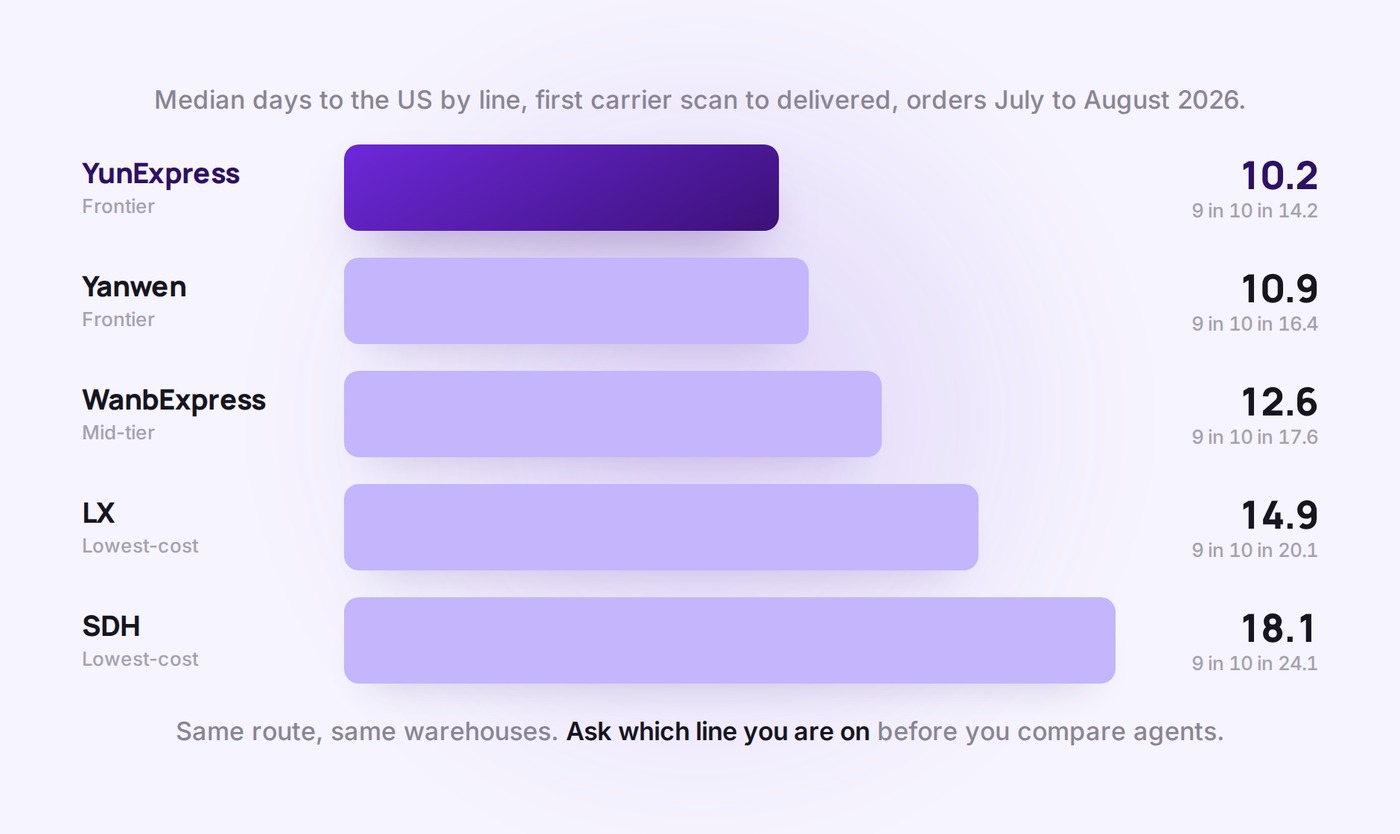
The slow end matters as much as the median. 9 in 10 YunExpress parcels arrived within 14.2 days; on SDH it was 24.1. A slower line might be the right choice for a low-price product with patient customers. That is a fair trade when you chose it, and a problem when you did not know.
Signs 4 and 5: the quote and the tracking do not hold up
Sign 4: the delivery time you were quoted does not match your own orders. Work out the days from order to delivered scan on a month of orders at least six weeks old. Across all destinations, the median was 12.3 days from order to door, and 9 in 10 arrived within 19.6 days. If your agent quoted "7 to 12 days" and your own median is 18, the quote was not about your parcels. There is more on reading quotes in why quoted delivery times from China run short.
Sign 5: the tracking stops before the door. A parcel without a delivered scan is a parcel you cannot defend in a chargeback. About 97 in 100 parcels in the same cohort reached a delivered scan. If a noticeable share of yours end on "in transit" or "label created" for weeks, check which line and which country first, then ask the agent why. What each tracking status means explains when a quiet parcel needs action.
Signs 6 and 7: you do the chasing, and you cannot grow with them
Sign 6: you find the problems before your agent does. Out of stock, a wrong variant, a parcel returned to sender: every one of these shows up in the agent's system before it shows up in your inbox. If the customer tells you first, and then you tell the agent, you are doing the agent's monitoring for free.
Sign 7: you cannot test a product or hold stock on your terms. A growing brand needs two things an agent built for beginners often cannot offer: testing a new product without a large minimum order, and holding a few days of stock for winners so they ship the same day. If every new product means a bulk buy, or every order waits on a factory, you might have outgrown the setup, even if nothing is going wrong.
What is not a reason to switch
Not every bad week is the agent. Before you move, rule these out:
- The line, not the agent. A slow month on a lowest-cost line is the line doing what it does. On the US route, SDH was the slowest line and still had the highest delivered-scan share, 98.4%. Slow is not the same as lost.
- The factory. A product that goes out of stock at the factory slows first scans for that product only. Check whether the delay is across your store or on one product.
- Holidays. Golden Week and Chinese New Year slow every agent at once. Compare like weeks with like weeks.
- Price on its own. A lower quote from a new agent is worth a test order, not a migration. Measure the new agent's first scan and delivered times before you move volume.
How to switch without losing orders
The orders that get lost in a switch are the ones already paid for when you flip it.
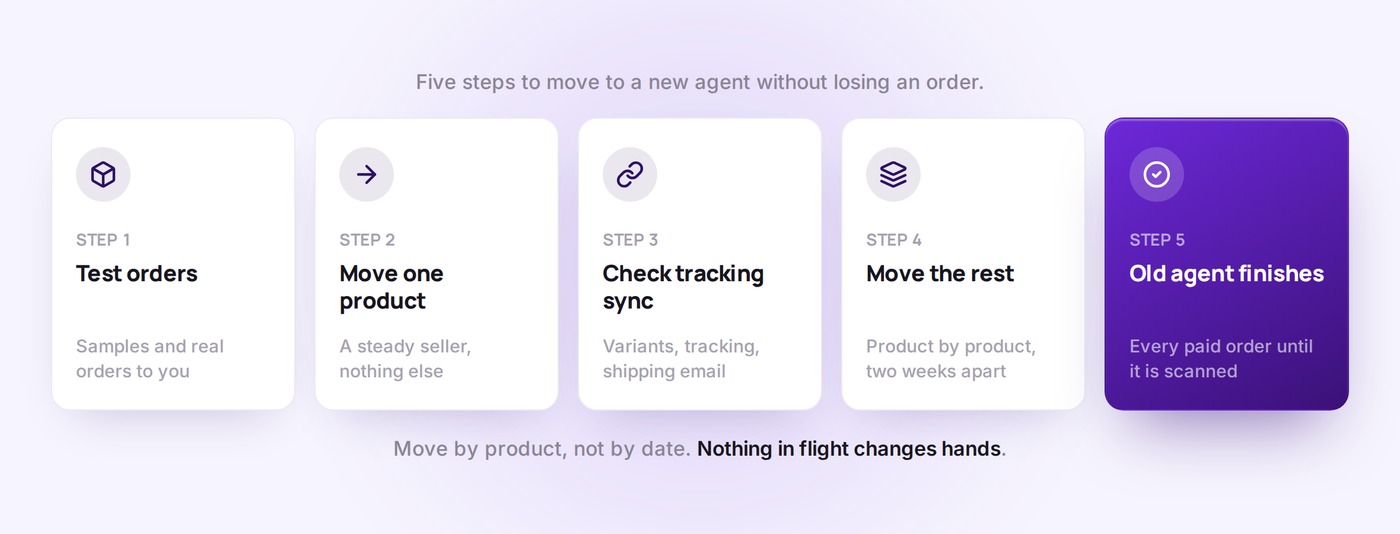
- Test before you commit. Send the new agent your products or links, ask for samples, and place a few real orders to your own address. Check the packaging, the line they ship on and the days to first scan.
- Move one product first. Route one product, ideally a steady seller, to the new agent. Leave the rest where they are.
- Check the plumbing. Confirm variants and SKUs match, that tracking numbers sync back to Shopify, and that the shipping email fires. One wrong variant mapping ships the wrong size to every customer who orders it.
- Move the rest product by product. Watch the new agent's first-scan times for two weeks against the benchmark above before moving the next batch.
- Let the old agent finish. Every order already paid for stays with the old agent until it has a first scan. Do not cancel and re-place in-flight orders unless the old agent has stopped working.
How to check your current agent in an afternoon
You need one export: last month's orders with the order date, the date the tracking number was added and, if you can get it, the first scan and delivered dates.
- Work out days from order to tracking number. Compare the median and the share within 2 days with the figures above.
- Ask the agent for the shipping line on each order. Count how many come back with a real line name.
- For orders at least six weeks old, count the share with a delivered scan, and the median days from order to delivered.
- Split everything by product and by country. One slow product is a factory problem; a slow store is an agent problem.
- Read your last 20 support tickets. Count how many the agent warned you about first.
What to do
- Measure before you move. Price is the last thing to compare, not the first.
- Ask for the line by name on every order, in writing.
- Hold your agent to the first scan. It is the one number almost entirely in their hands.
- Test the new agent with real orders before moving volume.
- Switch product by product and let the old agent finish what it has.
How we handle this at Commercive
Commercive is your all in one sourcing and fulfilment partner. We ship from China on frontier lines like YunExpress, Yanwen and 4PX, and you choose the line per product.
Every order in our dashboard shows its order date, line, first carrier scan and delivered scan, so the five checks above run on your own orders without asking anyone for an export. Our measured delivery times by line and country are public on our shipping status page. You can test a product without a minimum order, and hold a few days of stock for the products that sell. If you move to us, we can take your products over one by one while your current agent finishes the orders it already has.
If you're currently running a brand, just give us the product and your daily order volume. We'll get you a quote within the next 24 hours to hold up against what you're paying today.
How we measured this. Every order placed with us between 1 July and 31 August 2026 that had a tracking number, across all lines and destinations, measured on 3 October 2026 so each order had at least 33 days. Stocked and per-order products are counted together. Days are calendar days. "First carrier scan" is the first scan reported by the carrier; "tracking number in the store" is when the fulfillment with the tracking number was created in Shopify; "delivered scan" is the first delivered scan reaching our tracking, which is a floor on how many parcels arrived. The by-line figures cover US orders only and are medians per line, not added or averaged across lines.
When should I switch dropshipping agents?
When the problems are measurable and repeat, not after one bad week. The clearest signs are orders waiting more than 2 to 3 days for a first carrier scan, an agent that cannot name the shipping line, delivery times that do not match the quote on your own orders, and tracking that often stops before a delivered scan.
How long should a dropshipping agent take to ship an order?
On orders from China placed in July and August 2026, the median order had a first carrier scan within a day and 86% within 2 days. Per-order products that the agent has to buy from a factory first might take longer; stocked products should be at the fast end.
How do I switch dropshipping suppliers without losing orders?
Move product by product, not the whole store at once. Test the new agent with real orders, check that tracking numbers sync back to Shopify and the shipping email fires, then route one product, then the rest. Leave every order already paid for with the old agent until it has a carrier scan.
Is a cheaper dropshipping agent worth switching to?
It could be, but test it first. A lower price per order is easy to see; slower handling, a slower line or tracking that stops early cost you in support tickets, refunds and disputes. Place real orders and measure first scan and delivered times before moving volume.
What questions should I ask a new dropshipping agent?
Which shipping line each order goes on, the days from order to first carrier scan on recent orders, the share of parcels that reach a delivered scan by country, whether you can test a product without a minimum order, and how they tell you about stock problems before your customers do.
.png)
Fill in the application form, and our team will reach out to you to help you with making the above happen.
• Sell 1 day post-production
• Scale worldwide with 3-10 days
• Slice your lead times
• Prevent inventory risk and overstocking
• Hide china due custom software and carrier agreements
• Work with a multilingual team in mainland China
• Decades of supply-chain experience.

.png)