Table of Contents
Selling hair tools from China: the US hair dryer rule, the safety standards for straighteners and curlers, the EU and UK rules and how hair tools ship
Every hand-held hair dryer sold in the US needs immersion protection in its plug. Straighteners and curlers have no federal rule.


Search how to start selling hair tools from China and you get supplier listings with a minimum of 500 straighteners, marketplace blogs about certificates, and test labs selling reports. None of them tells a Shopify brand selling hair dryers, straighteners, curling irons and hot brushes by the parcel which of those carries a hard US rule, what the plug has to look like, or which shipping line a cordless straightener goes on.
The short answer: in the US, every hand-held hair dryer needs immersion protection, a shock cut-out usually built into a block-shaped plug, or it is treated as a hazard and can be recalled. Straighteners, curling irons and hot brushes carry no federal rule of their own, but retailers expect a UL 859 test report, and anything made for China's 220 volt mains has to be ordered as a 120 volt or dual-voltage model. In the EU, plug-in hair tools need the CE mark, and in the UK they need a UK plug. On the shipping side, plug-in tools usually go as general goods and cordless ones go on a battery line.
This guide covers:
- What decides the rules for hair tools: the airflow, the plug and the battery
- The US immersion protection rule for hair dryers, and what to check on the plug
- The safety standard for straighteners and curling irons, and the voltage to order
- The EU and UK rules for hair tools sold under your brand
- Which line hair tools go on, what a gift set costs to ship, and how long it takes

What decides the rules for hair tools
Hair tool ranges mix dryers, heated stylers, cordless gadgets and plain accessories, and the rules follow three things:
- Airflow over a heater. A hand-held hair dryer, including a hot-air brush or a multi-styler with a dryer head, falls under the one federal rule written for hair tools, set out in the next section.
- A heated plate or barrel on mains power. Straighteners, curling irons, crimpers and heated brushes plug into the wall, which brings in electrical safety standards in the US and the CE mark in the EU, and a plug and voltage for each market.
- A battery. Cordless straighteners, curlers, trimmers and clippers run on lithium cells, which changes the shipping line, as the guide to shipping products with batteries from China covers.
Brushes, combs, clips and rollers with no heat carry none of those, so for most accessories the work is quality and packing, not paperwork. Tools that pair with an app need the FCC rules in the guide to selling electronics from China. This is a summary, not legal advice.
The US immersion protection rule for hair dryers
Since 28 July 2011, US rules treat hand-supported hair dryers without integral immersion protection as a substantial product hazard. A hand-supported dryer is one held in one hand during use that blows air over or through its own heating element, which covers travel dryers and hot-air brushes as well as full-size dryers. Salon models count too when they are sold to consumers.

- What the protection does. It cuts the power if the dryer falls into water or water gets inside it, which lowers the risk of a shock.
- What it looks like. In most dryers it sits in a block-shaped plug with a circuit interrupter, usually with test and reset buttons. A thin two-pin plug on a dryer is the sign to ask questions.
- What the rule asks for. The protection has to meet section 5 of UL 859, the household standard, or section 6 of UL 1727, the salon standard.
A dryer without it can be recalled, and a recall can mean offering every buyer a repair, a replacement or a refund. The rule does not set a testing or certificate requirement of its own, so the check is yours: ask the factory for a test report that covers immersion protection, and a photo of the US plug on the exact model you are buying. Many factories build the same dryer with a plain plug for other markets, so the order has to say "US version with immersion protection plug". The guide to ordering product samples from China covers how to check the first sample against what the supplier claims.
The safety standard for straighteners and curling irons
There is no federal rule written for straighteners, curling irons, crimpers or heated brushes. The standard they are judged against in the US is UL 859, for household personal grooming appliances, or UL 1727 for salon tools. Both are voluntary, but a test report from a recognised lab is what most retailers and marketplaces ask for before they list an electrical product, and what a recall investigation looks at.
A UL or ETL mark means a lab has tested the whole product against the standard. Marks on cheap tools are sometimes fake, so ask for the certificate and its file number, then look the number up in the lab's own online directory before you order stock, as the guide to selling Christmas lights from China describes for string lights. On the first sample, check that the tool shuts off on its own if your range promises it, that the cord swivels, and that the handle stays cool enough to hold.
The voltage to order. China's mains runs at 220 volts, the US at 120. A tool built for 220 volts can run weak or not at all on a US outlet, and a 120 volt tool plugged in abroad can overheat. Order the 110 to 120 volt version with a US plug for the US, or a dual-voltage model if you sell to several markets, and check the rating on the label of the sample.
The EU and UK rules for hair tools
In the EU, plug-in hair tools run on mains voltage, so they fall under the Low Voltage Directive and need the CE mark, with the EMC rules on top for tools with electronics. The usual way to show they are safe is EN IEC 60335-2-23:2023, the standard for skin and hair care appliances, which replaced the 2003 edition. The current edition adds rules that matter for this range: the handle on a curling iron or straightener has to be clearly marked off from the hot part, and a dryer needs protection against hair being drawn into the air intake. Check that the factory's report is to the current edition, not the old one.

Since 13 December 2024, every EU listing also has to show the manufacturer's name and contact details, an EU responsible person when the manufacturer is outside the EU, a picture of the product and its warnings. Hair tools are electrical goods, so the crossed-out bin symbol and the take-back registration that come with them apply too, in each country where you sell direct.
In the UK, the Electrical Equipment (Safety) Regulations 2016 ask that plug-in equipment sold for home use comes with a correctly fitted UK plug, or a non-UK plug correctly fitted with a conversion plug and a fuse. A loose travel adapter in the box is not a correctly fitted plug. Factories make the same straightener with US, EU and UK plugs, so the plug is one more line on the order. A compliance service can tell you which standards apply to your range.
Which line hair tools go on
Parcel lines out of China run separate products by goods class, and a parcel goes on the one its contents allow. YunExpress, a frontier line, runs a general "Economy, Unrestricted" product beside "Economy with Battery" and its clothing and cosmetics products. SDH, a lowest-cost line to the US, runs general goods, battery and sensitive goods lines.
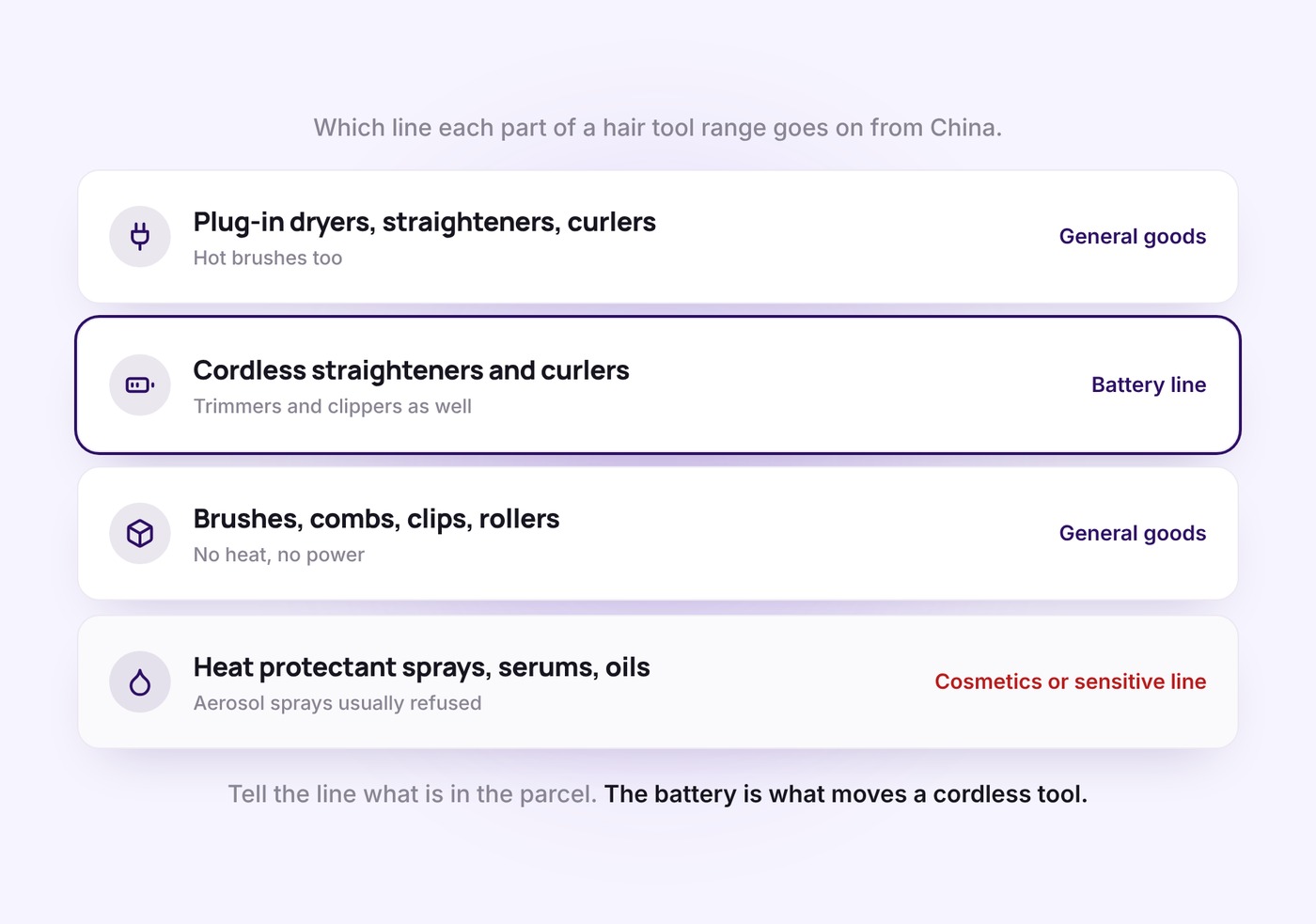
- Plug-in dryers, straighteners, curling irons and hot brushes usually ship as general goods.
- Cordless straighteners, cordless curlers, trimmers and clippers carry a lithium battery and go on a battery line.
- Brushes, combs, clips and rollers ship as general goods.
- Heat protectant sprays, serums and hair oils are liquids that go on a cosmetics or sensitive goods line, and aerosol sprays are usually refused. The guide to shipping cosmetics from China covers the labels they need.
Tell the line exactly what is in the parcel and let it pick the product. A cordless tool packed as general goods can be held or sent back, and in December that wait lands on a present.
What a hair tool costs to ship
Hair tools are dense, so most bill on their weight, until the gift box takes over. On lines that bill the greater of the scale weight and the volumetric weight, a straightener in a 35 x 10 x 6 cm box has a volumetric weight of about 0.26 kg on a divisor of 8,000, while it weighs about 0.45 kg, so it bills on its weight. A hair dryer in a 25 x 22 x 10 cm box comes out about even, at around 0.7 kg either way. A hot-air styler gift set in a 36 x 26 x 12 cm presentation box is about 1.4 kg volumetric against about 1.1 kg on the scale, so it bills on its box.
Those are worked examples, not quotes, but they show where the money goes: the presentation box on a gift set, not the tool. Weigh and measure one packed unit of each product before you set shipping rates; the rules by line are in the guide to custom packaging for products shipped from China.
How long hair tools take from China
Hair tool orders cannot be told apart in the parcel data, so the times here are for the line products they travel on. On YunExpress to the US, parcels with a first carrier scan in August 2026, the per-store median on the general goods Economy product ran 8.9 to 18.7 days, and 9 in 10 parcels arrived within 12.1 to 21.6 days depending on the store. The Economy with Battery product, for cordless tools, ran 11.0 to 14.0 days at the median. On SDH, a lowest-cost line, the general goods product ran 14.3 to 15.2 days.
Those are August times. Parcels slow down through the peak, and hair tools sell as gifts, so the date that matters is the last day an order can leave and still arrive for Christmas. The guide to Q4 shipping dates from China works that out by destination: for the US, it is around the first week of December.
What to do
- Sort your range into dryers, heated plug-in tools, cordless tools and accessories before you ask the factory for anything
- Order every hand-held dryer as the US version with an immersion protection plug, and get the test report and a plug photo for that model
- Ask for UL 859 reports on straighteners, curling irons and hot brushes, and check any UL or ETL file number in the lab's directory
- Order the right voltage and plug for each market: 120 volts and a US plug for the US, 230 volts and a fitted UK plug for the UK
- Check the CE report is to EN IEC 60335-2-23:2023, and show the manufacturer and EU responsible person on every EU listing
- Sort the range by goods class before you book shipping: general for plug-in tools, battery for cordless ones
- Weigh and measure one packed gift set before you set shipping rates
How we handle this at Commercive
Commercive is your all in one sourcing and fulfilment partner. We source from a product link or a photo across our vetted factories, or work with the supplier you already use, and we test products without holding you to the factory's minimum, which suits a store trying a few dryers and stylers before the gift season.
Your stock is received on our floor in China, and every order ships on the line that fits the product and the destination: a general goods line for plug-in tools and brushes, a battery line for cordless straighteners and clippers, and a check with the line before any sprays or oils go out. Each parcel's scans and weights sit in our dashboard. We recommend frontier lines such as YunExpress to essentially everyone, and in the gift weeks above all; a lower-cost line might suit low-price accessories ordered early. Our measured delivery times by line and country are on our shipping status page.
If you're currently running a brand, just give us the product and your daily order volume. We'll get you a quote within the next 24 hours to hold up against what you're paying today.
Where these numbers come from. The US hair dryer rule is from 16 CFR 1120.3(a), read 8 November 2026, the final rule at 76 FR 37636 (28 June 2011, effective 28 July 2011), and the CPSC's business guidance on hand-supported hair dryers. The straightener standards are UL 859 and UL 1727. The UK plug rule is from regulation 35 of the Electrical Equipment (Safety) Regulations 2016; the EU picture is from the Low Voltage Directive 2014/35/EU, EN IEC 60335-2-23:2023 and its A11 amendment, and the General Product Safety Regulation (EU) 2023/988. This is a summary, not legal advice. The box weights are worked examples, not measurements. Line product names are the carriers' own. Delivery times are our own measurement: parcels to the US from stores we fulfil from China, first carrier scan 1 to 31 August 2026, test stores excluded, calendar days from the first scan to the first delivered scan, measured 8 November 2026, shown as the range of per-store medians and 90th percentiles for stores with at least 30 delivered parcels on that line product.
Why do hair dryers have a big plug?
The block on the plug holds the immersion protection, a circuit interrupter that cuts the power if the dryer falls into water or gets wet inside. US rules treat a hand-held hair dryer without it as a substantial product hazard, so every hand-held dryer sold in the US needs one, usually with test and reset buttons on the block.
Do hair straighteners need UL certification?
Not by law. There is no federal rule written for straighteners or curling irons, and UL 859 is a voluntary standard. A test report from a recognised lab such as UL or Intertek (ETL) is what most retailers and marketplaces ask for, and it is the best evidence you have if a customer complains.
Can I sell a 220V hair dryer in the US?
You should not. US outlets supply 120 volts, so a dryer built for 220 volts can run weak or not at all, and a US dryer also needs the immersion protection plug. Order the 110 to 120 volt US version, or a dual-voltage model with a US immersion protection plug.
Do hair tools need a CE mark in the EU?
Plug-in hair dryers, straighteners and curling irons do, under the Low Voltage Directive, usually tested to EN IEC 60335-2-23:2023. Brushes, combs and clips with no power do not carry a CE mark, but still sit under the General Product Safety Regulation.
Can you ship a cordless straightener from China?
Yes, on a battery line. Cordless straighteners, curlers, trimmers and clippers carry a lithium battery and go on the line's battery product. Plug-in tools usually go as general goods, and aerosol sprays are usually refused.
How long do hair tools take to ship from China to the US?
About as long as other goods on the same line. On YunExpress in August 2026, the per-store median ran 8.9 to 18.7 days on the general goods product and 11.0 to 14.0 days on the battery product, from the first carrier scan to delivery. Parcels slow down in December, so plan gift orders around the first week of December.

Fulfillment from our own warehouses in China and the US.
Tell us what you sell and how much you ship. We reply with a quote within one business day.