Table of Contents
Selling bedding from China: the US law label for pillows and duvets, the fire rules for toppers and rugs, the UK rules and how bedding ships
Anything with a hidden filling needs a state law label in the US. Toppers, mattresses and small rugs have their own federal fire tests.

Search how to start selling bedding from China and you get label printers explaining pillow tags, compliance consultants listing state rules, and dropshipping apps asking whether dropshipping is legal. None of them tells a Shopify brand buying pillows, duvets, sheets, toppers and rugs from a factory which items carry a hard rule, what the tag has to say, or what a duvet costs to ship once it is in a box.
The short answer: in the US, anything with a hidden filling, such as a pillow, a duvet insert or a filled topper, needs a law label under state rules, and several states also want the maker or importer registered. Mattresses, mattress pads and rugs have federal fire standards of their own. Sheets, covers and blankets mostly need the fibre and care labels any textile needs. In the UK, mattresses, pillows and cushions have to pass fire tests on their filling. On the shipping side, bedding is general goods on most lines, and the box, not the weight, decides the price.
This guide covers:
- What decides the rules for bedding: the filling, the mattress and the rug
- The law label: what it says, where it goes and who registers
- The fire rules for toppers, mattress pads and rugs
- The UK and EU rules for bedding sold under your brand
- Which line bedding goes on, what a duvet costs to ship, and how long it takes
What decides the rules for bedding
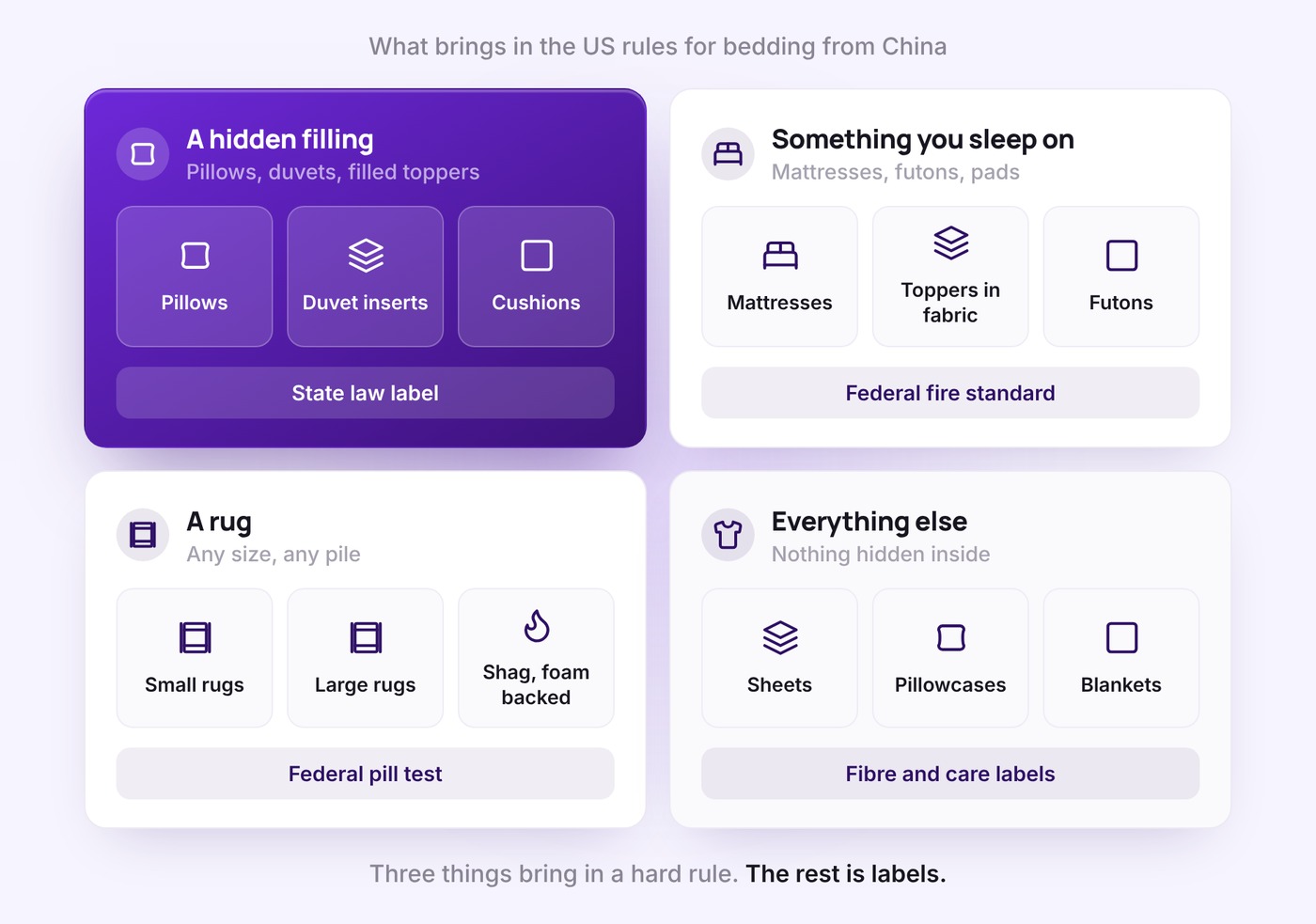
Bedding covers a wide range, and the rules follow what the product is made of and what it is for:
- A hidden filling. Pillows, duvet inserts, comforters, quilts, filled toppers and cushions are "stuffed articles" under state bedding laws, which means a law label and, in some states, a registration.
- Something you sleep on. Mattresses, futons and mattress pads have federal fire standards, and importers count as manufacturers for them.
- A rug. Rugs and carpets have a federal fire test, with a separate rule for small rugs.
- Everything else. Flat sheets, fitted sheets, pillowcases, duvet covers and unfilled blankets generally fall outside the law label rules, because nothing is hidden inside. They still need the fibre content and care labels covered in the guide to shipping clothing from China.
Sorting your range into those four groups first tells you which tags and tests to ask the factory for. Bedding made for babies and children has extra rules, set out in the guide to selling baby products from China. This is a summary, not legal advice.
The law label for pillows and duvets
There is no federal law label. The tag that says "All New Material" on a pillow comes from state bedding laws, and a retailer or marketplace will usually expect it on anything with a filling, whichever state the customer is in. Ohio's rule is a good picture of what one asks for:

- Material and size: white cloth or Tyvek, at least 2 by 3 inches, printed in black.
- "All New Material" in English, in letters at least an eighth of an inch high.
- The filling, stated plainly: polyester fibre, feathers, down, memory foam.
- A registration number, preceded by the name of the state that issued it.
- The registered name and address of the maker, distributor or seller, with no PO box.
- Placement: on pillows, pads and comforters, sewn into one outside seam.
Several states, Ohio and Pennsylvania among them, also ask the maker or importer to register before selling there, and Pennsylvania's registration renews every year. A number from one state can often be used in others. The usual approach is one uniform law label that meets the strictest states, sewn in at the factory before the goods ship.
Ask the factory to send a photo of the sewn label on the first sample, and check the filling it states against what is actually inside. A pillow sold as "down" with a polyester filling has a label problem and a listing problem. The guide to ordering product samples from China covers how to check a sample before you order stock.
The fire rules for toppers, mattress pads and rugs
Two federal fire standards catch products that bedding stores often source from China.
Mattresses and mattress pads. Under 16 CFR 1632, a mattress is a filled ticking sold for sleeping on, and that includes futons and air mattresses with upholstery. A mattress pad is a thin mat or filled ticking for use on top of a mattress. A topper fully enclosed in fabric counts as a mattress pad and has to pass the standard's cigarette test; an egg-crate foam topper with no cover does not. Full mattresses also have an open flame standard, 16 CFR 1633. Importers count as manufacturers, so the testing records sit with you, not just with the factory.
Rugs. Rugs and carpets have a federal fire test, the "pill test". A small rug, meaning no side over 6 feet and no more than 24 square feet, falls under 16 CFR 1631, and at least seven of eight samples have to pass. A small rug that fails can still be sold, but only with a permanent label that reads: "FLAMMABLE (FAILS U.S. DEPARTMENT OF COMMERCE STANDARD FF 2-70): SHOULD NOT BE USED NEAR SOURCES OF IGNITION." A larger rug, under 16 CFR 1630, has to pass.
- Shag and fluffy rugs, and rugs with a foam backing, usually fail the test untreated, according to CPSC staff. Those are the ones to test first.
- A certificate. A rug for general use needs a General Certificate of Conformity, based on a test or a reasonable testing program. A rug made for a child's room needs a CPSC-accepted lab test and a Children's Product Certificate.
This is a summary, not legal advice; a CPSC-accepted lab can tell you which tests your range needs.
The UK and EU rules for bedding
In the UK, the Furniture and Furnishings (Fire) (Safety) Regulations 1988 cover mattresses, pillows and cushions sold for use in the home, and their filling has to pass the regulations' fire tests. Bedding such as duvets and pillowcases, and floor coverings such as rugs and mats, are outside those regulations, and an amendment in force since 30 October 2025 took a list of baby products out of scope as well. A factory's own fire test for a pillow is worth asking for in writing before UK stock is ordered.
In the EU there is no single fire rule for bedding. It sits under the General Product Safety Regulation, which asks for products that are safe in normal use, and since 13 December 2024 every EU listing has to show the manufacturer's name and contact details, an EU responsible person when the manufacturer is outside the EU, a picture of the product and its warnings. Sheets, covers and blankets also need a fibre composition label under the EU textile rules. Some member states add national rules, so a compliance service can tell you which apply to your range.
Which line bedding goes on
Parcel lines out of China run separate products by goods class, and a parcel goes on the one its contents allow. YunExpress, a frontier line, runs a general "Economy, Unrestricted" product beside its clothing, battery and cosmetics products. SDH, a lowest-cost line to the US, runs general goods, battery and sensitive goods lines.
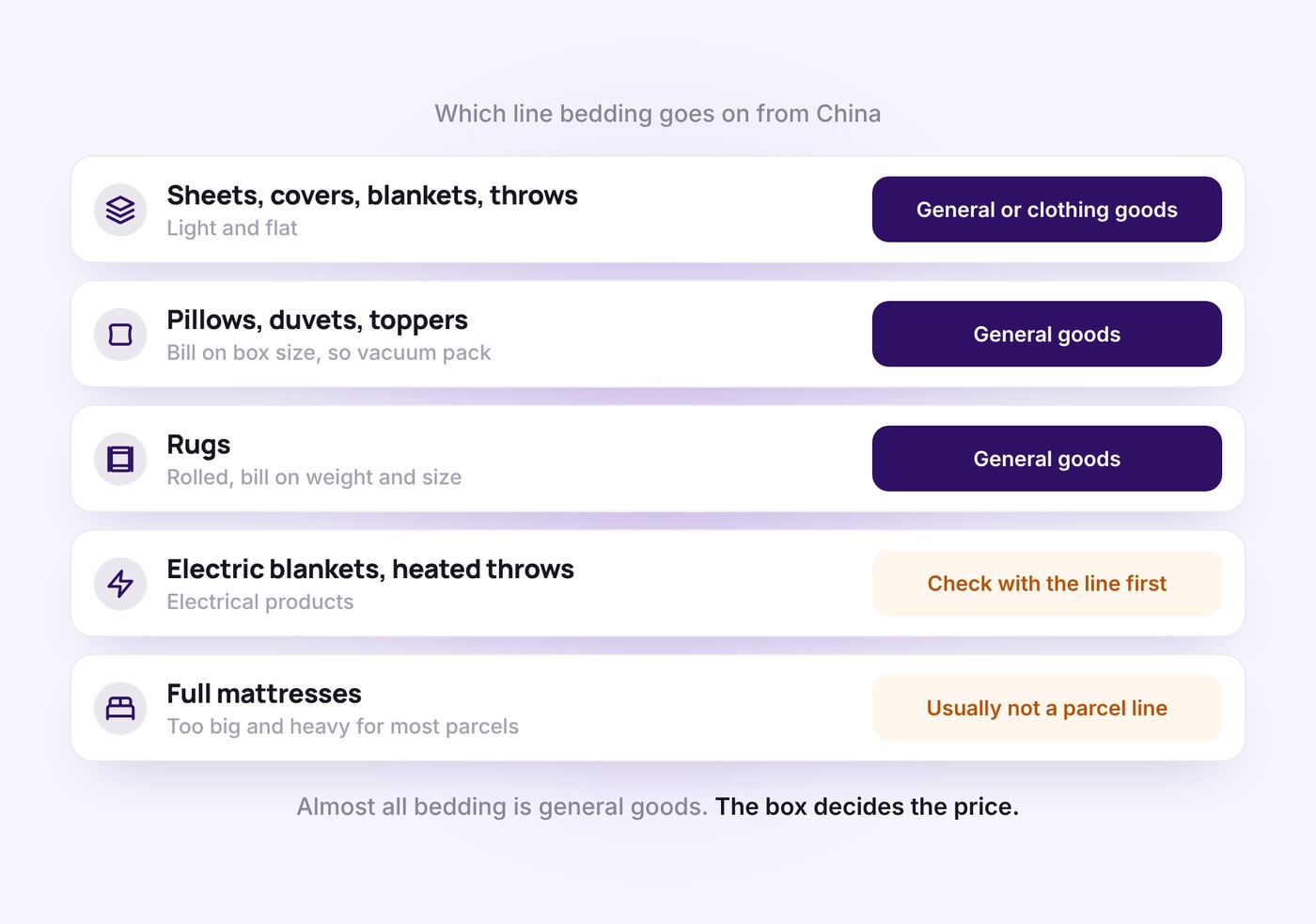
- Sheets, pillowcases, duvet covers, blankets and throws usually ship as general or clothing goods.
- Pillows, duvets and toppers ship as general goods, and bill on their box size.
- Rugs ship as general goods, rolled, and bill on weight and size.
- Electric blankets and heated throws need a check with the line first, and the rules in the guide to selling electronics from China.
- Full mattresses are usually too big for a parcel line.
Tell the line exactly what is in the parcel and let it pick the product.
What a duvet costs to ship
Bedding is light for its size, so the box decides the price. On lines that bill the greater of the scale weight and the volumetric weight, a duvet boxed at 50 x 40 x 25 cm has a volumetric weight of about 6.3 kg on a divisor of 8,000, while it weighs about 2 kg on the scale. Vacuum-packed to 40 x 30 x 12 cm, the same duvet works out at 1.8 kg volumetric, so it bills on its scale weight instead. That is a worked example, not a quote, but the gap is why most bedding from China arrives vacuum-packed. Ask the factory whether it can compress pillows, duvets and toppers before you set shipping rates; the rules by line are in the guide to custom packaging for products shipped from China.
How long bedding takes from China
Bedding orders cannot be told apart in the parcel data, so the times here are for the line products they travel on. On YunExpress to the US, parcels with a first carrier scan in August 2026, the per-store median on the general goods Economy product ran 8.9 to 18.7 days, and 9 in 10 parcels arrived within 12.1 to 21.6 days depending on the store. The Clothing Economy product, on a smaller sample, ran 8.0 to 13.9 days. On SDH, a lowest-cost line, the general goods product ran 14.3 to 15.2 days.
Throws and bedding sets sell well in Q4 as gifts, so the date that matters is the last day an order can leave and still arrive in time, worked out by destination in the guide to Q4 shipping dates from China.
What to do
- Sort your range into four groups: filled, sleep surfaces, rugs, everything else
- Get a uniform law label sewn in at the factory for every pillow, duvet, comforter and filled topper
- Check the filling on the label against what is inside the first sample
- Register where the states ask for it, and keep the number current
- Test toppers enclosed in fabric against 16 CFR 1632, and keep the records yourself
- Test small rugs first, shag and foam-backed ones above all, and label any that fail
- Ask for a UK fire test on pillows and cushions before UK stock is ordered
- Show the manufacturer and EU responsible person on every EU listing
- Weigh and measure one packed duvet before you set shipping rates
How we handle this at Commercive
Commercive is your all in one sourcing and fulfilment partner. We source from a product link or a photo across our vetted factories, or work with the supplier you already use, and we test products without holding you to the factory's minimum, which suits a store trying a few pillows, throws and sets before it commits.
Your stock is received on our floor in China, and every order ships on the line that fits the product and the destination: a general or clothing line for sheets and throws, a general goods line for pillows, duvets and rugs, and a check with the line before anything electrical goes out. Each parcel's scans and weights sit in our dashboard. We recommend frontier lines such as YunExpress to essentially everyone; a lower-cost line might suit low-price throws with patient customers. Our measured delivery times by line and country are on our shipping status page.
If you're currently running a brand, just give us the product and your daily order volume. We'll get you a quote within the next 24 hours to hold up against what you're paying today.
Where these numbers come from. The US mattress and mattress pad definitions are from 16 CFR 1632.1 and 1632.2, the rug rules from 16 CFR 1631.1 to 1631.3 and the CPSC's carpets and rugs FAQ, and the law label example from Ohio Administrative Code 4101:6-1-05, read 5 November 2026. The UK scope is from regulation 3 of the Furniture and Furnishings (Fire) (Safety) Regulations 1988 as amended, read 5 November 2026; the EU picture is from the General Product Safety Regulation (EU) 2023/988. This is a summary, not legal advice. The duvet weights are a worked example, not a measurement. Line product names are the carriers' own. Delivery times are our own measurement: parcels to the US from stores we fulfil from China, first carrier scan 1 to 31 August 2026, test stores excluded, calendar days from the first scan to the first delivered scan, measured 5 November 2026, shown as the range of per-store medians and 90th percentiles for stores with at least 30 delivered parcels on that line product.
Do pillows need a law label?
Yes, in practice. Pillows, duvet inserts, comforters and other bedding with a hidden filling need a law label under state bedding laws, with "All New Material", the filling contents, a registration number and the maker's or seller's name and address, sewn into an outside seam. There is no federal law label, so the usual approach is one uniform label that meets the strictest states.
What is a law label?
It is the tag on a pillow or comforter that says "All New Material" and lists the filling. It comes from state laws on stuffed bedding and upholstered furniture, not from the fibre and care label rules, so a pillow needs both. Some states also ask the maker or importer to register and print the registration number on it.
Do sheets and blankets need a law label?
Generally not, because nothing is hidden inside them. Flat and fitted sheets, pillowcases, duvet covers and unfilled blankets still need the fibre content and care labels any textile needs. A quilt or comforter with a filling does need a law label.
Do mattress toppers need flammability testing?
A topper fully enclosed in fabric counts as a mattress pad under 16 CFR 1632 and has to pass the standard's cigarette test, with the importer treated as the manufacturer. An egg-crate foam topper with no cover is outside that definition. Full mattresses and futons also fall under federal fire standards.
Do rugs from China need a flammability label?
Only if they fail. A small rug, no side over 6 feet and no more than 24 square feet, that fails the federal pill test must carry a permanent "FLAMMABLE" warning label; a larger rug has to pass. Untreated shag rugs and rugs with a foam backing are the ones that usually fail.
How long does bedding take to ship from China to the US?
About as long as other general goods on the same line. On YunExpress in August 2026, the per-store median on the general goods product ran 8.9 to 18.7 days from the first carrier scan to delivery, and a lowest-cost line took 14.3 to 15.2 days.

Fulfillment from our own warehouses in China and the US.
Tell us what you sell and how much you ship. We reply with a quote within one business day.