Table of Contents
Selling kitchenware from China: the food contact rules in the US and EU, the warnings and labels your listing needs, and how it ships
There is no FDA certificate for a mug. The work is proof the material is cleared, the lead in the glaze, and the label on the box.

Search how to sell kitchenware from China and you get sourcing guides that list certificates to ask for, FDA, LFGB, SGS, as if a factory can hand one over and the job is done. None of them says what a certificate is actually worth, what your own product page and box have to show, or which line a set of mugs or a milk frother travels on.
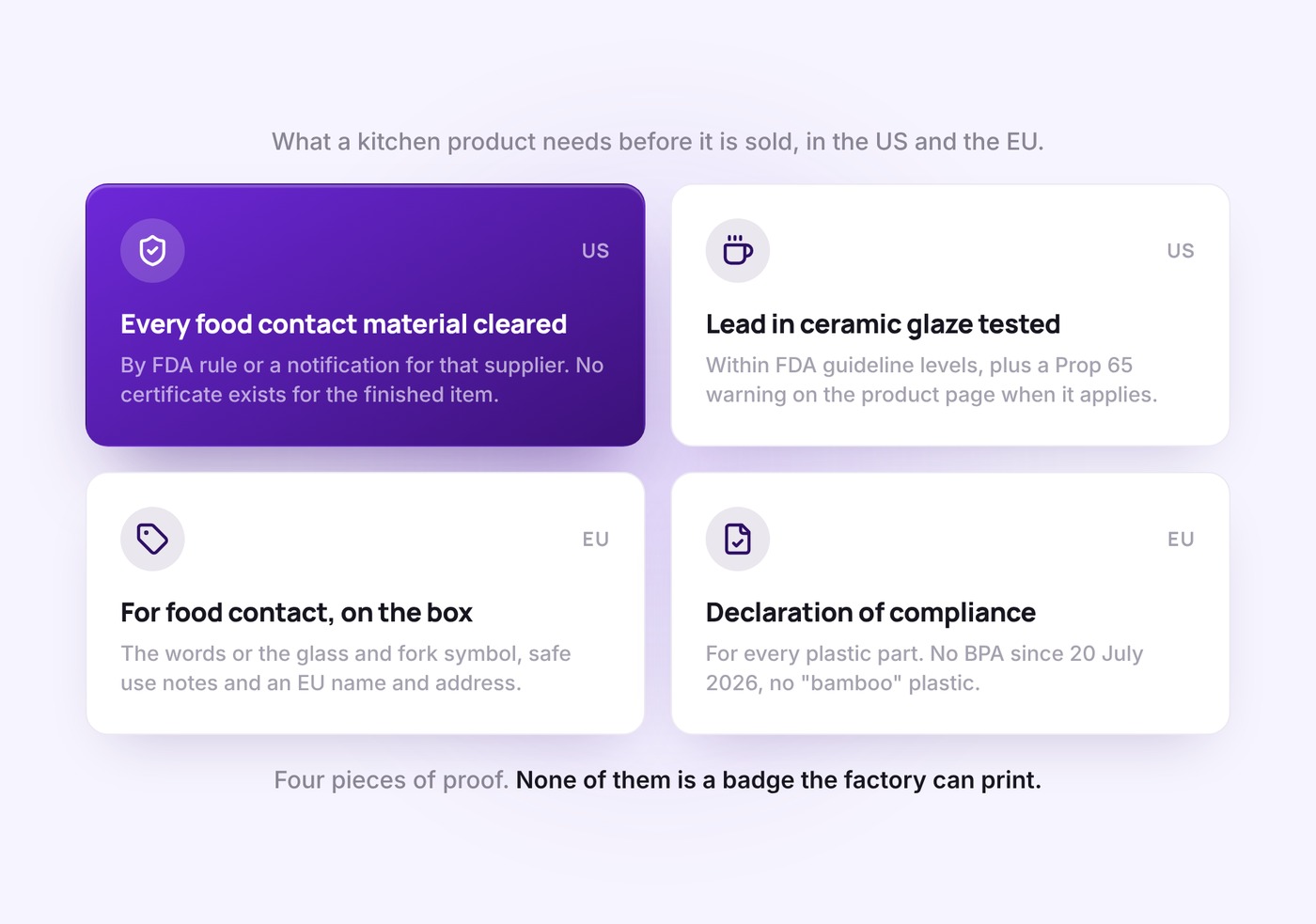
The short answer: most kitchenware ships on the general goods products that parcel lines out of China run, so the shipping is the easy part. The work is proof. In the US there is no FDA certificate for a finished product; each material that touches food has to be cleared, and ceramics are judged on how much lead leaches from the glaze. In the EU, the box needs the words "for food contact" or the glass and fork symbol and a name and address in the EU, and plastics need a written declaration of compliance.
This guide covers:
- What each claim on a factory listing is actually worth
- What the US asks of anything that touches food, and of ceramics in particular
- The warning a California buyer has to see on your product page
- What the EU asks to be on the box, and the materials it no longer accepts
- Which line kitchen products go on, and how long they take
What the claims on a factory listing are worth
A Chinese factory's kitchenware listing often carries a row of badges: "FDA approved", "food grade", "LFGB", "SGS tested". Read them like this:
- "FDA approved" or "FDA certificate". The FDA does not approve or certify a finished mug, pan or lunch box. What exists is clearance for the materials that touch food, by regulation or by a Food Contact Notification. A notification only covers the company named in it, so a factory quoting someone else's notification number proves nothing about its own material.
- "Food grade". A marketing word, not a legal status, in either market.
- "LFGB". Germany's national food code. A report saying "LFGB tested" means a German test regime was run on a sample. It is a useful report, not a pass for the EU or the US.
- "SGS tested" or any lab name. Worth as much as the report behind it. Ask for the report itself, check that it names your exact product, colour and material, and check the date.
The useful question is "which material is this, what was it tested against, and can I see the report for this item?". The guide to verifying a Chinese supplier covers how to check the company behind the answer, and quality control for small batches covers checking the goods.
What the US asks of anything that touches food
Under US food law, anything that migrates from a cup or a pan into food counts as a food additive unless it is cleared, by FDA regulations (21 CFR parts 174 to 178 cover plastics, coatings, rubber and paper), by older approvals, or by an effective Food Contact Notification for that supplier's substance. For a brand:
- Get the material of every food contact part in writing: the body, the lid, the seal, any coating on the inside.
- Ask which rule or notification covers each one, and for test reports that show it.
- Treat coatings as their own part. A non-stick layer is a separate material from the steel under it.
This is a summary, not legal advice. A food contact testing lab can tell you which tests your range needs.
Ceramics: the lead in the glaze
Glazed ceramics carry a risk of their own: some glazes leach lead into food. The FDA judges ceramic foodware by a leach test: the piece is filled with a mild acid and the lead that comes out is measured, in micrograms per millilitre.
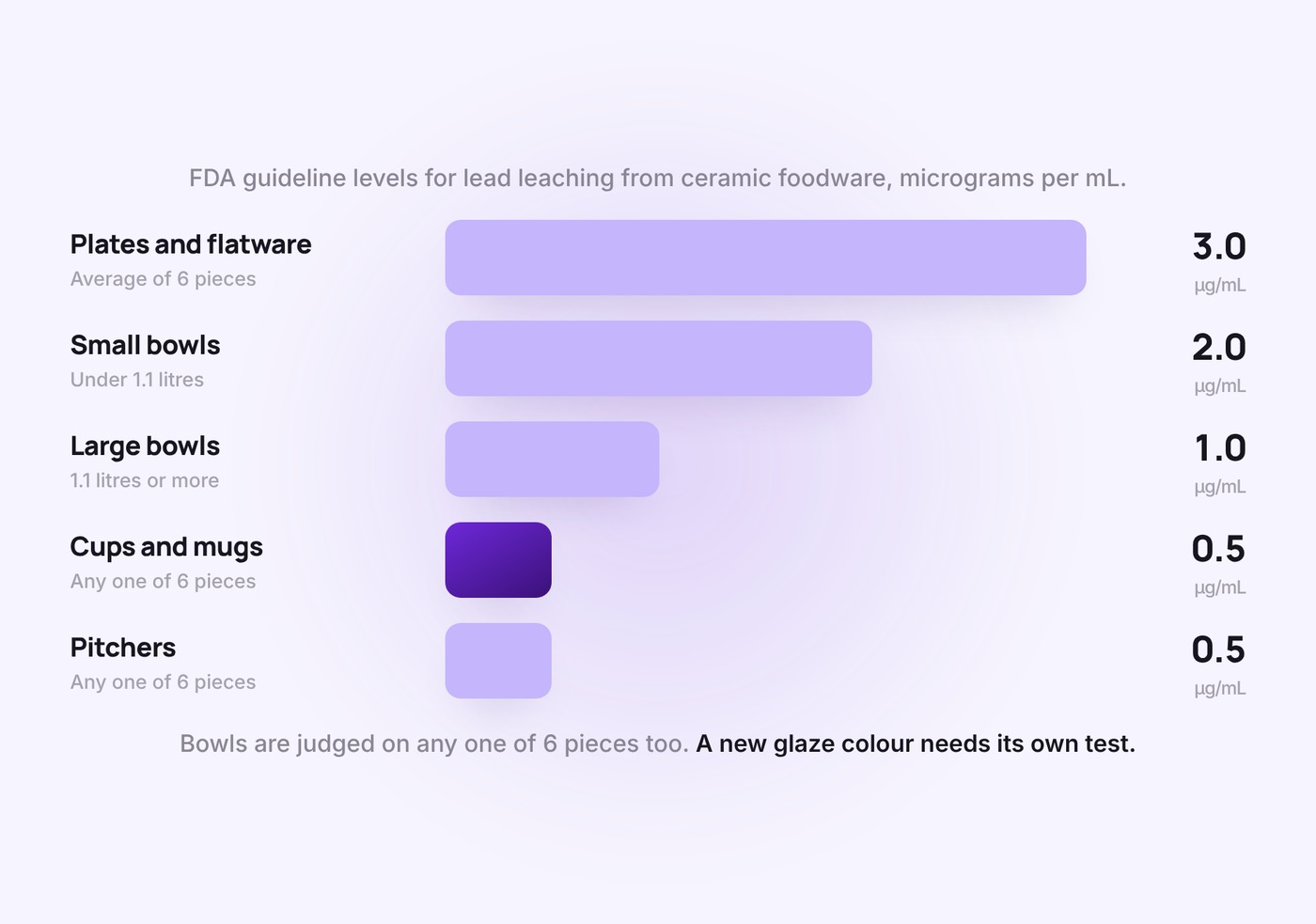
The levels are tightest for the pieces that hold hot drinks and acidic juice: cups, mugs and pitchers at 0.5, large bowls and casseroles at 1.0, small bowls at 2.0 and plates at 3.0, the plate figure an average across six pieces. A factory report for your exact glaze and colour, tested to the FDA method, is the proof to ask for. A new colour is a new glaze.
Decorative ceramics have a rule of their own. A vase, a decorative plate or a planter that looks like it could hold food has to carry a label saying "Not for Food Use. May Poison Food." on a surface buyers can see, and the same words fired or painted on the base, or have a hole bored through it. If you sell a decorative bowl, either test it as foodware or label it that way.
The warning a California buyer has to see
California's Proposition 65 asks for a warning when a product exposes buyers to a listed chemical, and lead is on the list. Ceramic dishware is a common subject of Prop 65 notices.
For online sales the rule is specific. The warning has to be on the product page, or behind a clearly marked link on the product page that reads "WARNING", "CA WARNING" or "CALIFORNIA WARNING", or shown some other prominent way before the buyer completes the purchase. A warning the buyer has to search the site for does not count, so a line in your terms page is not enough. Whether a product needs one depends on what is in it, which is a question for the test report. This is a summary, not legal advice.
What the EU asks to be on the box
Kitchenware sold in the EU falls under the food contact Regulation, (EC) 1935/2004. Anything not yet in contact with food when it is sold carries:
- "For food contact", a specific use such as "soup spoon", or the glass and fork symbol. Not needed when the item is clearly meant for food, like a plate, but it costs nothing to print.
- Instructions for safe use where they matter, such as "not for the oven" or "hand wash only".
- The name and address of the manufacturer, processor or seller established in the EU. For a brand shipping direct from China, this is the piece most often missing.
- A batch or traceability mark, so the item can be traced.
The information has to be clear, legible and indelible, on the item, its packaging or a label attached to it, and in a language the buyer understands.
Plastics add a step. Under the EU plastics Regulation, (EU) 10/2011, a plastic that touches food must keep its total migration into food within 10 milligrams per square decimetre, and every business before the retailer has to hold a written declaration of compliance from the one before it. Ask the factory for that declaration for each plastic part.
Two materials are now out. Since 20 July 2026, most food contact articles made with BPA can no longer be placed on the EU market for the first time, under Regulation (EU) 2024/3190; the ban covers plastics, coatings, inks, adhesives, silicones and rubbers. And plastic cups and plates sold as "bamboo", a melamine plastic with bamboo powder, are likely to be refused: bamboo is not an authorised additive, and EU countries have pulled these products from sale, online shops included. This is a summary, not legal advice.
Which line kitchen products go on
Parcel lines out of China run separate products by goods class, and a parcel goes on the one its contents allow. YunExpress, a frontier line, runs a general "Economy, Unrestricted" product beside its "Economy with Battery" product. SDH, a lowest-cost line to the US, runs general goods, battery and sensitive goods lines.
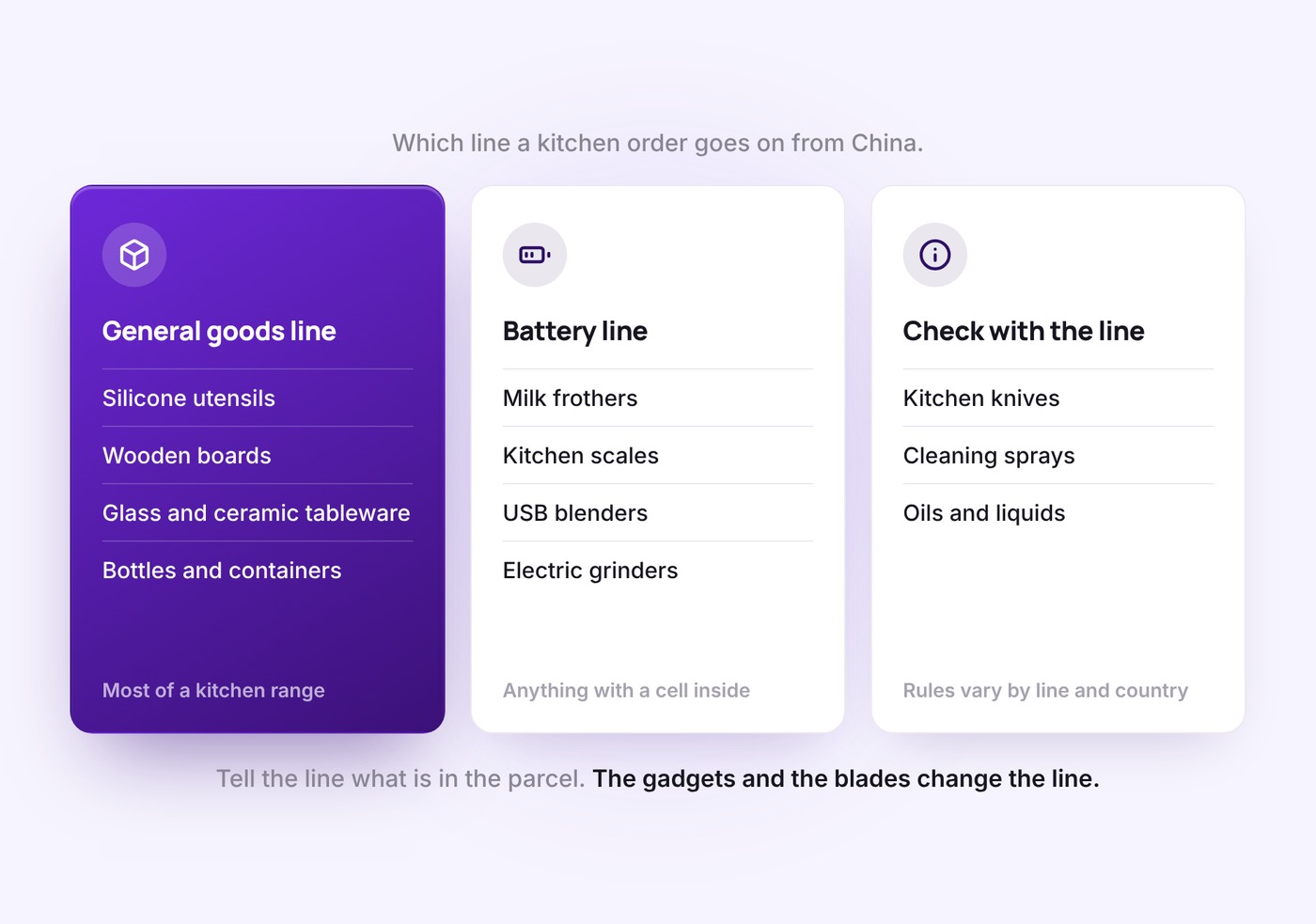
Most of a kitchen range is general goods. A few things change the line:
- Milk frothers, kitchen scales, USB blenders and electric grinders carry a battery and follow the rules in the guide to shipping products with batteries from China.
- Kitchen knives are restricted by many carriers and postal services, and the rules change by line and destination country. Ask the line before you list them.
- Cleaning sprays and oils are liquids, and an aerosol counts as flammable on a flight.
Glass and ceramics also need padding, and padding adds size. On lines that bill the greater of scale and volumetric weight, a boxed set of plates can be billed on its size; the rules are in the guide to custom packaging for products shipped from China.
How long kitchenware takes from China
Kitchen orders are too mixed a set to give them a figure of their own, so the times here are for the line products they travel on. On YunExpress to the US, parcels with a first carrier scan in August 2026, the per-store median on the general goods Economy product ran 8.9 to 18.7 days, and 9 in 10 parcels arrived within 12.1 to 21.6 days depending on the store. The Economy with Battery product, for the gadgets, ran 11.0 to 14.0 days. On SDH, a lowest-cost line, the general goods product ran 14.3 to 15.2 days.
What to do
- Get the material of every food contact part in writing, lid and seal included
- Ask for the test report for your exact item, not a certificate badge, and check the date and the product it names
- Test every ceramic glaze and colour for lead to the FDA method before you sell
- Label decorative ceramics "Not for Food Use" or test them as foodware
- Put any Prop 65 warning on the product page, not in your terms
- Print the EU food contact words or symbol, safe use notes and an EU name and address on the box before you sell in the EU
- Hold a declaration of compliance for every plastic part, and drop BPA and "bamboo" plastic for the EU
- Sort your range by goods class: general, battery (gadgets), or check first (knives, sprays, oils)
How we handle this at Commercive
Commercive is your all in one sourcing and fulfilment partner. We source from a product link or a photo across our vetted factories, or work with the supplier you already use, and we test products without holding you to the factory's minimum, which suits a kitchen store trying a few designs and colours before it commits.
Your stock is received on our floor in China, and every order ships on the line that fits the product and the destination: a general goods line for tableware and utensils, a battery line for anything with a motor or a charger, and a check with the line before anything with a blade or a liquid goes out. Each parcel's scans sit in our dashboard. We recommend frontier lines such as YunExpress to essentially everyone; a lower-cost line might suit low-price utensils with patient customers. Our measured delivery times by line and country are on our shipping status page.
If you're currently running a brand, just give us the product and your daily order volume. We'll get you a quote within the next 24 hours to hold up against what you're paying today.
Where these numbers come from. The US rules are from 21 CFR 170.100 and the FDA's Food Contact Notification pages (notifications are effective only for the supplier named), FDA Compliance Policy Guide Sec. 545.450 on lead in ceramics (revised May 2005), 21 CFR 109.16 (decorative ceramicware) and California's 27 CCR 25602 (Prop 65 warnings for internet purchases), read 28 October 2026. The EU rules are from Regulation (EC) 1935/2004, Article 15, and Regulation (EU) 10/2011, Articles 12 and 15, read 28 October 2026, with the BPA Regulation (EU) 2024/3190 and the bamboo-melamine withdrawals as summarised by UL Solutions and TÜV SÜD. This is a summary, not legal advice. Line product names are the carriers' own. Delivery times are our own measurement: parcels to the US from stores we fulfil from China, first carrier scan 1 to 31 August 2026, test stores excluded, calendar days from the first scan to the first delivered scan, measured 28 October 2026, shown as the range of per-store medians and 90th percentiles for stores with at least 30 parcels on that line product.
Can you dropship kitchenware from China?
Yes. Silicone utensils, boards, tableware, bottles and containers ship on the general goods products that parcel lines out of China run. Gadgets with a battery need a battery product, and knives, sprays and oils need a check with the line first. The rules that take work are about the materials that touch food, not the shipping.
Is there such a thing as an FDA certificate for kitchenware?
No. The FDA does not approve or certify finished kitchen products. Each material that touches food has to be cleared, by FDA regulation or by a Food Contact Notification, and a notification only covers the supplier named in it. Ask for the material and the test report for your exact item instead.
How much lead is allowed in a ceramic mug?
FDA guideline levels for cups and mugs are 0.5 micrograms of lead per millilitre of leach solution, measured with the FDA's leach test. Plates are held to 3.0 as an average of six pieces, small bowls to 2.0 and large bowls to 1.0. Each glaze and colour needs its own test.
Do I need a Prop 65 warning on my Shopify store?
When a product exposes California buyers to a listed chemical, such as lead in a glaze, the warning has to be on the product page, behind a clearly marked "WARNING" link on that page, or shown prominently before checkout. Whether one is needed depends on what is in the product, so check the test report.
What does the glass and fork symbol mean?
It is the EU symbol for materials meant to touch food, set by Regulation (EC) 1935/2004. It can replace the words "for food contact". The box also needs safe use instructions where relevant, a traceability mark, and the name and address of a manufacturer or seller established in the EU.
Is BPA banned in the EU?
Yes, for most food contact uses. Under Regulation (EU) 2024/3190, the main transition ended on 20 July 2026, and since then most food contact articles made with BPA can no longer be placed on the EU market for the first time. The ban covers plastics, coatings, inks, adhesives, silicones and rubbers.

Fulfillment from our own warehouses in China and the US.
Tell us what you sell and how much you ship. We reply with a quote within one business day.