
Table of Contents
US warehouse or ship direct from China: the delivery time difference, the costs to compare, and when US stock might pay
US orders shipped direct from China took a median 13 days from order to door. From a US shelf, the USPS standard is 2 to 5 business days.


Every brand selling to the US from a Chinese supplier hits the same question once a product starts to sell: keep shipping each order from China, or send stock to a US warehouse and ship from there.
The time gap is real but smaller than most guides say. Measured on US orders placed from June to August 2026, the median order shipped direct from China reached the customer in 13.0 days, not "2 to 4 weeks". From a US shelf, USPS Ground Advantage has a standard of 2 to 5 business days. What you pay for that gap is stock bought weeks before the order, and the cash sitting in it.
This guide covers:
- How long US orders take shipped direct from China, measured, against a US warehouse
- The cost lines each model adds, and which ones only show up with a US warehouse
- How much cash US stock ties up, as a formula you can fill in
- Four signs a product might be ready to move to a US warehouse
- How to run both at once, so a new product never needs stock first

How long each route takes: about 2 weeks against 2 to 5 business days
Direct from China. On US orders placed from June to August 2026, 98.0% got a delivered scan. Of those, counted from the customer's order:
- Median: 13.0 days
- Middle half: between 10.6 and 16.5 days
- Slowest 1 in 10: more than 21.3 days
- First carrier scan: a median 0.8 days after the order
From a US warehouse. The warehouse picks and packs the order, then the label carrier takes over. USPS gives Ground Advantage a standard of 2 to 5 business days. That is a standard, not a promise, and it starts when the parcel is handed over, not when the customer orders.
Here is how the China-direct orders were spread across the first three weeks.
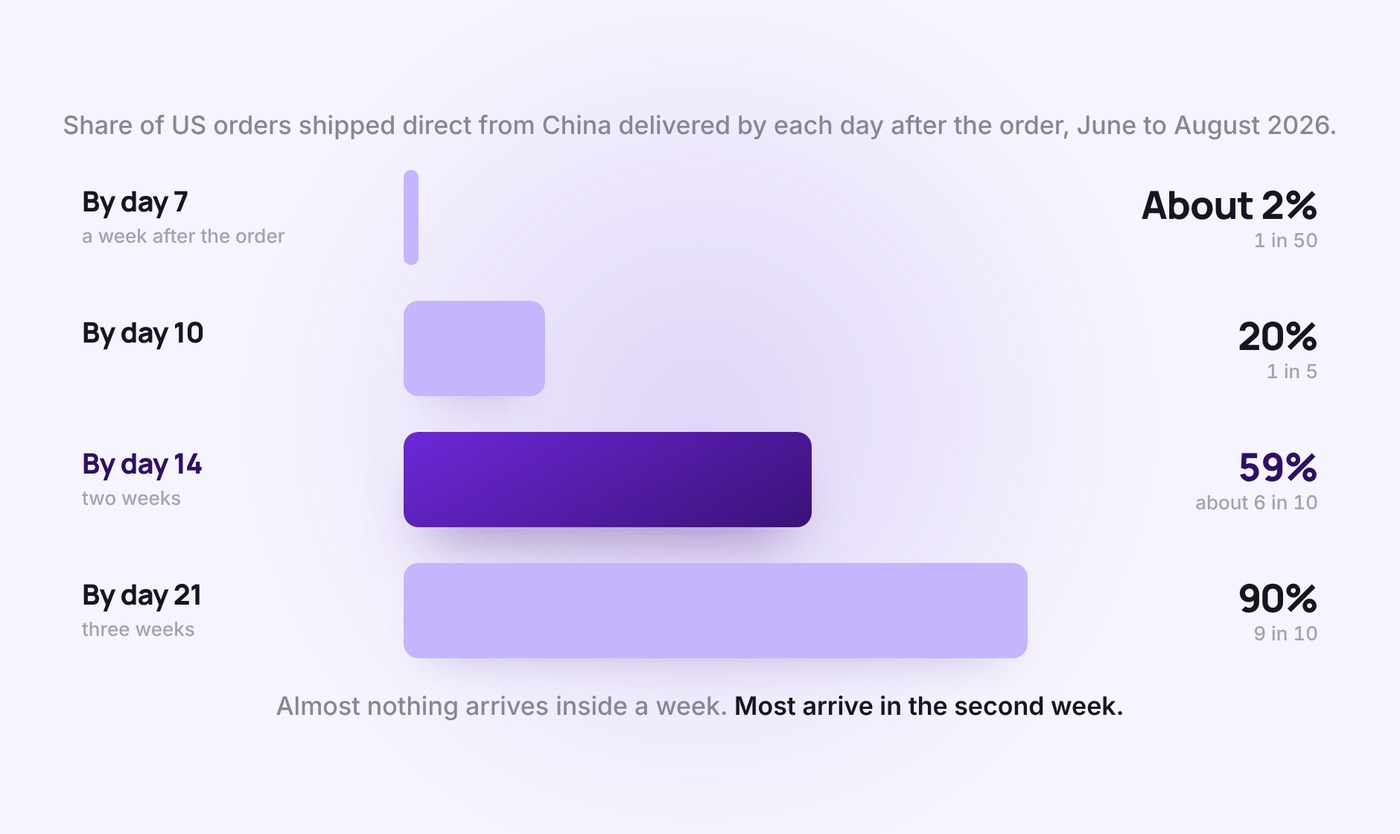
That first bar is the honest part. About 2% of US orders shipped direct from China arrived within 7 days. If your product page needs "delivered this week", shipping direct from China cannot give it to you on any line.
What each model costs per order
Shipping direct from China has one main cost line per order: the parcel rate on the line you use, which carries the item from the warehouse in China to the customer's door. You pay it only when an order comes in.
A US warehouse splits that into lines you pay at different times:
- Freight to the US, paid per shipment of stock, before any of it sells
- Import costs on the bulk shipment, paid when it lands
- Receiving, often charged per carton, pallet or hour when the stock arrives
- Storage, charged by space each month for as long as the stock sits there
- Pick and pack, per order, often with a fee per extra item
- The US label, per order. At USPS commercial prices from 4 October 2026, Ground Advantage for 1 lb is $8.01 to $11.22, depending on distance
Two of those lines grow when sales slow down. Storage keeps charging on stock that is not moving, and stock that never sells still paid its freight. Shipping direct from China has neither, because nothing travels until there is an order.
Q4 adds one more line to the US side. USPS, UPS and FedEx all run holiday price changes and surcharges from October to mid-January, so the label on a US warehouse order costs more in exactly the months you sell most.
The cash a US warehouse ties up
The bigger cost of a US warehouse is often not a fee. It is the cash in the stock, paid for weeks before the customer pays you.
The formula: units sold a day x days of stock you hold x what one unit costs you, landed in the warehouse.
Days of stock is not just the selling time. It is the time the next shipment takes to arrive, plus the selling time until it lands, plus a buffer. By sea, stock takes roughly 22 to 35 days door to door to a West Coast warehouse and 34 to 52 days to the East Coast, according to a 2026 freight guide.
For example: a product that sells 50 units a day, costs $8 a unit landed and needs 75 days of stock (about 5 weeks on the water and in receiving, 4 weeks of selling, 2 weeks of buffer) ties up 50 x 75 x $8 = $30,000. Shipped direct from China, the same product ties up the units your supplier holds for you, or none if they buy per order.
Two things follow from that:
- A product that stops selling costs more in a US warehouse. The units are already paid for and storage keeps charging. From China, you stop ordering.
- Growth costs cash before it pays. If sales double, the stock in the pipeline doubles too, weeks before the extra revenue arrives.
Four signs a product might be ready for a US warehouse
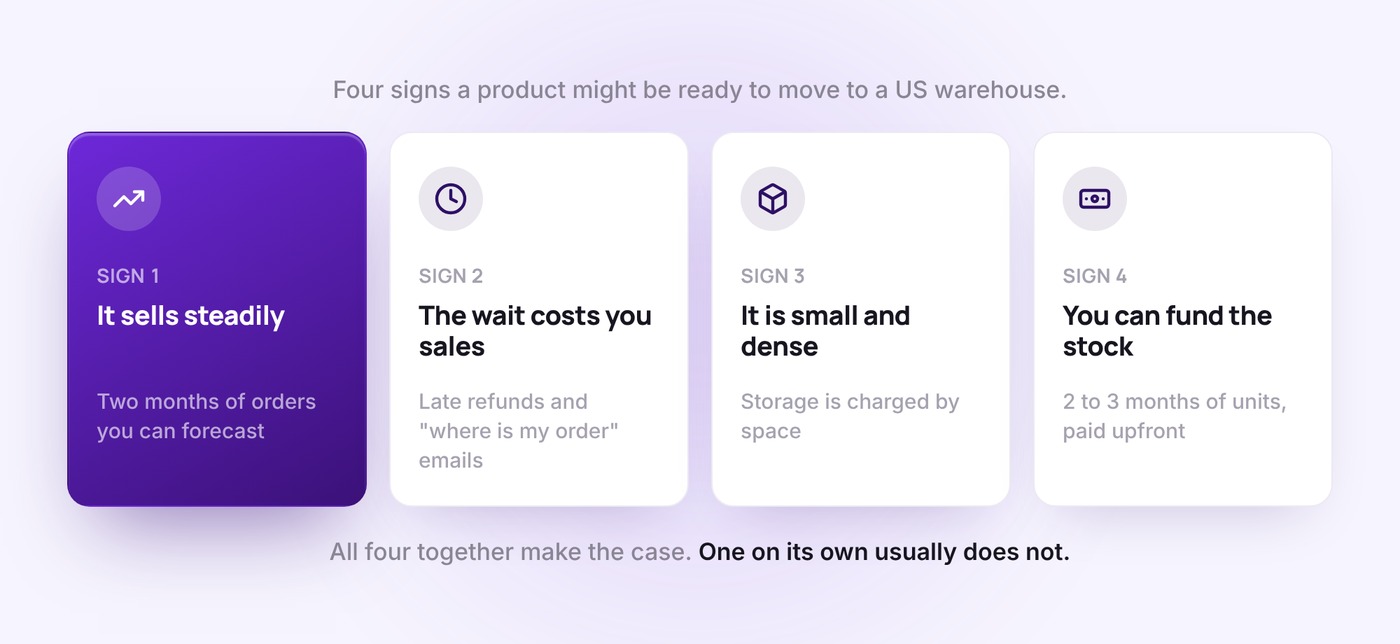
- It sells steadily. Two months or more of orders at a level you can forecast. A product still in testing is the wrong one to stock, because you cannot size the order.
- Delivery time is costing you sales. "Where is my order" emails, refunds for late delivery, or a checkout that converts worse when the delivery estimate shows. If customers do not mind 2 weeks, the speed is not worth much.
- It is small and dense. Storage is charged by space. A light, bulky product could cost more to hold for a few months than the faster delivery earns.
- You can fund the stock. Work out the formula above for 2 to 3 months of sales. If that sum would stop you running ads, the product could stay in China a while longer.
The middle route: both at once
A store does not have to pick one model for every product. A common split:
- New products ship direct from China, with no stock bought upfront, until the orders show which ones sell
- Proven sellers move to a US warehouse, where the faster delivery could lift conversion on the products that carry the store
- The rest of the range stays in China, including slow sellers and anything bulky
The split also gives you a backup. If the US stock runs out before the next shipment lands, the same product can ship from China in the meantime, slower but still moving.
How to check it for your own store
- Pull your last three months of US orders and the delivered date of each. Work out your own median and slowest 1 in 10, counted from the order.
- List your top products by orders and mark the ones with two months or more of steady sales.
- Read your "where is my order" emails and late-delivery refunds by product. That is the cost of the wait, per product.
- Get a US warehouse quote with every line priced: receiving, storage per month, pick and pack, extra items and labels by weight.
- Fill in the cash formula for each product you would move, at 2 to 3 months of stock.
What to do
- Measure your real delivery time from the order, not the line's quote
- Price every US warehouse line, not just pick and pack
- Work out the cash in stock before you send the first shipment
- Move only proven products, and keep testing new ones direct from China
- Keep China as the backup for products you stock in the US
- Book Q4 stock early, because it takes weeks to cross and holiday label prices start in October
How we handle this at Commercive
Commercive is your all in one sourcing and fulfilment partner. We ship from China on frontier lines like YunExpress, Yanwen and 4PX, and our dashboard shows every parcel's scans from the first one to the delivered scan, so you can measure your own delivery time instead of trusting a quote.
You can test a product with us without buying the full minimum first, so a product only goes into stock once its orders have earned it. Our measured delivery times by line and country are on our shipping status page, and there is more on testing in testing a product from China without an MOQ.
If you're currently running a brand, just give us the product and your daily order volume. We'll get you a quote within the next 24 hours to hold up against what you're paying today.
How we measured this. Delivery times are every US order placed with stores we fulfil from China between 1 June and 31 August 2026 whose parcel got a first carrier scan, test stores excluded, counted in calendar days from the customer's order to the first delivered scan, measured on 9 October 2026 so every order had at least 39 days. US warehouse times are the USPS Ground Advantage standard, not a measurement. Prices are from the USPS price list effective 4 October 2026 for a 1 lb commercial parcel. Sea freight times are from a 2026 freight guide and vary by port, season and booking.
How long does shipping direct from China to the US take?
On US orders placed from June to August 2026, the median from order to delivered was 13.0 days. Half arrived between 10.6 and 16.5 days, and 9 in 10 within about three weeks. About 2% arrived within a week.
Is a US warehouse cheaper than shipping from China?
Not always. A US warehouse adds freight, receiving, storage and pick and pack on top of the US label, and ties up cash in stock. It could still pay on a steady seller where faster delivery lifts sales.
How much stock should I send to a US warehouse?
Enough to cover the time the next shipment takes to arrive, plus the selling time until it lands, plus a buffer. By sea that is often 2 to 3 months of sales. Multiply units a day by days of stock by the landed cost of a unit to see the cash it needs.
Can I use a US warehouse and ship from China at the same time?
Yes. A common setup is to stock the best sellers in the US and keep new and slow products shipping direct from China. The China route also works as a backup when US stock runs out.
Does a US warehouse help in Q4?
It helps with speed, if the stock lands before the peak. Sea freight takes about 3 to 7 weeks door to door, and US label prices go up from October to mid-January, so the stock has to be booked early.
.png)
Fill in the application form, and our team will reach out to you to help you with making the above happen.
• Sell 1 day post-production
• Scale worldwide with 3-10 days
• Slice your lead times
• Prevent inventory risk and overstocking
• Hide china due custom software and carrier agreements
• Work with a multilingual team in mainland China
• Decades of supply-chain experience.

.png)