
Table of Contents
New EU customs fees for parcels from China: the €2 handling fee and €3 duty explained
What the €2 handling fee (from 1 November) and the €3 duty (since 1 July) add to an order from China, with worked examples.


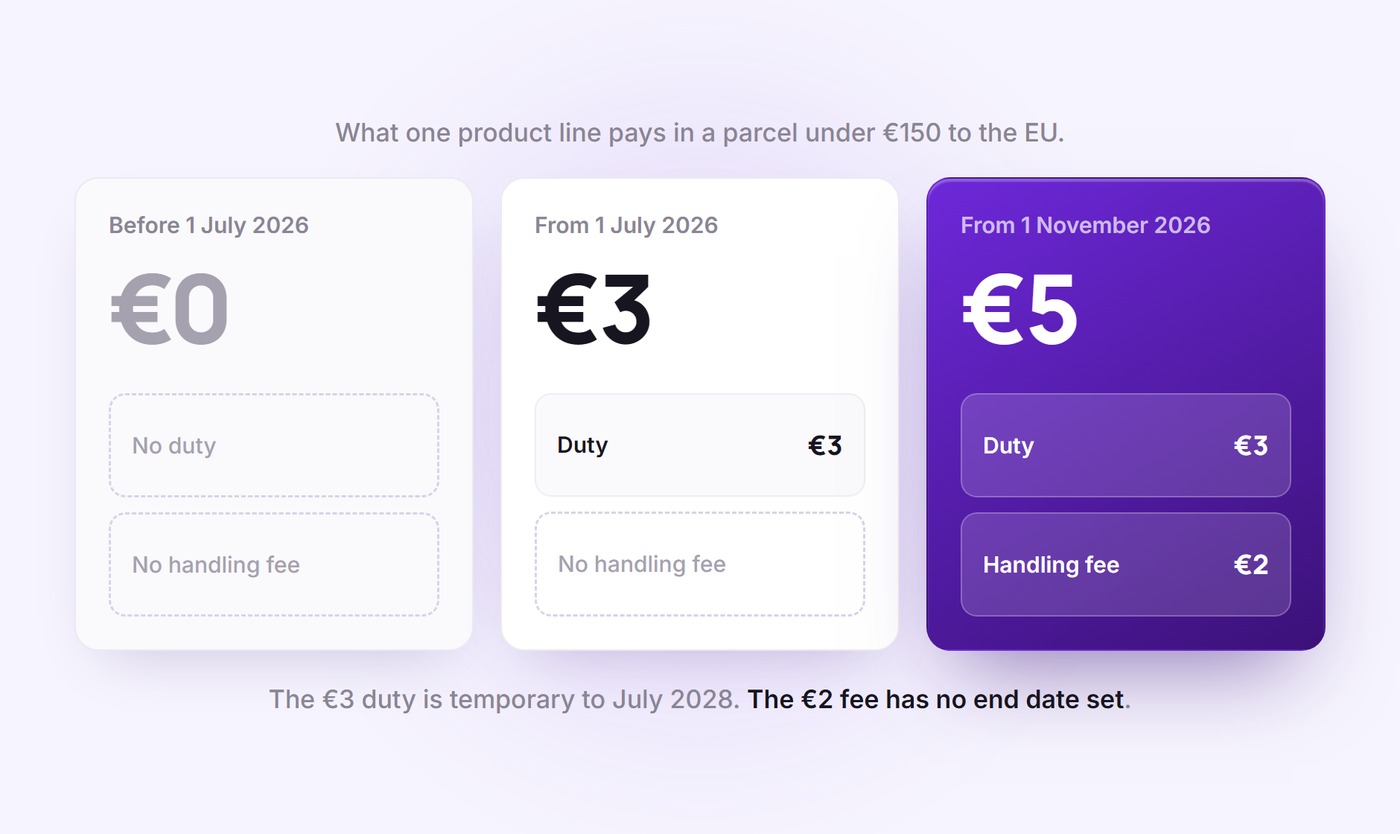
From 1 November 2026, every ecommerce parcel sent from outside the EU to an EU consumer is set to pay a €2 customs handling fee. That is the date the EU and Dutch Customs have set, once the Commission's act is published in the EU's Official Journal. It stacks on top of the €3 duty that parcels under €150 have paid since 1 July.
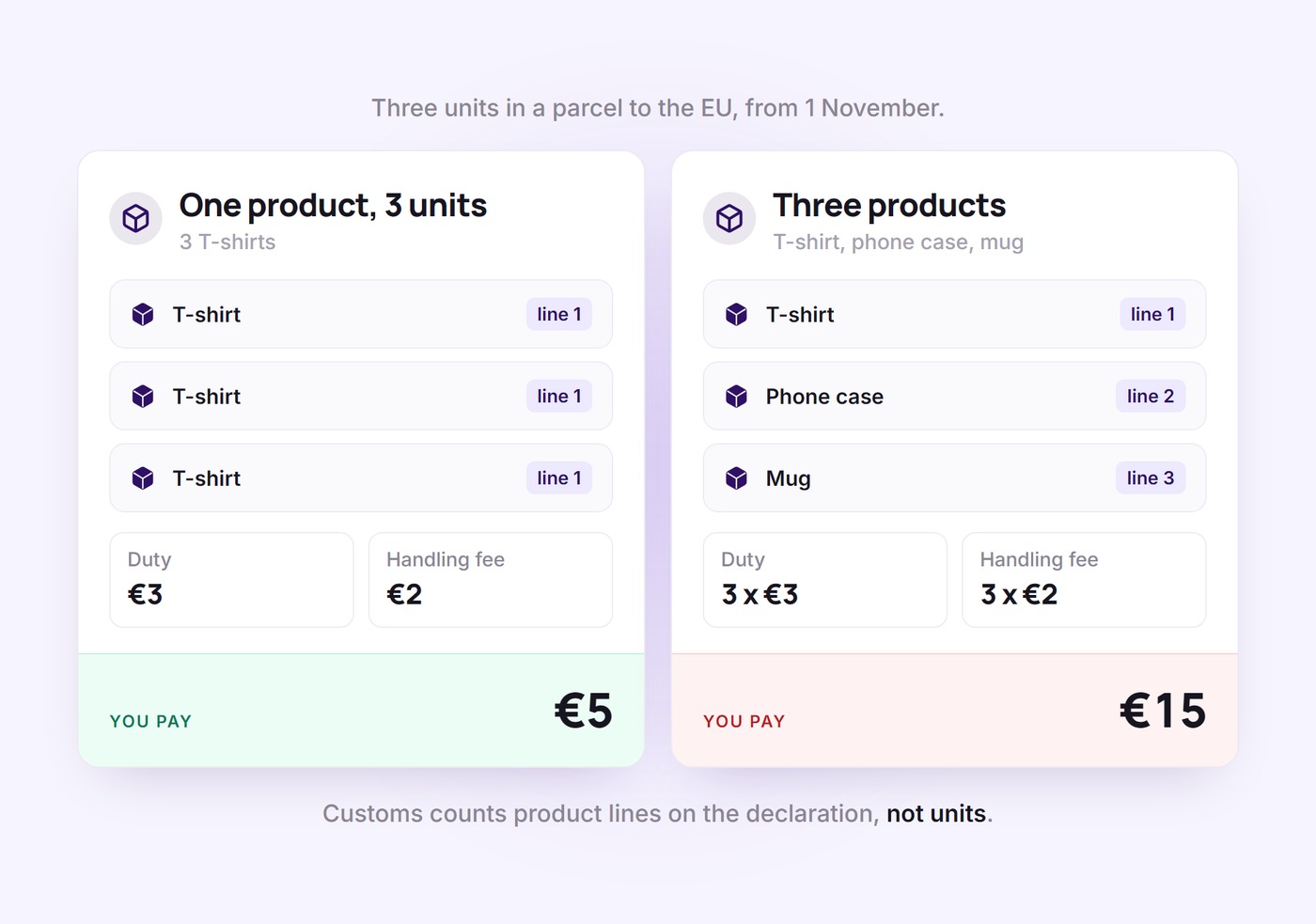
The part most sellers get wrong is the unit. The fee is €2 per customs item, meaning each declaration line, not per unit and not per parcel. Three units of the same product pay €2 in fees and €3 in duty, so €5 for the parcel, not the €6 or €15 a per-unit reading gives you.
This guide covers:
- What changes on 1 November, and what has already changed since 1 July
- What "per item" actually means, using the worked example EU customs published
- What a real EU order costs in fees, measured on our own EU orders
- The free gift that now costs you €5, and other orders to rethink
- What to change in your store this month, before the first parcel is charged
What changes on 1 November, and what changed on 1 July
Two separate charges now hit a parcel from China to an EU customer, announced months apart.
- The €3 customs duty, live since 1 July 2026. Parcels valued up to €150 used to enter the EU with no duty. Since 1 July they pay a flat €3 per item, where "item" means each different tariff classification in the parcel. It is temporary and runs to 1 July 2028, until the EU's new customs data system can apply normal duty rates to small parcels.
- The €2 handling fee, from 1 November 2026. A new fee, not a duty, to pay for customs checking the flood of small parcels. The European Commission set the amount at €2 on 21 September. The EU says member states collect it from 1 November at the latest. The Commission's act takes effect once it is published in the EU's Official Journal, which had not happened as of 30 September, and as long as the European Parliament and the Council do not object.
- Product identifiers, also from 1 November. Customs declarations for ecommerce parcels must carry your own product code (your SKU) and the manufacturer's product reference, plus the barcode number where one exists. This part was voluntary since July. From November it is required.
Two details matter for pricing. The €2 fee applies to every ecommerce parcel, including parcels over €150, where the €3 flat duty does not apply. And Dutch Customs says the fee cannot be reclaimed if the customer refuses the parcel or sends it back.
Both charges are paid by whoever lodges the customs declaration. For a parcel from China that is normally the shipping line's customs agent, acting for the seller, and the cost comes back to the seller. Your customer does not pay it at the door if you ship with duties paid.
Some EU countries add a national fee on top of the EU charges. Italy's €2 per parcel from 1 December, Romania's 25 lei and France's suspended fee are covered in our guide to national parcel fees in the EU.
What "per item" actually means
Most English coverage says "€2 per item" and stops there. Brands keep asking whether a parcel with three units now pays €6.
Dutch Customs has answered it on its own website, with a worked example. The fee is €2 per declaration line. Their example: one parcel holding 2 pairs of trousers, 3 sweaters and 1 pair of shoes is 3 declaration lines, so the fee is 3 x €2 = €6. Six units, three lines, €6.
A declaration line is one tariff classification. Five T-shirts share one classification, so they are one line. The European Commission uses the same rule for the €3 duty and gives the same kind of example: 5 T-shirts pay €3 of duty, 3 T-shirts and a watch pay €6.
So for any parcel under €150 from 1 November, the sum is simple:
- Each product line costs €5: €3 duty plus €2 handling fee.
- Extra units of the same product cost nothing extra in duty or fees.
- Each different product adds €5, unless it shares a tariff classification with something already in the box. Two T-shirt designs are still one line. A T-shirt and a phone case are two.
Here is how that works out on common orders, as of 28 September 2026:
- 1 product, 1 unit: €3 + €2 = €5 (was €0 before July, €3 until November)
- 1 product, 3 units: €3 + €2 = €5 (a per-unit reading says €15)
- 3 different products, 1 each: 3 x €3 + 3 x €2 = €15
- 1 product plus a free gift of a different product: 2 x €5 = €10
- Order over €150: no flat €3, normal duty rate for each product's tariff code as before, plus €2 per line
What a real EU order costs in fees
The unit matters because of what EU customers actually buy. Across the orders shipped to EU countries between 1 July and 28 September 2026:
- 53% had one product in them
- 33.5% had two products
- 13.5% had three or more
- The average order held 1.65 products but 2.49 units
- 58% of orders had more units than products, so a per-unit reading overstates their fees
- About 1 in 20 orders was over €150, where normal duty rates apply instead of the flat €3
- The median order was worth about €79
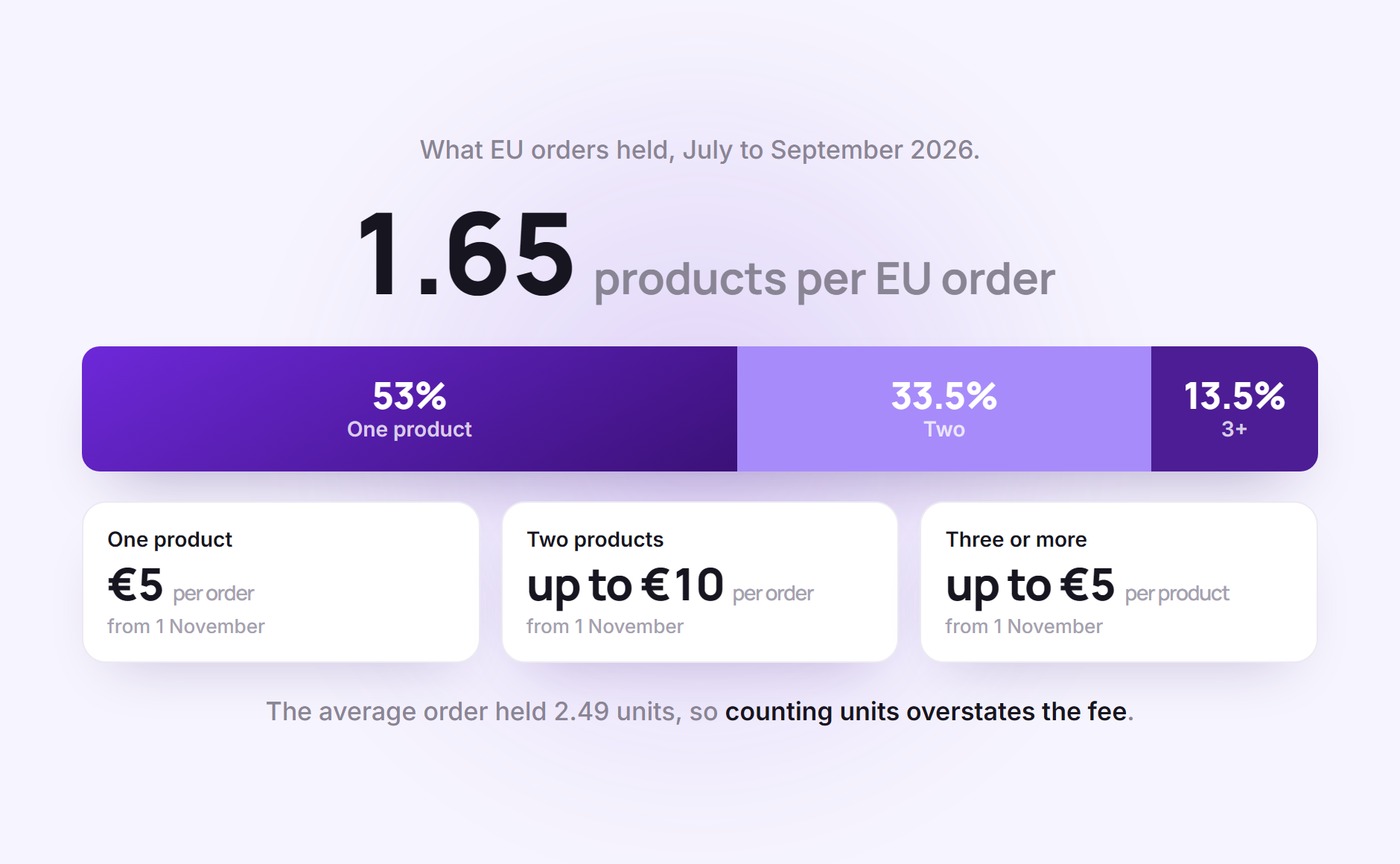
Put that together and the typical EU order pays €5 in duty and fees from November, on a basket worth about €79. That is around 6% of the order. An order with two different products pays up to €10. These counts are upper limits, because two different products can share a tariff classification and count as one line.
If you had priced on a per-unit reading, you would be overpricing more than half your EU orders. If you had priced on a per-parcel reading, you could be underpricing close to half of them.
Free gifts and mixed bundles now cost €5 a line
About 1 in 15 of those EU orders carried a free item that was a different product from the one the customer paid for. From 1 November, a free gift of a different product is its own declaration line. That is €3 duty plus €2 fee, so €5 per parcel, on something you are giving away. For a brand doing 100 EU orders a day with a free gift in every box, that is €500 a day.
Some options that could work instead:
- Give more of the same product, such as a second unit, which adds no duty and no fee
- Move the gift to orders over a spend threshold, where the margin can carry €5
- Drop it for EU orders only and keep it for other countries
Bundles work the same way. A "complete the set" bundle of three different products is three lines, €15 from November. Three units of one product is one line, €5. A multi-pack might now be the better EU offer, and a mixed bundle needs €15 built into its EU price.
What to check before 1 November
- Count lines, not units. Take your top 20 EU orders by volume and count the different products in each. That is your fee per order.
- Give every product a SKU in Shopify. From 1 November your SKU is the merchant product code that goes on the declaration.
- Add barcodes where your products have them. The EAN or GTIN goes on the declaration where one exists.
- Reprice EU orders with more than one product line. €5 per line from November, on top of whatever you already pay.
- Rethink free gifts and mixed bundles for EU orders, as above.
- Keep duties paid at checkout. If your customer is asked to pay €5 or €15 at the door, some will refuse the parcel, and Dutch Customs says the €2 fee is not refunded on a refusal.
- Watch refusals and returns. Every refused EU parcel now costs you the shipping and the fee, with nothing back.
How we handle this at Commercive
Commercive is your all in one sourcing and fulfilment partner. We ship EU orders from China on frontier lines like YunExpress, Yanwen and 4PX.
One thing no fulfilment company can do, us included, is make this fee go away. It is charged on every ecommerce parcel into the EU, whoever ships it. The shipping line handles the declaration and collects the duty and the fee, and the cost comes through on the shipping bill.
Carriers that published notices for the July €3 duty bill it per distinct tariff code in the parcel, to the shipper. As of 30 September, none of the lines we use has sent us a notice on how they will apply the €2 fee. As soon as they do, we will tell every client exactly how it shows up on their bill.
Every parcel we ship shows its live status in our dashboard, and our measured delivery times by line and country are public on our shipping status page. If you want to see how we handle China fulfilment end to end, start here.
If you're currently running a brand, just give us the product and your daily order volume. We'll get you a quote within the next 24 hours to hold up against what you're paying today.
How we measured this. Measured on every order shipped to EU countries from 1 July to 28 September 2026 across our client base. A product counts once however many variants or units are in the order. Lines that do not ship, like shipping protection, are left out. Rules are quoted from the European Commission and Dutch Customs as published on 28 September 2026.
Is the EU €2 handling fee per parcel or per item?
Per customs item, meaning each declaration line: in practice, each different product type in the parcel. Dutch Customs' own example: a parcel with 2 trousers, 3 sweaters and 1 pair of shoes is 3 lines, so €6. Several units of the same product are one line.
When does the €2 handling fee start?
1 November 2026 is the date the EU and Dutch Customs have set. The European Commission set the amount on 21 September 2026, and the EU says member states collect it from 1 November at the latest. The Commission's act takes effect once it is published in the EU's Official Journal, which had not happened as of 30 September, and as long as the European Parliament and the Council do not object.
Does the €2 fee replace the €3 customs duty?
No. They stack. A parcel under €150 pays €3 duty per line (since 1 July 2026) plus €2 handling fee per line (from 1 November 2026), so €5 per line.
Does the €2 fee apply to parcels over €150?
Yes. The €3 flat duty only applies up to €150, but the €2 handling fee applies to every ecommerce parcel sent to an EU consumer, whatever its value. Over €150, normal duty rates apply as before, plus €2 per line.
Who pays the handling fee, the seller or the customer?
Whoever lodges the customs declaration pays it. For parcels from China shipped with duties paid, that is normally the shipping line's customs agent acting for the seller, and the cost comes back to the seller. The customer only pays at the door if the parcel was shipped without duties paid.
.png)
Fill in the application form, and our team will reach out to you to help you with making the above happen.
• Sell 1 day post-production
• Scale worldwide with 3-10 days
• Slice your lead times
• Prevent inventory risk and overstocking
• Hide china due custom software and carrier agreements
• Work with a multilingual team in mainland China
• Decades of supply-chain experience.

.png)