Table of Contents
Selling shoes from China: reading the factory's sizes, the EU material label, what the shoe box costs to ship and how long it takes
Shoes ship as general goods. The work is the size chart, the material label on the shoe, and a box that can be billed on its size.


Search how to sell shoes from China and you get supplier lists, wholesale market tours and a size conversion table copied from site to site. None of them tells a brand what has to be marked on the shoe before it is sold in Europe, what "leather" may mean on a US listing, or why the same pair can cost noticeably more to ship in its box than out of it.
The short answer: plain shoes ship on the general goods products that parcel lines out of China run, so the line is the easy part. The work sits in three places. The size chart, because China's own standard sizes a shoe by the foot length in millimetres and factories print other numbers beside it. The label, because the EU asks for the material of the upper, the lining and the sole on the shoe itself. And the box, because many lines bill a parcel on its size when that is more than its weight.
This guide covers:
- How to read the sizes on a Chinese factory's listing and build your own chart
- What the EU asks to be marked on every pair
- What "leather" can and cannot mean on a US listing
- Which line shoes go on, and the pairs that need a different one
- What the shoe box does to the shipping bill, and how long shoes take

How to read a shoe size from a Chinese factory
China has its own shoe size standard, GB/T 43293-2022, which replaced the 1998 version in May 2023. It sizes a shoe by the length of the foot it fits, in millimetres, with no unit printed. A shoe marked 250 is made for a 250 mm foot. The system is called Mondopoint and is adapted from the international standard, ISO 9407.
A factory's listing for export often shows other numbers beside it:
- 250, 255, 260. The national standard: foot length in millimetres.
- 25, 25.5, 26. The same thing in centimetres, which some makers print even though the standard asks for millimetres.
- 38, 39, 40. EU-style numbers from the factory's own chart. Charts vary from factory to factory, so a 39 from one is not always a 39 from the next.
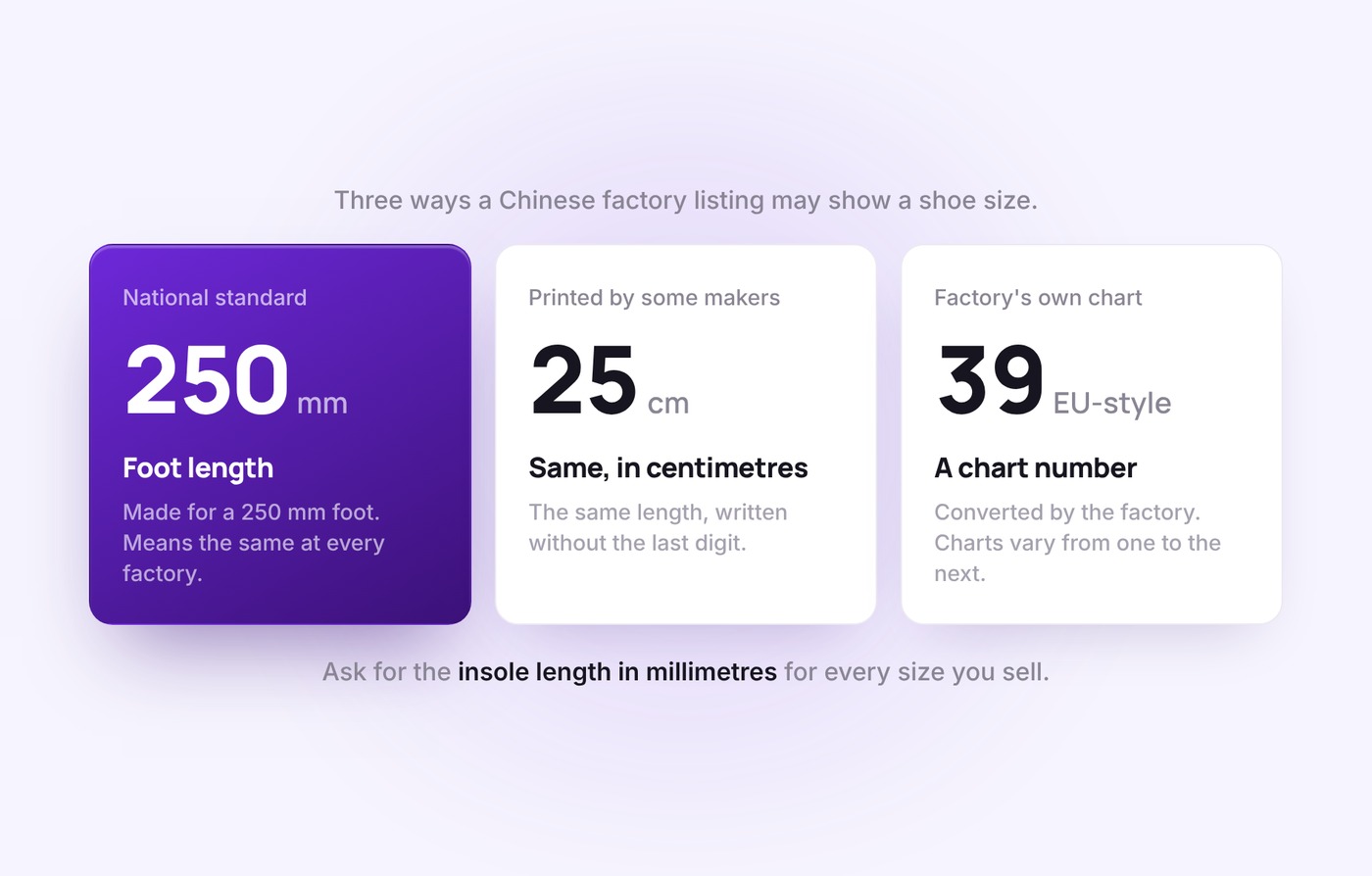
That is why a copied conversion table is the weak point in most shoe stores. Ask the factory for the insole length in millimetres for every size it makes, measure a sample pair yourself, and build your size chart from those measurements. Put the foot length in centimetres and inches on the product page, with how to measure a foot, so the customer picks a size from a number and not from a guess.
Sizing is also where shoe returns come from, and a return to China is slow and expensive, as the guide to returns for products shipped from China shows. The clothing version of this advice is in the guide to shipping clothing from China.
What the EU asks to be marked on the shoe
Shoes sold to consumers in the EU fall under the footwear labelling Directive, 94/11/EC. It is short and specific:
- Three parts are labelled: the upper, the lining and sock (the insole), and the outer sole.
- Four material classes: leather, coated leather, textile, and other materials. A knit trainer with a rubber sole, for example, is textile on the upper and other materials on the sole.
- The 80% rule. Each part is labelled with the material that makes up at least 80% of its surface, or of its volume for the sole. If no material reaches 80%, the two main materials are given. Buckles, edging, tabs and other trims do not count toward the upper.
- Pictograms or words, in the language the country of sale asks for. Pictograms avoid printing a label per language.
- On at least one shoe of each pair, printed, stuck, embossed or on an attached label, visible and securely attached.
Responsibility sits with the manufacturer or its agent in the EU, and when neither is based there, with whoever first places the shoes on the EU market. For a brand shipping direct from China to EU customers, that is usually the brand. Second-hand shoes, protective footwear and toy footwear are outside the Directive. This is a summary, not legal advice.
What "leather" can mean on a US listing
The US has no label rule for shoe materials like the EU's; the textile label rules that cover clothing leave shoes out. What does apply is the FTC's guidance on leather claims, which names footwear in its scope:
- "Leather" on its own only when the shoe is leather in all substantial parts.
- Material that looks like leather but is not should be disclosed, with words such as "imitation leather", "vinyl" or "plastic".
- Bonded or reconstituted leather should not be called leather. If the term "bonded leather" is used, the guidance asks for the share of leather fibres, such as "60% leather fibers".
"Vegan leather" is not defined in that guidance. Say what the material is, such as polyurethane, next to it. Ask the factory for the materials of the upper, lining and sole in writing before you write the listing; the same answer fills the EU label.
Which line shoes go on
Parcel lines out of China run separate products by goods class, and a parcel goes on the one its contents allow. YunExpress, a frontier line, runs a general "Economy, Unrestricted" product beside its battery, cosmetics and clothing products. SDH, a lowest-cost line to the US, runs general goods, battery and sensitive goods lines.
Trainers, boots, sandals and slippers are general goods. A shoe store often sells a few things that are not:
- Light-up shoes and heated insoles carry a battery and follow the rules in the guide to shipping products with batteries from China.
- Shoe cleaner and protector sprays are aerosols, which count as flammable on a flight, and many lines refuse them.
Tell the line exactly what is in the parcel and let it pick the product. A battery packed as general goods can be held or sent back, and the wait lands on your customer.
What the shoe box does to the shipping bill
Shoes are one of the few products where the packaging can decide the shipping cost. Parcel lines price by weight, and many bill the greater of the scale weight and a volumetric weight worked out from the parcel's size. On YunExpress's Standard Express, for example, the volumetric weight is length x width x height in centimetres divided by 8,000.

Take a pair of trainers weighing 0.75 kg, as an example:
- Bagged, no shoe box. About 0.78 kg on the scale. Packed down to about 30 x 20 x 10 cm, its volumetric weight is 0.75 kg, so it is billed at 0.78 kg.
- In its shoe box, 33 x 22 x 12 cm, in a mailer. 0.97 kg on the scale, but 1.09 kg volumetric, so it is billed at 1.09 kg.
- Shoe box inside a carton, 38 x 26 x 15 cm. 1.12 kg on the scale, 1.85 kg volumetric, billed at 1.85 kg.
The rule changes by line and country. YunExpress's Economy product to Canada and New Zealand only bills volumetric weight when it is at least twice the scale weight, with a divisor of 6,000: there the boxed pair in a mailer is billed on its scale weight, but the box in a carton is still billed on its size. The full rules are in the guide to custom packaging for products shipped from China.
Whether to keep the box is a brand call. A branded box is part of the product for some shoes and dead weight for others. If you keep it, pack it tight in a mailer rather than a second carton. On measured YunExpress parcels shipped from China where the line reported both weights, from late May to October 2026, the weight charged matched the scale weight on 999 in 1,000, which is what tight packing looks like.
How long shoes take from China
Shoe-only orders are too small a share of the measured parcels to give shoes a delivery figure of their own, so the times here are for general goods, the product most shoes ship on. On YunExpress to the US, parcels with a first carrier scan in June and July 2026, the per-store median on the general goods Economy product ran 9.2 to 15.7 days. On SDH, a lowest-cost line, the general goods product ran 14.0 to 21.9. The line made far more difference than the goods class.
What to do
- Get the insole length in millimetres for every size, and measure a sample pair yourself
- Build your own size chart from those measurements, in centimetres and inches, on the product page
- Get the materials of the upper, lining and sole in writing before you write the listing
- Mark the EU label on at least one shoe of each pair, by pictogram or in the local language, before you sell in the EU
- Use "leather" only for leather, and say what an imitation leather is made of
- Sort your range by goods class: general, battery (light-up, heated) or aerosol (care sprays)
- Weigh and measure one packed pair on the line you plan to use before you set shipping rates
- Measure delivery on real orders, per line and per country
How we handle this at Commercive
Commercive is your all in one sourcing and fulfilment partner. We source from a product link or a photo across our vetted factories, or work with the supplier you already use, and we test products without holding you to the factory's minimum, which suits a shoe store trying a few styles across a full size run.
Your stock is received on our floor in China, and every order ships on the line that fits the product and the destination: a general goods line for plain shoes, a battery line when a pair lights up or heats, and a sensitive line when there is a liquid or a spray in the order. Each parcel's scans and weights sit in our dashboard. We recommend frontier lines such as YunExpress to essentially everyone; a lower-cost line might suit low-price slippers or sandals with patient customers. Our measured delivery times by line and country are on our shipping status page.
If you're currently running a brand, just give us the product and your daily order volume. We'll get you a quote within the next 24 hours to hold up against what you're paying today.
Where these numbers come from. China's shoe size standard is GB/T 43293-2022, as summarised by SGS and Bureau Veritas, read 26 October 2026. The EU label rules are from Directive 94/11/EC, Articles 1 and 4 and Annex I, as published in the Official Journal of 19 April 1994, read 26 October 2026. The US leather guidance is the FTC's Guides for Select Leather and Imitation Leather Products, 16 CFR 24.0 and 24.2, read 26 October 2026. This is a summary, not legal advice. Volumetric rules are YunExpress's own, as published on its product pages on 20 October 2026; the box example is our arithmetic, not a measurement. Delivery times are our own measurement: parcels to the US from stores we fulfil from China, first carrier scan 1 June to 31 July 2026, test stores excluded, calendar days from the first scan to the first delivered scan, shown as the range of per-store medians for stores with at least 30 parcels on that line product. The billed weight share covers YunExpress parcels where the line reported both weights, created 27 May to 20 October 2026.
Can you dropship shoes from China?
Yes. Trainers, boots, sandals and slippers ship on the general goods products that parcel lines out of China run. Light-up shoes and heated insoles carry a battery and need a battery product, and shoe care sprays are aerosols that many lines refuse.
How do Chinese shoe sizes work?
China's national standard sizes a shoe by the length of the foot it fits, in millimetres, so 250 means a 250 mm foot. Factories selling abroad often also print the same length in centimetres or an EU-style number from their own chart, and those charts vary between factories.
Why do shoes from China fit differently than the size says?
Usually because the size on the listing comes from the factory's own conversion chart rather than a measurement. Ask for the insole length in millimetres for each size, measure a sample pair, and publish a chart built from those numbers.
What has to be on a shoe label in the EU?
The material of the upper, the lining and sock, and the outer sole, each as the material making up at least 80% of that part: leather, coated leather, textile or other materials. It goes on at least one shoe of each pair, by pictogram or in the local language.
Should I ship shoes with or without the box?
It depends on the brand and the line. On a line that bills the greater of scale and volumetric weight, a shoe box can add a lot to what is billed, and a carton around the box adds more. If the box matters to the product, pack it tight in a mailer.
How long does it take to ship shoes from China to the US?
About as long as general goods on the same line. On YunExpress in June and July 2026, the per-store median on the general goods product ran 9.2 to 15.7 days from the first carrier scan to delivery. A lowest-cost line took longer, 14.0 to 21.9.

Fill in the application form, and our team will reach out to you to help you with making the above happen.
• Sell 1 day post-production
• Scale worldwide with 3-10 days
• Slice your lead times
• Prevent inventory risk and overstocking
• Hide china due custom software and carrier agreements
• Work with a multilingual team in mainland China
• Decades of supply-chain experience.